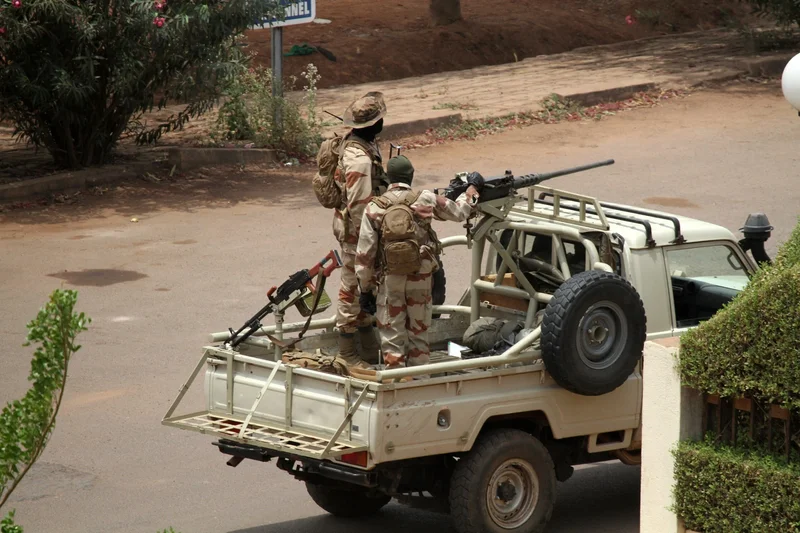
Human Rights Watch Says Russia’s Africa Corps Killed Nine Villagers in Mali
MALI · DEFENSE
What the Africa Corps report describes
According to the organisation’s account, more than 100 Africa Corps fighters entered Bombori in Mali’s Mopti region at about five in the morning on 10 July. Four Malian soldiers went with them, acting mainly as interpreters.
At least 80 men and boys were rounded up and held under a tree. Nine people were killed: five men aged between 19 and 34, and four children aged between six and 17.
Six of the nine were shot as they tried to flee. Three were taken away and executed, one of them beheaded.
At least eight homes were looted and burned and five granaries destroyed. The organisation says the village had been under the control of the armed group JNIM since 2017.
The detail that shapes the finding
One element of the account carries particular weight. Only the Fulani neighbourhood was attacked, and the adjacent Rimaïbé quarter was left alone.
That distinction was described to researchers by a Rimaïbé butcher who watched it happen. It is the difference between an indiscriminate operation and a targeted one.
The Fulani are a largely pastoralist community across the Sahel, and they have been collectively associated with jihadist recruitment by successive governments and militias. Attacks that follow ethnic lines have been documented repeatedly in central Mali.
The organisation says the pattern here matches its earlier findings. It published a separate report on 31 July concerning Africa Corps airstrikes in June.
How the evidence was gathered, and its limits
The findings rest on remote interviews with 13 people conducted between 19 and 30 July, including four witnesses to the attack and nine civil society members and community leaders. The work was led by Ilaria Allegrozzi, the organisation’s senior Sahel researcher.
No investigator visited Bombori. Central Mali is largely inaccessible to independent researchers, which is precisely why so little of what happens there is documented at all.
Letters setting out the findings went to the Russian and Malian defence ministers on 4 and 5 August. Neither replied.
Neither government has commented publicly since publication. Readers should weigh testimony gathered at a distance accordingly, while noting that no alternative account has been offered.
From Wagner to Africa Corps
Russian forces have operated in Mali since late 2021, when the junta that took power in Bamako turned away from France and towards Moscow. They arrived under the Wagner Group.
Wagner announced its withdrawal in June 2025 and was replaced by Africa Corps, which reports through the Russian defence ministry rather than through a private company. The change moved the operation formally inside the Russian state.
The practical continuity has been considerable. Many of the same personnel and the same operating patterns carried across the rebranding.
That shift matters for accountability. A defence-ministry formation is harder to describe as a deniable private contractor.
What Russia is actually paid, and what it is not
The arrangement is often summarised as security in exchange for minerals. The most rigorous open-source work suggests something more complicated.
Africa Defense Forum has reported the junta paying close to US$10.8 million a month, part of which could be settled in gold. Investigators at The Sentry have described a model in Mali that runs through Russian and Guinean businesses rather than through mining concessions.
Transparency International’s Russia team goes further, saying the junta has failed to grant Russian operators significant mining concessions and has paid up to US$200 million for combat services instead. The Central African Republic, not Mali, is where concession-for-security is properly documented.
The distinction is worth holding. Mali appears to be paying cash for a security service, in a country whose public finances depend on gold.
Why the Sahel security file sits on mining desks
Mali is among Africa’s largest gold producers, and industrial output rose sharply in the first half of 2026. Several international miners hold assets in the country, and their operating arrangements with the state have themselves been contested.
Those operations are entirely separate from the events described in this report, and no allegation touches any of them. The connection is indirect and it is about risk rather than complicity.
A state that funds its security through gold revenue, and whose security partner is accused of atrocities, presents a compliance question to every buyer downstream. Refiners and banks are increasingly asked to answer it.
That is the reason a village in Mopti appears in an investor’s file at all. The Sahel’s security arrangements and its mineral economics are the same story told from two ends.
Frequently asked questions
What did Human Rights Watch say happened in Mali?
It says Russia’s Africa Corps killed nine civilians at Bombori in the Mopti region on 10 July 2026, including four children aged between six and 17. The report was published on 20 August.
How many people were involved in the attack?
The organisation says more than 100 Africa Corps fighters entered the village at about 5 am, accompanied by three or four Malian soldiers acting mainly as interpreters. At least 80 men and boys were detained.
Have Russia or Mali responded?
No. Human Rights Watch wrote to both defence ministers on 4 and 5 August 2026 and received no reply, and neither government has commented publicly since publication.
What is Africa Corps?
It is the Russian defence ministry formation that replaced the Wagner Group in Mali after Wagner announced its withdrawal in June 2025. Russian forces have operated in Mali since late 2021.
This article was produced by The Rio Times’ automated newsroom system. How we use AI · Report an error