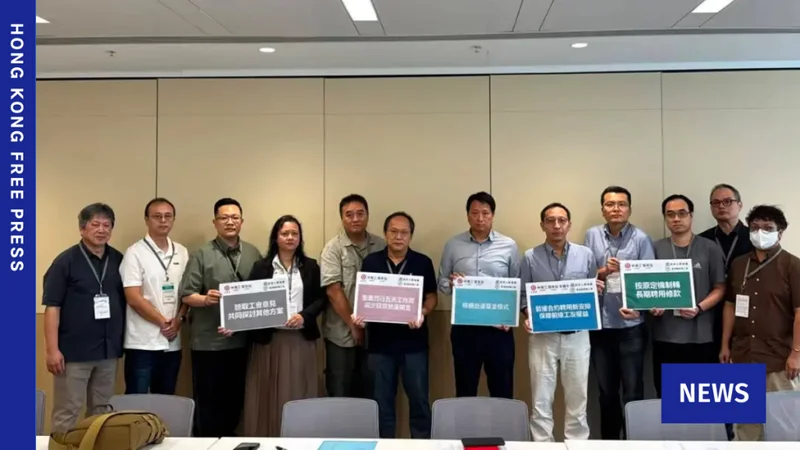
A pro-Beijing coalition of trade unions has urged the government to halt Hongkong Post’s decision to stop offering permanent civil servant contracts to new hires in a bid to cut operating costs – a move expected to affect 200 postal workers.
Hong Kong Federation of Trade Unions (FTU) lawmaker Bill Tang, along with other unionists and post office employees affected by the move, met with Hongkong Post and other government officials to express “deep concern” over the new employment terms.
They called on the Commerce and Economic Development Bureau, Civil Service Bureau, and the postal service not to rush the decision, and instead prioritise communication with trade unions to explore alternative means to alleviate financial pressure.
The federation’s move comes after Hongkong Post said it would only offer two-year contracts to new hires – including mail carriers and postal officers – whose probation periods are set to end during or after September this year.
“We are facing a continued decline in mail traffic, with fewer people sending mail in traditional formats. We expect the drop to continue and even widen in the future,” Postmaster General Leonia Tai said on Tuesday.
About 200 postal service staff members are expected to be affected, Tai said.
Record losses
Hongkong Post’s finances have been strained amid declining mail volume in recent years. Last year, it reported a record operating loss of HK$821 million – up from HK$554 million in 2024 – while mail traffic dropped 12 per cent year-on-year to 611 million items.
Amid a trade spat with Washington, the posting of packages to the US has also been suspended for over a year. The Legislative Council last month approved a HK$4.6 billion bailout to support the post office’s operations over the coming three years.
FTU lawmaker Lam Wai-kong said the capital injection should already offer a sufficient financial buffer, and that the authorities should not cite strained finances as a pretext to erode the rights of frontline employees.
He also noted that Hongkong Post introduced the new arrangement without “any prior consultation,” according to a post on the union’s Facebook page. The new system also lacks a clear explanation of renewal terms after the two-year contracts run out.
Some affected employees, as the “sole financial pillars” of their families, had believed the civil service contracts would offer a level of job security that would allow them to properly plan their livelihoods, the union’s statement said.
The government must maintain “stability and predictability” in its employment practices, the union said.