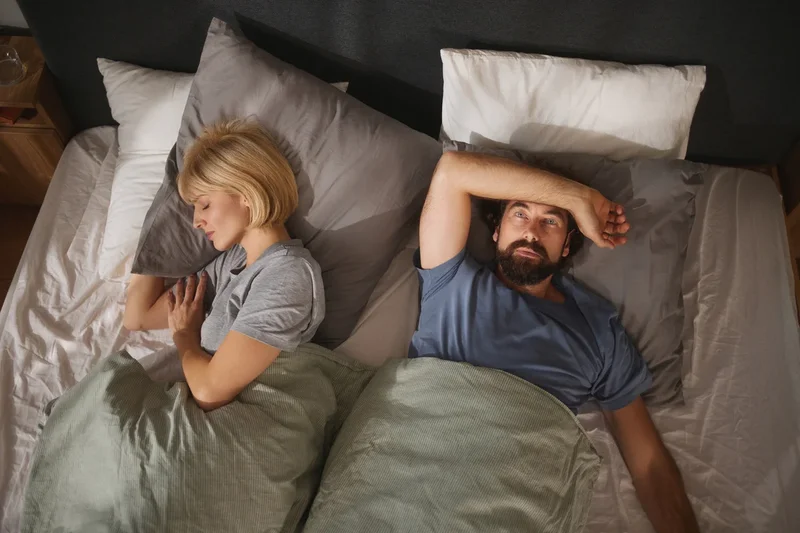
Getting a good night’s sleep is the key to a successful day ahead. But if you share a bed with a partner, your quality of sleep can be easily disrupted by their nighttime habits, too.
Sharing a bed with a cover hog, a sleep-talker or someone who tosses and turns all night can affect your quality and quantity of sleep, which can have an impact on your overall health, stress and concentration levels.
Some couples may address these problems by sleeping in separate rooms — known as a “sleep divorce” — but another option is the Scandinavian sleep method, where the couple shares the same bed, but each person sleeps under separate covers.
The method is most common in the Scandinavian countries Denmark, Norway and Sweden, where some couples will replace a double duvet for two twin duvets. Making the change can lead to a range of benefits, such as individual temperature control, more personal space and less fighting over the covers.
Does the Scandinavian sleep method actually work?
Wendy Troxel, Ph.D., a behavioral scientist at the RAND Corporation and author of Sharing the Covers: Every Couple’s Guide to Better Sleep, told Today that the sleep method gives couples more personal space during the night, without them having to be fully apart.
“It can satisfy the need for closeness, but also the need to have one’s own sleep space for the actual sleeping part of the night,” Troxel said.
The method is also helpful for partners who feel they play a tug-of-war during the night or who run hot or cold.
“Temperature preference when sleeping is highly individualized,” Deirdre Conroy, PhD, a board-certified behavioral sleep medicine specialist and clinical professor at the University of Michigan Department of Psychiatry, told Women’s Health. “For example, women experiencing menopausal hot flashes may also enjoy a cooler duvet. This method allows each person to sleep comfortably with their individual sleep needs met.”
However, the method won’t work if you or your partner have sleep conditions that ultimately make it difficult to sleep in the same bed.
“If your partner is snoring like a truck, the Scandinavian method is not going to do much good,” Troxel said. “The solution really is going to depend on the nature of the problem.”
When should you decide to sleep apart?
If the Scandinavian sleep method doesn’t work, that’s when a couple might consider sleeping apart.
Sharing a bed can bring many disturbances, especially if your partner snores or has other more serious sleep conditions, which can disrupt the other's quality and length of sleep.
Whether or not a couple chooses to sleep together isn’t a reflection of the strength of their relationship.
In the Victorian era, couples who could afford it would sleep in separate rooms. But Troxel said a change came in the 1960s in the U.S., when sleeping apart was stigmatized because it was associated with a lack of intimacy in the wake of the sexual revolution.
“People think it indicates that something is wrong with the relationship, but that doesn’t need to be the case at all,” Tina Sundelin, PhD, Assistant Professor in the Department of Psychology at Stockholm University, told Women’s Health.
Lots of people think they sleep better when they’re with a partner, because they feel safer and more comfortable. But Troxel said that this isn’t the case, based on various sleep studies.
“Using objective measurements of sleep … research generally shows that when people share a bed, they sleep a bit worse,” Troxel said.
“When the objective costs of sharing a bed override those psychological benefits, that’s when I think it can be very beneficial for couples to choose to sleep apart.
“We have solid scientific evidence that when you’re poorly slept, your communication skills suffer, and you’re more prone to mental health disorders ... which can negatively impact your relationship.”
The expert said that couples should make the decision based on what works best for them.