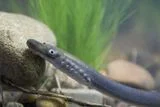
Luke Carpenter-Bundhoo was electrofishing a creek on K’gari in 2022 when he encountered an eel-like animal with seven visible gill openings. Its circular mouth was ringed with sharp teeth, features that pointed to a lamprey.
Yet no lamprey had been documented on K’gari. The island was about 870 miles (1,400 kilometers) north of the Australian brook lamprey’s previously known range, and its tropical waters fell outside the conditions in which lampreys were expected to be.
“I knew that what we had found were lampreys, and my immediate thought was ‘what are they doing here?’” Carpenter-Bundhoo recalled in a press release.
Carpenter-Bundhoo had been surveying how Australia’s Black Summer bushfires affected the island’s ecosystems, and the lamprey became the subject of a separate investigation.
It belonged to the Australian brook lamprey (Mordacia praecox), and Carpenter-Bundhoo and Queensland government scientist David Moffatt later documented populations in six tropical and subtropical watersheds. No other known lamprey lives in truly tropical waters. Despite its tooth-lined mouth, the species is non-parasitic, a combination that earned it the nickname “vegan Dracula.”
New Queensland government funding will allow Carpenter-Bundhoo and Moffatt to map the fish’s range and determine whether two smaller lampreys found in the state are species new to science.
The Australian Brook Lamprey Has Teeth but Does Not Feed
The Australian brook lamprey grows to only about 6 inches (15 centimeters). Many lampreys use their mouths to attach to fish and feed on their blood, but this species never enters that parasitic phase.
Most of the animal’s life passes beneath the creek bed. As a sightless larva, it spends three to four years filtering microscopic algae from the surrounding water. Metamorphosis begins a much shorter final phase in which the fish stops feeding, reproduces, and dies within months.
Because lampreys diverged early in vertebrate evolution, their DNA gives researchers a point of comparison for studying other animals.
“Studying lamprey DNA is a bit like looking back at an earlier edition of the vertebrate instruction manual, before hundreds of millions of years of evolutionary tinkering,” Carpenter-Bundhoo said.
Read More: A Small Genetic Shift May Have Launched Vertebrate Evolution
Two Queensland Lampreys May Be New Species
Carpenter-Bundhoo received a $90,116 Queensland government grant for the project. At Griffith University, researchers will compare the two candidates with known lampreys to determine whether each warrants a formal scientific description. Until that work is complete, neither can be formally recognized or named as a new species.
If lab work confirms both as distinct species, Australia’s known lamprey count would rise from three to five, with three species living in Queensland. The grant also supports new surveys that will give the team a fuller picture of where each candidate occurs.
Mapping Queensland Lampreys Could Help Protect Them
Burrowing makes the Australian brook lamprey difficult to find. Identifying one adds another obstacle: only during a brief period of adulthood can researchers reliably separate it from the parasitic short-headed lamprey (Mordacia mordax), which is considered at low risk of extinction.
Even after researchers locate a population, its creek may remain vulnerable. Fire, development, and sediment entering the water can damage lamprey habitat, while sea-level rise could bring saltwater into low-lying freshwater streams.
“This species was thought to be extinct in its original range, and now Queensland may be the only place it exists,” Carpenter-Bundhoo said in the press release. “This might be the last bastion of this endangered species.”
Read More: Fish and Amphibians May Have Hidden Necks, Challenging Long-Held Assumption
Article Sources
Our writers at Discovermagazine.com use peer-reviewed studies and high-quality sources for our articles, and our editors review for scientific accuracy and editorial standards. Review the sources used below for this article:
- This article references information from Griffith University: Funding fuels further study into Queensland’s elusive ‘vegan Dracula’ fish
- This article references information from a study published in Endangered Species Research: Expanding the known range and practical conservation issues of the Endangered Australian brook lamprey Mordacia praecox