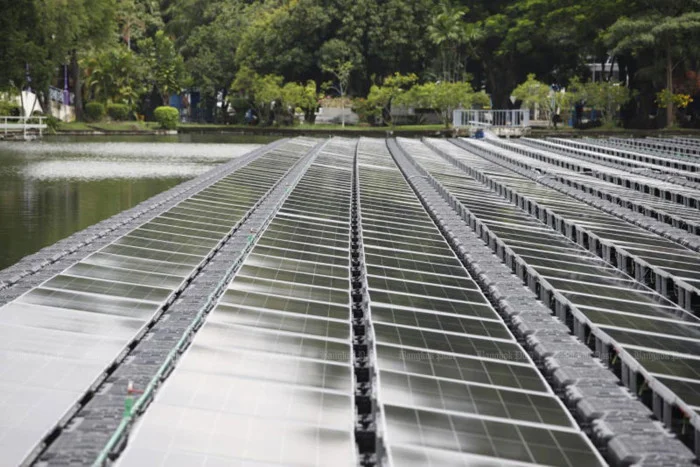
The Renewable Energy Industry Club under the Federation of Thai Industries has called on the government to allow renewable power producers with expired adder tariffs to sell electricity directly to fast-growing data centres, which require vast amounts of clean energy.
The adder tariff was introduced to encourage investment in renewable energy by adding extra charges to electricity prices.
However, the scheme was criticised for driving up electricity costs for households and businesses.
Although the tariff has expired, companies are still permitted to sell electricity to the government at wholesale prices, which adds financial pressure on consumers.
Club chairman Natee Sithiprassana said companies with expired adder tariffs should no longer sell electricity to the government, instead supplying data centres directly.
He said whether this proposal will be implemented depends on negotiations.
Firms with expired adder tariffs have a combined generation capacity of 2,596 megawatts.
Mr Natee's suggestion comes as the government is pushing ahead with a pilot direct power purchase agreement, which allows renewable power companies to sell electricity directly to data centres. Peer-to-peer power trade is prohibited in Thailand.
The government introduced the adder tariff in 2006 as part of efforts to expand renewable energy supply.
The National Energy Policy Council (NEPC) applied the tariff to renewable power purchases from small and very small power producers.
Rates varied from 0.3 to 6.5 baht per unit depending on the type of renewable energy, with solar power receiving the highest rate of 6.5 baht per unit, according to energy advocacy group JustPow.
The tariff was applicable for 7-10 years, with solar projects benefiting for up to 10 years.
According to JustPow, even after the adder tariff expired, companies retain the right to sell electricity at wholesale prices, which are automatically renewed every five years until their facilities retire.
Industry sources noted earlier that producers can still sell electricity at high prices because they benefit from a wholesale tariff of 3.78 baht per unit plus the fuel tariff, with both included in the final rate.
In 2014, the NEPC decided to end the adder tariff incentive, replacing it with a feed-in tariff for new renewable projects. However, companies with expired adder tariffs continue to sell electricity at wholesale prices.
JustPow research found 522 out of 566 renewable energy projects still enjoy this privilege.