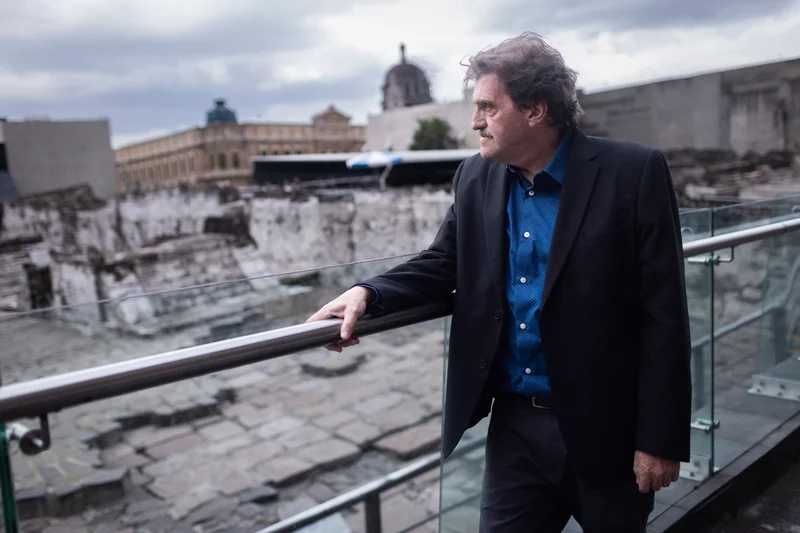
Enrique Serna, 67, has always been obsessed with the Aztec Empire. His fascination with the symbols and rituals of the Mexica people led the writer to spend five years working on his new historical novel, El Dios Hambriento (The Hungry God), which will be released in November of this year. It’s a story about the genesis of the most dominant empire of the pre-Hispanic era.
Serna, who was born in Mexico City, speaks with EL PAÍS from a terrace overlooking the Templo Mayor, which was the main temple of the Mexica people. It was the seat of power in Tenochtitlán, the capital of the Aztec Empire. He describes his latest work, which is set during the years of the consolidation of the Triple Alliance (made up of three Nahua city-states) and, primarily, the antagonistic relationship between Nezahualcóyotl, the ruler of Texcoco, and his cousin, Tlacaélel, the adviser to the Mexica tlatoanis (emperors).
Serna adds this story to his long publishing record of historical fiction, which includes such notable Spanish-language works as El vendedor de silencio (The Merchant of Silence) — the story of Carlos Denegri, an unscrupulous reporter in the mid-20th century — and El seductor de la patria (The Seducer of the Nation), a biographical account of the Mexican dictator Antonio López de Santa Anna.
The author suggests that, after the publication of The Hungry God, he’ll take a break from historical fiction for a while, so that he won’t have to read history books “out of obligation, but for pleasure.”
Question. Why did you choose the pre-Hispanic era for your return to historical fiction?
Answer. Since childhood, the Mexica Empire has attracted me with a mixture of fascination and morbid curiosity. The idea of transporting myself to that world in a novel has always been ingrained in my subconscious, but different twists of fate led me astray. And then, I returned to it.
Starting in 2017, when I wrote the script for a TV series about the conquest of the Americas that [the Mexican broadcaster] Televisa was going to produce — a project that never happened — my historical adviser recommended many books that rekindled my childhood fascination. So, I decided to take the plunge. So I decided to take the plunge, but not to write something about the Conquest, because I’m afraid that the most widely read novels about pre-Hispanic Mexico are set precisely during that period, as if that were the only event in the pre-Hispanic world worth writing about.
I wanted to go further back, to the genesis of the Mexica empire — which is when the alliance of the Mexicas and the Acolhuas defeated the Tepanecs of Azcapotzalco, who were the leading military power in the early 15th century —and the empire began to expand. I recount a rivalry that existed between Nezahualcóyotl [the poet-king of Texcoco] and [chief advisor to five successive Aztec emperors] Tlacaélel, who are the two male protagonists of my novel.
Q. At what point in your life did you feel drawn toward pre-Hispanic history?
A. Above all, it was because of the aesthetics, the sacrificial stone, the Aztec calendar and Coatlicue [“the Mother of the Gods”]. They’re beautiful figures but at the same time, they’re terrifying. Those images left a deep impression on me. As a child, I had nightmares about being taken to the sacrificial stone. In high school, I learned the names of all the tlatoanis. The destruction of Tenochtitlán evoked a feeling of loss in me; I deeply regretted that that marvelous world had disappeared. So, the only way to relive the great Tenochtitlán today is through fiction. And that’s what I embarked on. I understand that few writers have ventured down this path, because contemporary Mexicans already see it as a very distant world. But there are many points of connection between pre-Hispanic and contemporary Mexico, which are even evident in our language, because Nahuatl and modern Mexican Spanish aren’t separate languages: their union enriches our language.
Q. Did you learn Nahuatl to work on this book?
A. I only took classes for a year; I didn’t learn the language. But I wanted to learn etymology and how words are formed in an agglutinative language, like Japanese, for example.
Q. How did you use your knowledge of Nahuatl in this work?
A. I’m a writer who tries to bring characters to life through their speech. My style is quite colloquial, and I didn’t want to abandon that, because it’s one of the ways you can build a character. I ventured into an experiment that was unprecedented for me, trying to give vitality to that language. My novel is narrated in the third person. The narrator may use my own language as a writer, but when I try to delve into the characters’ souls or make them speak, I strive to make that language sound modern and not anachronistic.
Q. What difficulties arise when you’re recounting a period of history that we don’t have too much information about?
A. It’s both an advantage and a disadvantage, because the history of ancient Mexico is full of unanswered questions. It’s fertile ground for fictional conjectures. So, as novelists, we can fill in many of the gaps in our knowledge of the past. We’re not trying to fill a historical void; but rather to propose the solutions that our imagination can offer for these mysteries.
Q. There’s the case of Nezahualcóyotl, who, in the collective imagination, is a poet. But in your novel, he’s much more than that.
A. I was interested in telling the story of the transition from idealism to political pragmatism. In this case, Nezahualcóyotl is a man with very high-minded and noble ideals, because he’s a representative of the Toltec heritage. He wasn’t just a poet, but also an architect, an astronomer. In short, he was like a Renaissance humanist. He wanted the power to do good. My novel tells the story of what he had to accept and tolerate in order to reclaim his kingdom, from which he had been expelled by the usurpers who killed his father when he was 15 years old. He develops a very strong resentment that later transforms into a will to power. So, on one side, you have charismatic politicians like Nezahualcóyotl and Moctezuma, who try to win people over, and on the other, you have Tlacaélel, who tries to impose his will through terror.
Q. Your work often deals with how people wield power. What’s the main difference between The Hungry God and your other books?
A. In this case, Tlacaélel is a character who uses religion as an instrument of political domination. He manages to make his people believe that he’s a spokesperson for Huitzilopochtli [“the God of War”] and, in this way, he becomes a religious and political authority simultaneously. He’s the creator of “militaristic theocracy.” He imposed the dogma that Mexica warriors had to capture prisoners to sacrifice them to Huitzilopochtli, in order to ensure that the sun would continue to rise every morning. He turned them into fanatics and created a vast machine of domination.
All of this occurred to me because of a theory that [the historian] Miguel León-Portilla came up with: he drew an analogy between Nazism and the Mexica empire, stating that there was a coexistence of the ideology of barbarism and humanist philosophy, which was represented in Germany by Heidegger. I found it very compelling to portray that rivalry, because it was no longer just about individuals, but about visions of existence.
Q. Do you think that model of exercising power is still relevant today?
A. What is no longer relevant is that use of religion — the idea that someone could deify themselves to such an extreme, like Tlacaélel. Of course, there are other forms of deification today, especially in this era of rampant populism in various parts of the world, where charismatic leaders suddenly emerge and spark a massive wave of fanaticism.
Q. In The Hungry God, there are two female characters, Chimalma and Quilaztli, who are in control of their own destinies. Why did you choose to portray them that way?
A. I wanted to counteract the male egocentrism that prevailed at that time in all the rituals of power, in the family and so on. I wanted to show the other side of the coin, with two women who are intelligent and brave. Little is known about women during that era, but what is known is that women were always relegated to the hearth, to be matrons and to be beyond reproach. These were their main virtues: loyalty to their husbands, raising children, and so on. But a character like Chimalma — who is a poet and a tlacuila [an illustrator of codices] — isn’t totally unusual, because there were definitely female poets. A daughter of Tlacaélel, in fact, was a poet. In the world of the nobility, it was more common for that kind of thing to happen.
Q. What information about Mexica culture surprised you while you were doing research for this book?
A. Many aspects, especially the conflicts caused by polygamy. At that time, nobles had as many wives as they could support, so it was possible for a tlatoani to have 15 concubines. Often, they couldn’t even learn the names of all the children they had fathered with their mistresses. The children of secondary concubines were pushed aside when it came to the distribution of wealth and titles, which bred deep resentment toward the more privileged siblings within the family. This was one of the main causes of wars at the time. Family feuds triggered all the wars. They were wars between families, because the royal dynasties of different kingdoms were related to one another.
Q. Do you consider your novels to be guides for those who want to learn about the history of Mexico?
A. This novel doesn’t require prior knowledge of the period in which it takes place. It can serve as an introduction for readers. I never think of a reader as someone who necessarily has a great literary or historical background, but rather as someone willing to make an effort to transport themselves to the imaginary world that I’m portraying. There wasn’t a novel from this period that attempted to depict such complexity in its characters, and I believe that ethnography tends to blur the differences between individuals. That’s why the novel can contribute something interesting to our knowledge of the past.