Cabinet faces 'no-brainer' decision on ancient migration waka
The fate of the waka believed to be Rangihoua - a double-hulled ocean-going waka thought to be part of an early migration from Hawaiki centuries ago - is now in the hands of Cabinet.
Described as one of the most significant archaeological discoveries ever made in Aotearoa and the wider Pacific, the waka remains buried in coastal dunes on Rēkohu, the Chatham Islands.
Lead archaeologist Dr Justin Maxwell of Sunshine Archaeology told Mata with Mihingarangi Forbes it was an incredibly important taonga for Rēkohu and the wider Pacific, stressing that funding was urgently needed to excavate it.
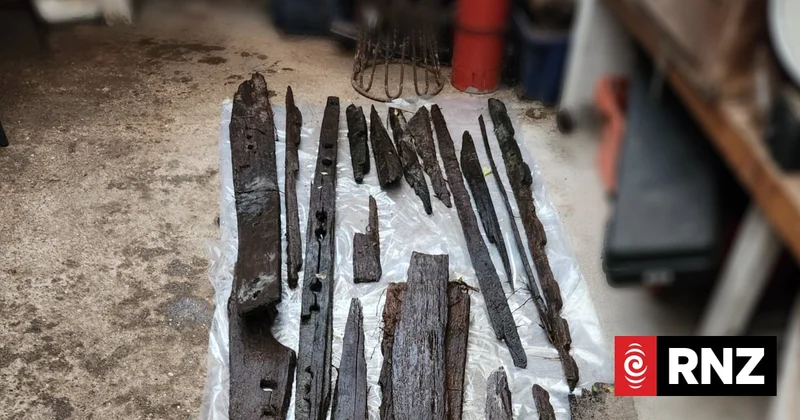
Pieces of the waka were discovered nearly two years ago by the Dix whānau, who own the land where around 750 fragments have since been recovered.
But Dr Maxwell believes those pieces represent only about 10 percent of the entire waka.
While the recovered fragments are now being cared for, the remaining section of the waka is still exposed to erosion, storm surges and the risk of permanent loss.
Carbon dating has dated the wrecked waka to between 1440 and 1470, making it one of the oldest known taonga of its kind in New Zealand history.
Much of it still lies beneath the sand at a site where storms have already washed away parts of it.
Archaeologists say time is critical. They warn that sandbags and other temporary protections are unlikely to save the site from a major storm, and that delaying or repeatedly stopping and starting the excavation could cause further damage.
In a recent court case to establish ownership of the waka, the Ministry for Culture and Heritage argued that its legal responsibilities extend only to the pieces already uncovered, not those still buried. It also said it does not currently have the funding required for a full excavation and the years of conservation work that would follow.
Minister for Arts, Culture and Heritage Paul Goldsmith said in a statement: "The Government is taking advice following this judgment and will consider it in due course."
He added: "Funding decisions are made by Cabinet as part of the official Budget process. I cannot make pre-commitments. We are operating in a tight fiscal environment with many competing priorities. Our main priority in the Arts, Culture and Heritage space is to continue funding grants available to the sector."
Manatū taonga deputy secretary delivery & investment Glenis Philip-Barbara added: "The Ministry has an interim role to care for newly found taonga tūturu until they are returned to traditional ownership through the processes in the Protected Objects Act. In carrying out this role, we are working with iwi and imi and other interested groups. Protecting significant finds can be complex and resource intensive."
But Dr Maxwell believes this discovery stands above all others.
"I can't think of anything that would be more important to fund when it comes to our culture. It's the biggest no-brainer I've ever seen. We have so many gaps in our knowledge of how Polynesian voyagers built their waka. This has the potential to make an enormous contribution. We found woven matting, sail, rope and twine."
Recently, the Māori Land Court rejected the Crown's narrow interpretation of its responsibility.
It ruled that the entire waka has been "found", including the parts still underground, and that the ministry's statutory duty to care for it cannot be avoided, delegated or postponed.
Moriori, Ngāti Mutunga and the Dix whānau, who own the station where the waka was found, argue the waka must be treated as one complete taonga.
But time is running out, and there are fears one of New Zealand's oldest archaeological discoveries may not survive the wait.
Dr Maxwell said the wreckage holds invaluable information about the early seafarers, and the materials and designs they used during Pacific migrations.
Minister Goldsmith will travel to the Chatham Islands in the coming weeks to progress Treaty negotiations and is expected to visit the waka site while he is there.