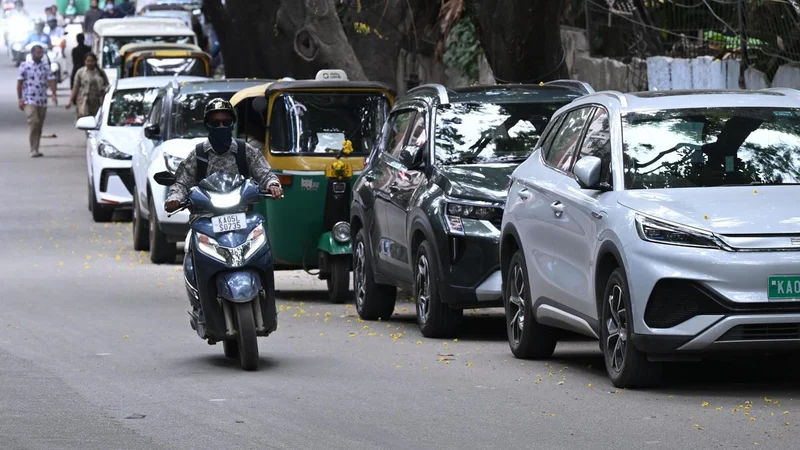
On August 11, the Karnataka government issued a draft notification of the Greater Bengaluru Authority (Parking) Rules, 2026, seeking a major overhaul of paid parking in the city, a system that the new corporations have struggled to implement. The rules have been drafted five years after the Karnataka government notified the Directorate of Urban Land Transport’s (DULT) Bengaluru parking policy.
The new rules envision a structured way of implementing paid parking through the identification and expansion of parking spaces across the city, while also seeking to monetise free spaces and residential stretches for paid parking.
While several aspects have been welcomed by citizens, it is the pricing and residential parking provisions that have drawn flak. The permits that citizens have to obtain for parking in residential lanes have especially drawn substantial criticism, as citizens may have to pay up to ₹25,000 to park their cars on smaller stretches.
What is the context of the new rules?
The fresh parking rules have come on the heels of Bengaluru’s city corporations failing to implement a paid parking system across the city, barring Bengaluru Central City Corporation, which has successfully implemented the system on more than seven stretches.
Paid parking has substantial potential to boost income but currently lacks demand. For example, in several stretches in Jayanagar, especially market areas, there is potential to create paid parking. However, citizens resort to residential lanes for parking, diminishing the actual potential. This also means that many paid parking operators do not participate in tenders, citing limited usage and potential losses.
To tackle this, the new rules now include residential parking permits, which essentially means that parking on any street would either require a permit or involve pay-and-park. This will naturally create a high demand for paid parking, especially on-street parking. To ensure that sufficient space is created to accommodate more vehicles, the rules also pitch and incentivise off-street parking.
However, experts have criticised the move, citing that paid parking is being viewed as a revenue-generating avenue rather than as a tool to shape commuter behaviour, create safe pedestrian infrastructure, and influence traffic flow.
How does it seek to end the parking problem?
The development of parking spaces rests with the respective Bengaluru city corporations. The primary job of the corporation is to set up a parking task force, which will include the corporation commissioner, the deputy commissioner of police of the respective corporation jurisdiction, RTO officers, and the executive engineer of the traffic engineering cell of the corporation.
The task force will oversee the preparation of area-wise parking plans based on an estimation of the need for parking, identification of spaces, and implementation of parking plans.
According to the rules, the corporations will create parking supply through a four-way plan: develop and organise on-street parking where feasible after ensuring adequate space is left for footpaths, bus bays, etc.; develop off-street parking on lands owned by city corporations; lease land from vacant plot owners for the development of parking facilities; and permit vacant plot owners or aggregators of vacant plots to provide parking services.
What is residential parking and why is it controversial?
The new rules mandate buying permits for parking four-wheelers on any residential street in the city.
The rules propose a minimum annual residential parking permit fee of ₹15,000 for hatchbacks, ₹20,000 for sedans, and ₹25,000 for sports utility vehicles (SUVs). The city corporations may also levy an additional administrative fee for issuing the permits, with the amount to be fixed by the GBA Chief Commissioner.
The rule states that residential parking on streets other than arterial and sub-arterial roads may be allowed only for vehicles that have been issued a residential parking permit by the respective city corporations. However, permits will be issued only to residents of residential buildings that are not in violation of the minimum parking requirements specified in the building bylaws.
So, if a resident living in a house with inadequate parking inside the premises, as per the building bylaws, parks their car on the road in front of their house, it will be deemed illegal and may attract fines under the illegal parking provisions enforced by the Bengaluru Traffic Police (BTP).
To avoid that, citizens will be forced to use parking facilities (off-street parking), for which the charges are exorbitant too.
The criticism now is that not only are the permits expensive, but corporations are also morally in the wrong to implement this system. Citizen groups argue that the corporations themselves have, in the past, issued occupancy certificates for houses without verifying building violations. Now, the same is being used for generating revenue.
What is on-street parking and how will it be done?
On-street parking is the model that the city is currently using, where the corporation identifies stretches or roads with demand for parking, develops parking infrastructure on such stretches, and monetises the space. The objective is to maintain orderly parking while also earning revenue and streamlining traffic flow.
The corporations will task the Parking Task Force with identifying places with parking demand across their jurisdictions and preparing an action plan. The plans should be based on the classification of roads as arterial, sub-arterial, and collector roads. Further, the civic body will float tenders for developing parking infrastructure on such stretches.
The concessionaire will set up a system using newer technology, along the lines of the technology used across the city, and maintain the parking facility. The revenue will be shared with the civic body.
What is off-street parking and what are its types?
Off-street parking simply means developing parking infrastructure at locations other than roads. This could be under flyovers or on vacant plots or even through Multi-Level Car Parking (MLCP) facilities. The system is intended to keep as many vehicles off the road as possible, which indirectly improves traffic flow as the full width of roads can be used for vehicle movement.
For off-street parking, the civic body can either develop infrastructure through concessionaires selected through a tender system or allow private plot owners to develop parking infrastructure on their own and maintain it as a business. Such systems will also be incentivised.
First, the corporations can make use of unused spaces such as areas beneath flyovers and CA sites and even take over unused government land. Such facilities will preferably be taken up on a public-private partnership basis, involving a professional parking operator, with revenue sharing between the operator and the city corporation.
Besides, the corporations can also lease or rent vacant plots for a specific period, which will be a minimum of three years in the case of surface parking on vacant plots, 10 years in the case of mechanised parking and 15 years in the case of concrete MLCPs.
Such implementation can only happen through the execution of a well-defined agreement, with the rent or lease based on the guidance value of the land and its geographic location.
How will off-street parking through private players be incentivised?
While developing parking infrastructure is a welcome plan, there is a dearth of space in the city, and vacant plot owners could be reluctant to lease their land to civic bodies. Hence, the GBA is now allowing plot owners to develop infrastructure on their own or even partner with parking operators to develop facilities across the city.
However, these facilities must share data on vacant parking spaces at any given hour on a centralised parking portal that the GBA will develop to ensure that citizens know the availability of parking spaces.
To encourage plot owners to set up parking infrastructure, city corporations will provide property tax and service charge exemptions to owners of vacant plots, including private owners and public agencies. The exemption will be available for the period during which the plot is used for public parking services.
For multi-level car parking (MLCP) or mechanised parking facilities with a capacity of up to 200 PCUs but not less than 30 PCUs, owners will be eligible for a 100% exemption from the applicable property tax and service charges. For surface-level parking facilities with a minimum capacity of 15 PCUs, the property tax and service charges will be assessed as applicable to a vacant plot, with 50% of the amount exempted.
How is the pricing set and whom does it benefit?
Parking charges will go up steeply for on-street parking, as the rules also envision encouraging off-street parking and public transport. The price has been decided based on whether the parking is on-street or off-street. In addition, roads will be divided into three categories.
For on-street parking, the minimum hourly fee has been proposed at ₹20 to ₹40 for two-wheelers and ₹40 to ₹80 for light motor vehicles (LMVs). For off-street parking, the minimum hourly fee has been proposed at ₹10 to ₹20 for two-wheelers and ₹20 to ₹40 for LMVs. The prices will vary based on the category of road on which the parking facility has been set up.
A commercial road that predominantly attracts people from across the city may be categorised as Category A. Commercial roads that attract people from surrounding neighbourhoods may be categorised as Category B, while other commercial roads catering largely to local residents may be categorised as Category C.
So, stretches such as M.G. Road, Indiranagar 80 Feet Road and 100 Feet Road, Kalyan Nagar Road, and other major roads will have a higher parking fee.
In addition, off-street parking is also not necessarily less expensive, as it is close to the current parking charges. Currently, parking charges across the city are ₹15 per hour for two-wheelers and ₹25 per hour for four-wheelers.
The draft also proposes monthly off-street parking rates. Those opting for off-street parking only at night, between 8 p.m. and 8 a.m., may be charged 50% of the monthly off-street parking fee.
What are the restrictions on on-street parking?
The new rules seek to fix haphazard parking, which could improve traffic movement on roads. Essentially, they seek to ensure that most of the road remains available for vehicle movement. With that in mind, the new rules prohibit parking on the main carriageway of arterial roads identified as high-density corridors. The city has more than 10 major high-density corridors, while the Bengaluru police had identified 96 stretches with high vehicle volumes before implementing towing in the city. These could also be considered for implementing paid parking.
Further, on other select arterial roads, parking will also be prohibited during peak hours, as notified by the BTP.
The rules also prescribe minimum distances from junctions where vehicles cannot be parked to prevent traffic obstruction, pedestrian conflicts, and reduced visibility. Parking will be prohibited within 100 meters of signalised junctions on arterial and sub-arterial roads and within 50 meters on other roads. For junctions without signals, the restriction will extend to 25 meters on arterial, sub-arterial, and connector roads and 10 meters on other roads.
The rules also state that bus stops must be located at least 75 meters away from junctions. More than 100 such bus stops have been identified in the city as being located too close to traffic signals, causing severe congestion during peak hours. The corporations have now taken up work to shift them after the BTP and the transport department identified suitable alternative locations.
Parking will be prohibited within 25 meters on either side of bus stops and access points to bus stations, railway stations, and metro and suburban rail station parking areas.
Autorickshaws, taxis, and other hired vehicles will also be prohibited from parking within 25 meters of metro, suburban rail, and bus station entrances and exits. Only designated pick-up and drop-off points will allow brief stoppages of up to five minutes.
Similarly, roads within 150 meters of metro and suburban rail stations will initially be notified as no-parking zones, with the restriction eventually proposed to expand to 500 meters as off-street parking capacity increases.
The rules also seek to end the practice of autorickshaw stands on arterial or subarterial roads. Such stands will instead be designated on low-traffic connector and local roads.
What happens to vehicles parked illegally?
Parking operators can tow violating vehicles to their parking lot or a nearby holding area if the lot is full. They can collect towing charges, while fines and penalties will be remitted to the city corporation. Under the draft rules, illegally parked cars on roads will attract a ₹500 fine, while two-wheelers will be fined ₹300. Vehicles parked on footpaths will attract a ₹1,000 fine for cars and ₹600 for two-wheelers.
However, enforcement of no-parking violations outside designated parking lots, including residential parking, will remain with the Bengaluru Traffic Police under the Motor Vehicles Act, 1988. The police can issue fines, tow or clamp vehicles, and, in the case of repeated violations, suspend driving licenses as notified by the Bengaluru City Police commissioner.
Can it affect commute charges?
While the increased parking charges will surely make commuters spend more, the major blow will come from the clauses relating to additional charges. To discourage long-duration parking, parking for more than two hours, particularly where off-street parking is available nearby, would attract exponentially higher charges.
For office-goers, especially in the commercial hubs of the city where there are several co-working spaces, this rule could pinch the pockets of citizens. While the prices are already high, if an office-goer spends more than six hours at a co-working space where there is no parking, they could have to cough up more than ₹200 just for parking their vehicle.
In addition, the draft states that parking charges would be periodically increased based on demand and supply, with revised rates to be notified by the GBA chief commissioner.
While the plan appears to encourage the use of public transport, if the rules are implemented without establishing adequate off-street parking infrastructure and expanding the public transport fleet, citizens could face considerable inconvenience.
Published - August 23, 2026 12:29 pm IST