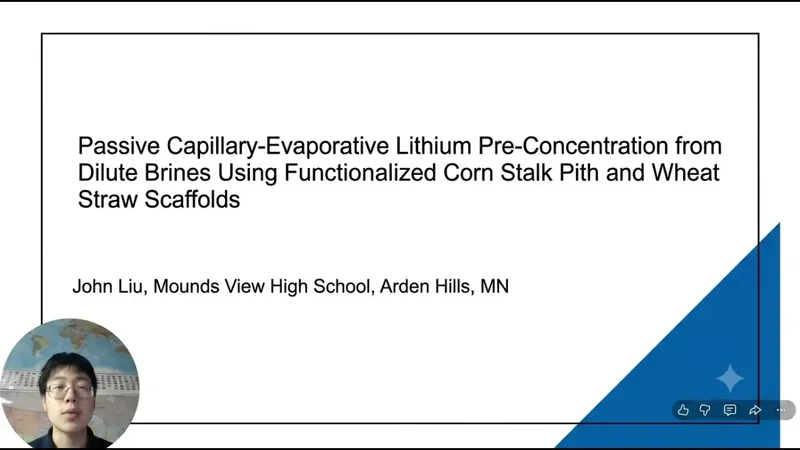
Lithium is a crucial ingredient in rechargeable batteries, but recovering it from dilute sources can be difficult and energy-intensive. John Liu, a high school student from St. Paul, Minnesota, approached that problem by looking at materials that are usually left behind after harvest: corn stalks and wheat straw. His project, titled âPassive Capillary-Evaporative Lithium Pre-Concentration from Dilute Brines Using Functionalized Corn Stalk Pith and Wheat Straw Scaffolds,â explored whether agricultural waste could help concentrate lithium from dilute brines. The project earned Liu a place among Minnesotaâs finalists for the 2026 Regeneron International Science and Engineering Fair and a Gold Award at the Minnesota State Science and Engineering Fair. The Minnesota Academy of Science lists his work among the fairâs top high-school projects and identifies him as a student from St. Paul.
How John Liu turned agricultural waste into a lithium recovery material
Liuâs project centred on two materials that are abundant agricultural by-products: corn stalk pith and wheat straw. Rather than treating them simply as waste, he investigated their potential as scaffolds for a process that could passively concentrate lithium from dilute brines.
The project title describes the approach as passive capillary-evaporative lithium pre-concentration. In practical terms, the research combines the ability of plant-based structures to move liquid through tiny spaces with evaporation to increase the concentration of lithium in a dilute solution. The corn stalk pith and wheat straw were functionalised for this purpose, turning naturally occurring agricultural material into engineered structures for lithium recovery. The idea is notable because it connects two very different problems: the growing need for lithium and the enormous quantities of agricultural residue produced after crops are harvested. Instead of relying solely on conventional materials, Liu investigated whether plant-based waste could form part of a lower-cost route for concentrating lithium. The Minnesota Academy of Science identifies Liuâs project under environmental engineering and lists it as HS-ENEV-500.
Why recovering lithium from dilute brines is difficult
Lithium can occur in brines at concentrations that make direct recovery challenging. When the concentration is low, separating the lithium from a large volume of water requires an efficient method for first bringing the lithium into a more concentrated form. That is where Liuâs research focused. Instead of attempting to extract lithium immediately from a highly dilute solution, his system was designed around pre-concentration. The plant-derived scaffolds provide a structure through which the brine can move, while evaporation removes water and leaves the dissolved lithium increasingly concentrated. The choice of corn stalk pith and wheat straw also gives the project a sustainability angle. Both are agricultural residues rather than purpose-built raw materials. Liu's work therefore investigates whether materials that already exist as crop waste can be adapted for a high-value environmental application. His project was strong enough to earn a Gold Award at the 2026 Minnesota State Science and Engineering Fair. The Minnesota Academy of Science says Gold Awards recognise projects in the top 5% of those presented at the state fair.
From a Minnesota science fair to international competition
Liu's project went beyond the state competition. He was named one of Minnesotaâs 2026 finalists for the Regeneron International Science and Engineering Fair, alongside other high-school researchers from across the state. The project later competed at the international fair; ISEF Grand Awards listed Liu as a second-award winner in the environmental engineering category, receiving $2,400. The Minnesota Academy of Science also reported that Liu won second place at ISEF and received the Chief of Naval Research Scholarship Award among the special awards won by Minnesota students. What began as an investigation into whether corn stalks and wheat straw could help concentrate lithium from dilute brines ultimately became an internationally recognised research project. Liu's work demonstrates how an everyday agricultural residue can become the starting point for a much more ambitious scientific question, whether waste from the farm can help recover a material increasingly important to modern energy technology.