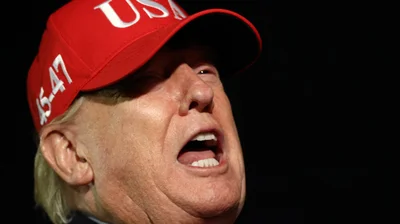
It is entirely in keeping with the way he has managed this war that US President Donald Trump’s first reaction to the collapse of talks in Islamabad was to announce a measure that helps Iran more than it hurts it.
Announcing his own blockade of the strait of Hormuz and vowing to hunt down the tankers that have got through would have the immediate effect of stopping Kuwait, the United Arab Emirates and Saudi Arabia from exporting their oil.
Three tankers from these countries passed through the strait during the ceasefire. One supertanker, carrying crude loaded from Saudi Arabia and the United Arab Emirates in early March, is expected to arrive at Malaysia’s Malacca Port on 21 April, according to shipping data.
Another tanker, Ocean Thunder, loaded with Iraqi crude and chartered by a unit of Malaysia's state energy company Petronas, got through the strait last week.
And yet Trump has instructed the US Navy to interdict every vessel in international waters that has paid a toll to Iran: "No one who pays an illegal toll will have safe passage on the high seas."
New MEE newsletter: Jerusalem Dispatch
Sign up to get the latest insights and analysis on Israel-Palestine, alongside Turkey Unpacked and other MEE newsletters
US Central Command tried to inject some order into the latest edict from their commander in chief by saying the US Navy "will not impede freedom of navigation for vessels transiting the Strait of Hormuz to and from non-Iranian ports".
However, those are the ones that are currently paying Iran the tariffs. The idiocy of this move has oil market specialists burying their heads in their hands.
A bizarre escalation
Since the US launched the war, Iran has allowed about 100 vessels through Hormuz. Trump, in the meantime, has gone from a policy of lifting sanctions on Iranian oil to ease the global supply pressures to seeking to cut it off altogether.
"Closing the strait entirely will spike oil prices even more than they did before, and put more pressure on the US from the international community," Jennifer Kavanagh, director of military analysis at Defense Priorities, a Washington think tank, told the Financial Times.
'Game on’: How Iran can exact a toll in the Strait of Hormuz
Vali Nasr, a former US official and a professor at Johns Hopkins University, said: "This is fine by the Iranians - it prolongs the chokehold on the global economy... And the Iranians could shut down [the] Bab el-Mandeb and then the US will have to deal with that."
Hasan Ahmadian, an Iranian academic and political commentator, said that the blockade assumed that Iran cannot break it by force, and that it would take the US a short time to break Iran and control energy prices.
Both assumptions were risky.
After 39 days of war, Ahmadian noted that US aircraft carriers have remained at a safe distance and added: "It is enough for Iran to simply hold out - even without a war - for energy markets to surge significantly."
Not unnaturally, the immediate response to Trump’s latest announcement was an eight percent increase in the price of a barrel with Brent Crude, the international marker, going from $70 to $119 in the course of the war.
The latest round of escalation in and around the Strait is even more bizarre because, according to both Trump and the Iranian Foreign Minister Abbas Araghchi, the talks were going well.
VIDEO
Trump said they were making enough progress to prevent further military action.
"In many ways, the points that were agreed to are better than us continuing our Military Operations to conclusion, but all of those points don’t matter compared to allowing Nuclear Power to be in the hands of such volatile, difficult, unpredictable people," he wrote on Truth Social.
If Trump had been referring to Israel, which has 90 nuclear weapons and is not part of the Treaty on the Non-Proliferation of Nuclear Weapons (NPT), most of the world would have heartily agreed.
But he wasn’t.
He was referring to a country that has no weapons programme, according to the International Atomic Energy Agency (IAEA), and is still a member of the NPT, though if this war resumes, probably not for much longer.
The Israel factor
Trump referenced Iran's offer to dilute its 60 percent enriched uranium, and only continue low-grade enrichment under international supervision.
Araghchi posted: "When just inches away from 'Islamabad MoU', we encountered maximalism, shifting goalposts, and blockade," he said on X.
Israel did not take kindly being cut out of the Islamabad negotiations that led to direct talks, and would have strained every sinew to get back into the process by sabotaging it
I have no evidence for this, but my guess would be that throughout the course of those 21 hours Trump had the Israeli Prime Minister Benjamin Netanyahu in his ear, either directly or through his son-in-law Jared Kushner.
Israel did not take kindly to being cut out of the Islamabad negotiations that led to direct talks, and would have strained every sinew to get back into the process by sabotaging it.
The end result is that Trump went back on all of Iran's ten points, which he had agreed to be a basis of negotiation.
Having been fully aware that Iran would never give up uranium enrichment, or hand over control of its most effective asset, the Strait of Hormuz, or cut Lebanon’s Hezbollah, Hamas, and Yemen's Ansar Allah (the Houthis) from all funding, Trump pivoted to a position that would have demanded Iran’s surrender on all three fronts.
There was indeed a fundamental asymmetry to the Islamabad talks.
The Iranian side sent over 70 specialists with their team of negotiators and was prepared to negotiate, while the US side, which had already reneged on a pledge to stop the war in Lebanon, packed in after 21 hours.
Rob Malley, the head of the US negotiating team with Iran under former President Joe Biden, made this point forcefully. He posted: "Twenty one hours was twenty hours too many if the goal was to reiterate a demand Iran had already rejected. It was many hours too few if the goal was to negotiate."
So we are now once again on the cusp of another major escalation in this conflict. The Islamic Revolutionary Guards Corps (IRGC) have warned that any military ship approaching the strait will be fired on.
And Trump appears to be only too willing to help the IRGC widen the scope of this conflict.
He threatened China with a 50 percent tariff if the US found evidence that Beijing was providing military assistance to Iran. He told Fox News: "We’re not going to let Iran make money on selling oil to people that they like."
This latest tariff threat is presumably his preparation for the summit with President Xi Jinping next month.
"I could take out Iran in one day… I could have [destroyed] their entire energy, everything, every one of their plants, their electric generating plants, which is a big deal," Trump bragged, continuing to believe that Iran had been defeated.
Stronger position
Outside the bubble of fantasy that Trump inhabits, most analysts agree that Iran is in a stronger position to confront the US that it was at the start of this war.
It has proven control over the Strait of Hormuz. US intelligence assessment judges that Iran has half its rocket launchers and drones, and retains thousands of missiles which it can fire from launchers buried underground.
Outside the bubble of fantasy that Trump inhabits, most analysts agree that Iran is in a stronger position to confront the US that it was at the start of this war
After 13,000 strikes by US and Israeli bombers, Iran has proven powers of regeneration.
It has the increasingly overt backing of China and Russia, and again, according to US intelligence, this is more than just verbal support. China is preparing to ship new air defence systems to Iran.
It has caused the largest energy supply shock in decades, slashing global oil production by up to nine million barrels per day and one-fifth of the world's gas supply.
It has the Houthis poised to join in. Hezbollah is fighting an Israeli incursion as never before,and Kuwait is being hit by missiles and drones from Iranian allies in Iraq.
Additionally, Iran has another card to play - the closure of the other chokepoint in world trade, the Bab el Mandeb, which would close off traffic through the Red Sea and the Suez Canal.
Already it has hit a pumping station for an east-west pipeline carrying Saudi oil to the Red Sea.
Any attempt by US military action to reverse any of these gains would be hard fought and bloody.
As Brandon Carr and Trita Parsi wrote, getting physical control of the Strait of Hormuz would involve US troops seizing three Iranian islands - Abu Musa, Larak, and Kharg - in the Persian Gulf.
VIDEO
They pointed out that the major difficulty is not landing Marines on or seizing these islands. Rather the problem would be to hold onto the islands once US forces are there.
"Without prepared, hardened fortifications to provide cover, even with air support from nearby naval assets, force protection would be an enormous challenge.
With his 'Stone Age' threat to Iran, Trump has unleashed a new age of savagery
Soumaya Ghannoushi
"The Marines would likely incur high casualties from Iranian ballistic missiles and drones relentlessly targeting either island, whether from nearby islands, including Qeshm, or Iran’s coastline itself, severely limiting their ability to project power into the strait. Providing logistical support would be extremely demanding.
"Marine Expeditionary Units are typically capable of self-sustainment for 15 days but require resupply thereafter. Any effort at resupply, depending on the remaining threat that Iran poses in the strait at that time, would come under intense fire."
Quite apart from this battleground, it is difficult to believe that Iran would not be raining down fire on every other oil terminal in the Gulf if its main terminal at Kharg Island were to be attacked.
The cost of liberating the islands in and around Hormuz could be a smouldering mass of ruins up and down the Gulf, which would halt oil and gas export for the foreseeable future.
Even if an overwhelming US force could seize Hormuz, there may not be any processed oil left to ship through it.
A new round
The prospect of a new and even fiercer round in this war has split not only the Gulf Cooperation Council (GCC) countries but the mutual defence pact that Saudi Arabia and Pakistan signed after Israel attacked Hamas negotiators in Doha last year.
The UAE and Bahrain, Israel’s closest allies in the Gulf, are firmly for "finishing the job", and probably have already started attacking Iran directly. Qatar and Oman are in the peace now camp.
Suez was the death knell for the British empire. Hormuz may do the same for the US
Kuwait and Saudi Arabia are hovering in between both, but even so Riyadh has no intention of making peace with Abu Dhabi over its rift with Yemen. If anything, Riyadh and Abu Dhabi want to do their counteroffensive against a steady stream of Iranian drones separately.
With Iran, Trump now finds himself in much the same position that Netanyahu found himself in after the Gaza war. Gaza’s refusal to wave the white flag enraged and weakened Netanyahu at the same time.
The moment the war stopped, Netanyahu found himself deluged with domestic criticism that the war aims had not been achieved.
The same thing is happening inside MAGA about the Iran war. The only response Netanyahu and Trump can have to this protest is to keep the war going.
Worse still, other voices are reaching Trump’s ear. Such as his friend Mark Levin, who is consistently drawing a comparison to the Japanese surrender after the Second World War. "[In order to get the Japanese to surrender], we dropped two atomic bombs," Levin said.
"I think it would be very helpful to go back and read the terms of surrender from the Japanese…because the Japanese were dug in, even after dropping two atomic bombs, and it took a lot of pressure - even after that - to get them to surrender," he said.
Madness is afoot and it is becoming a global problem. Europe is out of the game and China is watching from a distance.
Meanwhile, the case to impeach Trump because he is simply not mentally fit to do the job grows. Trump’s antics have stopped being a joke. They are a major cause of global instability.
The views expressed in this article belong to the author and do not necessarily reflect the editorial policy of Middle East Eye.