Endless summer: How the hottest season gained 49 days in 33 years
Save
You have reached your maximum number of saved items.
Remove items from your saved list to add more.
Save this article for later
Add articles to your saved list and come back to them anytime.
Got it
AAA
If you feel like summer is longer than it used to be, you’re not imagining it.
Scientists have measured the length of summer – defined by climate rather than dates – and found it is expanding by six days every decade globally.
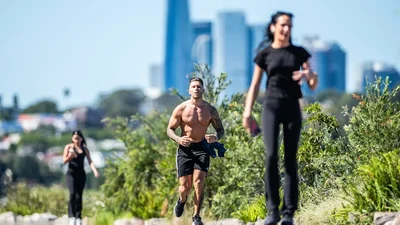
Sydneysiders take in the warm weather on April 13, 2026. Research suggests the city’s summers now stretch from November 27 to March 28.Steven Siewert
Among 10 global cities studied in depth by the University of British Columbia researchers, Sydney is copping the biggest increase, adding about 15 extra days of summer every decade since 1990.
By 2023, a Sydney summer lasted 125 days, up from 76 days in 1990, 49 extra days of summer. If trends continue, summer will last half the year within a few decades.
Summer is also starting and ending more suddenly rather than warming gradually throughout spring and then tapering off in autumn.
That sharp drop-off is arguably yet to occur this year. Sydney is expected to warm up throughout the week to reach a maximum of 29 degrees on Friday, while Brisbane will be in the high 20s or early 30s all week. It is cooler in Melbourne, but the temperature is still expected to reach 24 degrees on Thursday.
Lead author Ted Scott, a PhD candidate who wrote the paper with his thesis supervisors, said the research confirmed his life experience.
“I’m 53 – the summers that I remember from my youth, summer does not feel like those any more; it feels longer, and this study confirms that sense,” Scott said. “I also have the sense that at least where I am living, summer starts really abruptly. And it turns out this study confirms that the seasonal transitions are becoming more abrupt and that was true on average everywhere in the mid-latitudes.”
The longer summer and general seasonal disruption would have implications for everything from bushfires, droughts, energy demand for cooling, and agriculture, Scott said. For example, farmers would not necessarily be able to plant crops earlier in the year just because the weather was already warm, Scott said, since pollinators might not be active yet and the hours of daylight would not change.
“For policymakers, there’s an assumption or baked-in expectation that summer is this gradual thing that appears, and there’s a pretty constant rhythm every year, and we can kind of rely on that and plan on that,” Scott said. “This is throwing a monkey wrench in that way of thinking.”
Beachgoers enjoy Wollongong Harbour on a warm day on April 8.Steven Siewert
The research published in the journal Environmental Science Letters found summers are expanding 50 per cent more rapidly than was previously revealed by older research that analysed temperatures until the early 2010s.
The research compares ERA5 data from the European Union’s Copernicus Climate Change Service, which divides the world into 25-square-kilometre grids that might not align precisely with cities, with weather station data from 10 cities around the world.
The researchers picked cities in the mid-latitudes – between the polar circles and the tropics – with continuous weather data. Sydney was the only Australian city included in the study, using the Sydney Airport weather station.
Minneapolis in the United States has an extra 30 days of summer; a Toronto summer has expanded by 27 days; and summer is just over three weeks longer respectively in Paris, France and Reykjavik, Iceland.
The meteorological summer still starts on December 1 and ends on the last day of February. The astronomical summer still starts on the summer solstice and ends on the autumn equinox.
In this research, summer is defined as the stretch of days per year when the average daily temperature is in the hottest quarter of the year for the 1961-90 historical baseline. For Sydney, the summer threshold was an average daily temperature above 21.4 degrees with some degree of consistency.
From 1961 to 1970, an average Sydney summer started on January 5 and ended on March 9. From 1991 to 2000, it was December 2 to March 12. And from 2014 to 2023, it was November 2 to March 28.
Emma Bacon, founder of climate action and adaptation advocacy group Sweltering Cities, said it was great to have a study that confirmed what so many people were experiencing, from being disconcerted by flowers blooming at the wrong time of year to the financial and health stress of extreme heat and the cost of cooling homes.
Soaking up the sunshine in Wollongong on a warm autumn day on April 8.Steven Siewert
“It’s a reflection of what lots of people around Australia already feel and know, which is that the summers of our childhood are not the summers of our future,” Bacon said.
Get to the heart of what’s happening with climate change and the environment. Sign up for our fortnightly Environment newsletter.
Save
You have reached your maximum number of saved items.
Remove items from your saved list to add more.
Caitlin Fitzsimmons is the environment and climate reporter for The Sydney Morning Herald. She was previously the social affairs reporter and the Money editor.Connect via email.