It’s been almost six months since my daughter was born. We’re past the baby blob stage and she finally seems to be taking an interest in the books I’m reading to her: crushing the crinkly pages of a fabric book, giggling when I lift a flap to reveal a hiding monkey. Sure, she is as fascinated by her toes as she is by books, but it’s a start, right?
This daily exercise reminded me of the thrill of tactile books and has left me longing to sink back into the sensorial luxury that is reading. As a new mum, I do my fair share of doomscrolling, but in an age of AI-outsourced everything, reading a real book — not for self-help or upskilling, but for the sheer pleasure of it — seems almost illicit. Perhaps that’s why I’ve been craving something that engages the senses rather than just the algorithm.
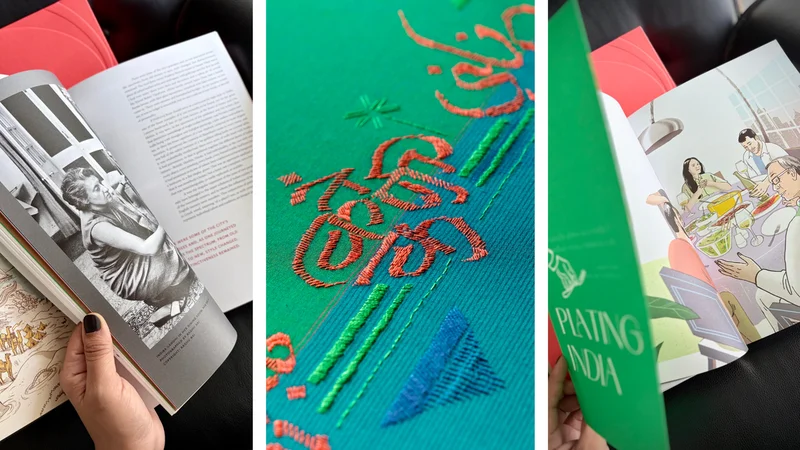
To me, Taste, an experimental, limited-edition publication by Juggernaut Books, feels both personal and political. Edited by journalist Lakshmi Chaudhry and designed by graphic designer Kriti Monga, this “part art object, part literary magazine” explores the idea of taste through written and visual essays that span music, food, travel, literature, culture, spaces, history, fashion and identity.
To call Taste a coffee-table book would be doing it a disservice, because it is as much a collection of literary writing as it is a work of delightful design that invites a reader to slow down and be enchanted — by an anaglyph on the story of Madras Checks; to ponder the journey of the pineapple, from fruit to luxury statement; to examine the unlikely popularity of the music of Boney M in India. Published in a finite edition of 500 copies, Taste is the first of an annual imprint that costs ₹15,000.
Appealing to the mind and the senses
“Taste isn’t just personal. It’s not as simple as, ‘Oh, I like this better than that’,” says Chaudhry to me, over the phone. “If you start asking why people like certain things, you quickly realise it’s a rabbit hole. It’s a deceptively simple question with incredibly complex answers.” Having worked in journalism for two decades covering war, genocide and terrorism, Chaudhry, per her introduction in the book, “ached to create something of beauty and meaning in a world greatly short on both”. And what a beauty Taste is.
The book appeals to both the cerebral — with writing by the likes of author Aatish Taseer, journalist and translator Srinath Perur and Nobel Prize laureate Abhijit Banerjee — and the sensory, with its use of creative art and varied printing innovations such as intricate filigree flaps, postcards and pull out sections. A product that doesn’t soothe, but challenges, the brain. Take for instance, a conversation between critic and writer Parul Sehgal with Kannada writer Vivek Shanbag on how language shapes our worldview, rearranging things that feel worthy and beautiful per the context of words. Says Shanbag, “For me, taste must have two things: surprise and tolerance. Both are essential, and both shape how one writes.”
Over the course of the conversation, Sehgal says to Shanbag, “You’re helping me see that taste isn’t just a matter of aesthetics or style or personality but an orientation. It can be the ability to arrange oneself to be present for an encounter. To grapple with the unknown.”
It’s this grappling with the unknown that author Meenakshi Reddy Madhavan explores when she embarks on a Dilwale Dulhania Le Jayenge-themed bus tour of Switzerland, with a gang of tentative countrymen who view the Swiss countryside through the comforting lens of filmmaker Aditya Chopra. These layered ideas of identity and migration are carried forward in visual essays that trace the journeys of the kamarband, from temple yakshi goddesses to James Bond; and bandhani, from Sindh to gang-coded bandanas in Los Angeles.
The book comes at an opportune time. The discourse around taste, the lack of it, its importance has never been louder. Do we actually like things because we genuinely do or because everyone — and hence, the algorithm — does? Chaudhury, in her introduction to the book says: “Pinterest is an emery board, smoothing the jagged edges of personality and culture into a readymade aesthetic.” This choice, then, to challenge the reader, to create a new art form of words and design, is very much an editorial decision.
Meant to be dipped into
Designed as an artistic endeavour, Taste doesn’t spoon feed opinions. Instead, it allows for the reader to make their own observations and connections. Over the phone, Monga explains her idea of taste: “I define it as a constellation of well-digested experiences and ideas that’s always evolving. Developing a sense of taste also means being open to changing it. I don’t have a fixed sense of my own taste, and I wouldn’t want to.”
Meant to be dipped into and not read cover to cover, each essay stands on its own, carrying its own visual identity while being connected to the larger theme. The Switzerland travel essay follows a horizontal layout, to mimic the journey of a bus across the pages, and comes with an enclosed hand painted travel guide.
The essay on India’s elite living rooms resembling a generic hotel style, follows a design that’s almost architectural in its scope, with block-like chunks of text that resemble skyscrapers.
In The Tastekeepers — an incisive, witty take on the Bengali idea of taste and culture, and its reinvention, by author Sandip Roy — the design spans everything from kitschy collages to gilded imagery of the colonial era bhadralok and raises questions of its own about the quirks and contradictions of their idea of taste.
As enjoyable as the reading experience is, I do wish some essays explored their subject areas with more depth. For instance, while the conversation between Abhijit Banerjee and some of India’s top chefs on the changing idea of Indian cuisine is interesting, it sadly does not add anything new to the conversations already out there. The Bhadralok essay too, left me wanting for more.
Still, the book endures. To me, its greatest triumph is that it is an invitation. To critique, to read, to think and discuss. To delight in postcard prints, trace the journey of the pineapple across a map with your finger and lose an afternoon exploring new ideas and contexts.
As I type this, I catch my daughter gnawing on the edge of the book. I scramble to save it from her saliva, but what can I say? She clearly has great taste.
The writer is a food and travel journalist, and the host of the Big Food Energy podcast.
Published - July 25, 2026 12:28 pm IST