Our experiences
Mabatho Marakalla
The taxi looked perfectly fine from the outside until we got on the road. We were taking it from the Alexandra rank in Pan African Mall and were seated at the back.
Then we noticed that the driverâs rearview mirror was nowhere to be seen and the brakes were not working properly. Every stop at the robots was harsh.
The 30-minute trip felt like an eternity, and panic was visible in the faces of other passengers as we all held tight to the seats in front for balance. The seats were worn out and uncomfortable, with almost no cushion between the wooden base.
While getting out of the taxi, my pants got ripped as I squeezed past the seat that folds up to let passengers pass, as its metal frame had sharp edges.
Then thereâs the reckless driving. Taxis speed, drive in lanes for oncoming traffic, and switch lanes without indicating, leaving passengers in panic, but few will speak up out of fear that the driver could tell a vocal passenger to get off the taxi.
Bheki C. Simelane
On Monday, I was in a taxi from Joburg to Chiawelo, Soweto. It looked like it was going to fall apart.
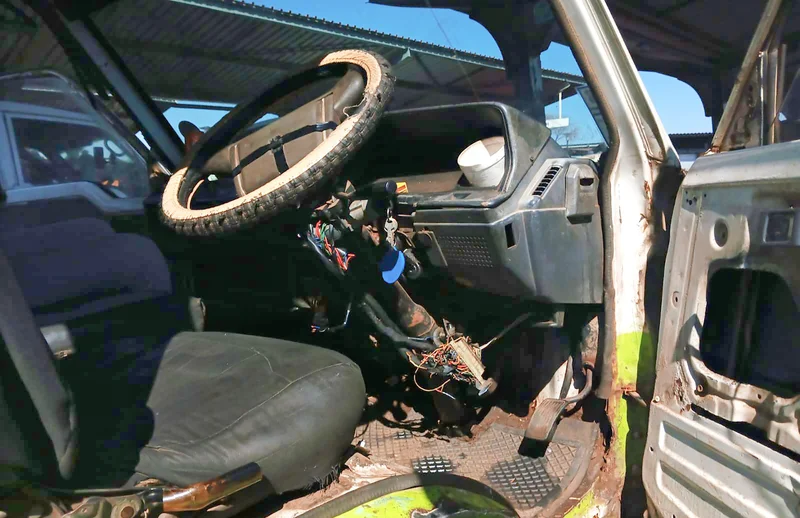
The outside of the taxi looked like it had rotted at sea. The paint was peeling off, and some of the lights were missing. The interior was just metal, with all the covering panels gone.
It shook all the way to Diepkloof, and when it got there, it finally gave in and broke down. The driver asked the passengers to get out and push the taxi. Everyone was stunned, before four people got out and pushed the taxi until it started again, but refused to move.
The driver called another taxi to pick up the passengers. It was in better shape, but not in good condition.
âTrappedâ
If you take minibus taxis daily, like the 16 million people nationally or 1.5-2 million people in Joburg (according to the SA National Taxi Council â Santaco), you probably have similar stories.
A significant number of minibus taxis in Joburg resemble scrapyards on wheels. Their engines cough through the morning rush, their doors rattle like loose teeth. Windows are patched with plastic, seats wobble on their mountings, and dashboards are stitched together with wire, if not entirely bare.
Often, drivers have to get out of the taxi and fix the main sliding door that comes off when passengers get in and out. Passengers know what to do when thereâs no door handle on the inside of the vehicle â reach out the window and open it from the outside.
âWe are being taken for a ride, literally. The taxi industry must stop being greedy because greed is the source of many of the problems we face in the sector,â said commuter Futhi Mdhluli (48), from Joburg.
âMany taxis are in a very bad condition. You think twice before getting on board,â said Sakhile Mkhize (27), from Ekurhuleni. âBut we are trapped because, despite the danger, they are efficient in moving people.â
Commuters are also victims of industry competition, with drivers or marshals yanking unsuspecting commuters out of taxis owned by another association or rival modes of transport, like e-hailing vehicles. The countryâs top taxi associations, Santaco and the National Taxi Alliance, told Daily Maverick they condemned the intimidation of passengers.
**Industry acknowledgement **
âYou are correct that a significant number of our taxis are in a very bad condition. They are not in a state where they should be transporting people, but we have no means of livelihood if we park them,â said Faraday Taxi Association spokesperson Sihle Makhanya.
Members of the taxi industry blamed the poor condition of vehicles on low profit margins and the lack of government intervention.
A Soweto taxi owner, who asked not to be named, laid bare the reality of missing vehicle payments: âThere are days when we cash up a quarter of what we used to make just a few years ago.â
Santaco attributed the sharp revenue slump primarily to the fallout from Covid-19, compounded by structural shifts in commuting. Key pressures include the rise of remote and hybrid work, lift clubs, e-hailing, and illegal seven-seater operators running door-to-door routes. Soaring fuel prices, escalating maintenance costs and heavy vehicle finance repayments have further squeezed operatorsâ margins.
âThese financial pressures make it more difficult for operators to replace older vehicles and maintain their fleets. Nevertheless, Santaco continues to encourage operators to prioritise safety, maintain roadworthy vehicles and comply with all regulatory requirements,â said Santaco spokesperson Graham Fritz.
âA new minibus taxi now costs approximately R500,000, with monthly finance repayments often exceeding R20,000 and making replacement difficult for many operators.â
The most dilapidated vehicles on the road are often ageing Siyayas â a model now mostly replaced by the newer Toyota Quantum.
Industry bodies largely blame the governmentâs taxi recapitalisation programme. Intended to professionalise the sector by subsidising the retirement of unsafe vehicles, the initiative faltered as many operators resisted compliance or fell through system loopholes.
âTaxis do not have a subsidy from the government, but buses are subsidised. That is why you always see them in good condition,â said the Faraday Taxi Associationâs Makhanya.
âWhen it comes to us, we fend for ourselves.â
Much like taxi commuters. DM