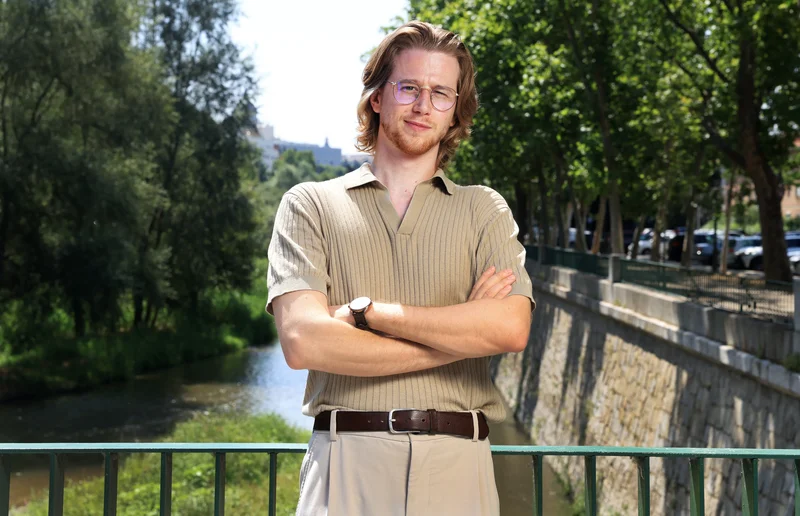
Berna León, 30, was very comfortable at Harvard College working as a Teaching Fellow for Michael Sandel, one of the leading critics of hyperliberalism. A philosopher and sociologist trained at the Sorbonne in Paris, with a master’s in international relations theory from the London School of Economics and Political Science, a PhD in sociology from Sciences Po, and an expert in public policy, he had always imagined himself in a classroom or a library, among books and papers. But a phone call changed his mind and drew him out of academia.
The offer was for the position of managing director of Fundación Avanza, the think tank of the Spanish Socialist Party (PSOE), which currently heads Spain’s government under Prime Minister Pedro Sánchez. The proposal came at a pivotal moment in León’s life: amid the Trumpist backlash against progressive institutions such as Harvard and the international retreat of the left and the advance of illiberal forces. “I had some doubts, but I couldn’t pass up this opportunity,” he admits.
Question. Why did you have doubts?
Answer. Entering politics today is a bit like throwing yourself to the wolves. And there’s the prejudice that academics who split their time between the university and politics are less serious than those who devote themselves exclusively to research. But I couldn’t say no in this international context, where many people tell me how lucky I am to be Spanish, how lucky that my government is standing up to Trump and calling a genocide by its name and leading an international progressive space.
Q. What do you think will happen in the 2027 elections in Spain?
A. In 2023, there were many doomsayers who thought everything was lost. We went out to win, and we won. Today, most Spaniards are aware that they are better off than in 2018, so I don’t see why we can’t expect a progressive victory in 2027.
Q. Your father, Bernardino León, was Spanish secretary of state for foreign affairs during the government of former [Socialist] prime minister José Luis Rodríguez Zapatero. What did he think about you taking this job?
A. At first my parents had trouble understanding why I would leave Harvard for Spanish politics. They couldn’t see why I would expose myself to attacks from a thousand different fronts when I could be studying quietly in a library in Cambridge, Massachusetts. I also think the conversation I had with my father was not very different from the one he had with my grandfather when he told him he was going to leave the diplomatic career for a while to go into politics. These cycles repeat. As they age, parents become more risk‑averse, but I have to say mine have always supported me in all my decisions.
Q. When the Avanza Foundation was launched in 2024, it was billed as the “spearhead” of progressivism at a time when the right was advancing. What do you think the left has done wrong that has enabled the right to gain ground?
A. In the case of the United States, for example, I think there was a strategic mistake in building coalitions. Too much emphasis was placed on cultural and identity rights and not enough on class and a redistributive agenda. That was a historic error that the Biden administration began to correct. Ignoring the class element has cost the left many elections in our region. At a more global level, the rise of the international reactionary movement cannot be understood without analyzing the coordination and alliances they have forged, which have allowed them to exchange funding and strategies and helped them advance in their countries. The left has to emulate those strategies to build international coalitions. It’s an unfinished task.
Q. One of Avanza’s areas of focus is intergenerational justice, meaning inequality between generations. Is it true that young Spaniards are worse off than their parents?
A. It depends on how you measure it. During the Transition [to democracy following the Franco dictatorship], many opportunities for upward social mobility opened up. Many senior and mid‑level civil service positions had to be filled, and there was enormous growth thanks to Spain’s accession to the European Communities. All that generated huge intergenerational mobility that allowed for greater welfare and a more optimistic view of the future. Millennials and Gen Z, by contrast, have faced the global economic crisis of 2008, the Covid-19 pandemic and the war in Ukraine. Today it’s cheaper than ever to buy a TV or to travel, but buying a home is more expensive than ever. That doesn’t mean the main gap is between generations, as some claim. A third of today’s young Spaniards with very little capital will inherit a huge sum from their parents in a few years, and we will discover that what today looks like a generational gap was actually a class divide.
Q. What role does the banking sector play in the housing crisis?
A. Banks have benefited indirectly from rising housing prices because higher prices increase the value of mortgage collateral and reduce expected losses in case of default; but they are not the main problem, and in any case I’m not in favor of moralizing their responsibility too much. I can’t ask banks to be benevolent motu proprio; what I want is for the state to prohibit bad practices and, above all, to establish the right incentive structure. The macroprudential measures implemented to avoid another 2008‑style crisis have prevented another bubble, but they have also made private housing development more difficult. Moreover, from the demand side, they have created winners and losers: winners are those who can access mortgages, with interest rates much lower than in the English-speaking world, while losers are those with slightly less solvent profiles who are pushed into perpetual renting by very high down payments and stringent risk assessments. In other words, the role of banks is inseparable from that of the regulator.
Q. And what does Avanza propose?
A. At Avanza, what we want to do on housing and other issues is avoid falling into false dilemmas or clichés. The report we will publish this autumn is critical of the harmful idea, entrenched in parts of the left, that building more housing does little good. Few measures are as effective at lowering the price of a good as increasing its supply. But, of course, that doesn’t mean accepting the right’s panacea that deregulating the housing market will solve all our problems. I think we need to start viewing housing policy the way we view industrial policy: without a state that coordinates the private sector, while working with it, we will not mobilize enough resources to provide collective goods. In that sense, one of the major proposals in our report will be a kind of housing “New Deal,” so named for the scale of resources to be mobilized. We must activate every lever, public and private.
Q. Another Avanza priority is disinformation. There’s a lot of talk about fake news and pseudo‑media but little about people’s declining interest in getting information from traditional media. How do you interpret that?
A. I would say there are three dynamics behind this disenchantment. First, the crisis media faced with the arrival of the internet, where no one foresaw that free information would kill subscriptions and lead to the closure of many news companies. There was a very aggressive and damaging adjustment to the journalism we need most. Second, the attention economy: you increasingly have to compete more aggressively for attention, with ever simpler codes and ever less sophisticated ideas. The third dynamic, deeper and more general, is the disappearance of the intermediate institutions that characterized the 20th‑century world. There were spaces — unions, political parties, media — that interpreted reality and transmitted that interpretation to society. They helped make sense of the world. Today those spaces are disappearing. The producer of information and the receiver communicate directly, and everything has been simplified. Content is simpler, more visual. Our current cognitive capacity to maintain concentration has been radically reduced. I force my students not to use laptops or phones in class: I print the texts, and we read and discuss them in class.
Q. What can be done to tackle this problem?
A. At Avanza, we want to start working on what we call democracy and digital sovereignty. We don’t politicize the digital sphere enough. Prime Minister Sánchez has been very brave confronting the “tech oligarchs” and calling them out by name. One of our proposals is to try to intervene in algorithms so that minors do not suffer abuses online: violent and sexual content, etc. We shouldn’t ban minors from using social networks; we need algorithms that are safe for them. That will only be achieved with technically grounded measures and the political will this government has. Right now the internet is a mix of the Wild West and a feudal encomienda system [Spanish colonial labor system] because we’re leaving sovereignty over a large part of our reality in private hands.
Q. Do you agree that young people are disengaged from politics?
A. Youth participation has gone in phases. During the 15‑M movement [the anti-austerity movement that swept Spain in 2011], politics had a young face. Now we’re in a cycle in which some young people feel politics has become distant from them. It’s a vicious circle: young people vote less, so political proposals pay less attention to them and that breeds disinterest, a sense that politics doesn’t concern them. But I think the level of disenchantment is sometimes exaggerated. It fluctuates.
Q. Are there not enough young role models?
A. Young people don’t only feel represented by people their own age. Bernie Sanders is a good example. A near‑octogenarian is the politician who has best mobilized young people in the U.S.
Q. Who have been your own role models?
A. I come with certain biases. One of my main role models is Michael Sandel, with whom I had the good fortune to work at Harvard. He was close to going into politics, even participating as an adviser in campaigns, but ultimately decided to be a public intellectual from the university, while remaining deeply engaged in politics. Thomas Piketty is another important role model, someone who not only researches, but maintains an active commitment to political debate and opens up new discussions.
Q. Speaking of role models, many on the left — and also on the right — are in shock over the corruption allegations against Zapatero. How has it affected you?
A. I have known Zapatero for many years. I have a personal relationship with him, and he is clearly one of the people I most admire in politics. Beyond the presumption of innocence, I am convinced the legal and media trial being carried out responds to certain political issues at national and international levels. What I would like is to wait and see the evidence the Attorney General’s Office and prime minister Zapatero will present. I am convinced that it will be important to resolve this case.
Q. A recent poll by Spain’s statistical bureau CIS shows nine out of 10 Spaniards believe the justice system does not treat all politicians equally. Do you agree?
A. I think this CIS poll captures Spaniards’ intuition that the judiciary is mixing corruption cases that must be resolved with the utmost diligence — such as [Jorge Luis] Ábalos [the former transportation minister embroiled in a kickbacks investigation], Koldo [García, his former aide] and [businessman Víctor de] Aldama [who has emerged as a key intermediary and witness in the affair]— with cases that are part of a judicialization of politics, a use of state powers to pursue political opponents. The strategy being pursued — to try to win in the courts rather than at the ballot box — is not working. Most Spaniards see what’s behind it.
Q. According to the same poll, 87.5% of Spaniards believe the country lacks sufficient mechanisms to combat corruption. Are mechanisms missing?
A. Corruption is not Spaniards’ top problem. Spain is not particularly corrupt compared with other countries in our environment, and pointing to worse examples doesn’t help. There are more pressing worries for Spaniards, such as making ends meet. But corruption is the most corrosive problem; it generates the greatest anti‑political sentiment and citizens’ mistrust of the system itself. That is why we must be absolutely uncompromising on the issue. More can be done at the level of parties and institutional design.
Q. Would you say there is a shortage of politicians with high academic training like yours?
A. Politics should not be a club for elite degree‑holders; that would be bad news for democracy. When voters don’t see people who look like them and those decision‑makers become disconnected from everyday concerns, that leads to electoral collapse for certain parties and to their disappearance. Politics is not a meritocratic contest equivalent to civil service exams nor should it be a place selected by a company’s headhunter.
Politics is a tool to transform reality, and what’s needed is willingness to sacrifice, work and activism to steer it in a given direction. That doesn’t depend on degrees or résumés but on commitment and activism. Major transformations have always come from alliances between different profiles: the experience of a union activist who has spent 30 years on the streets is as valuable or more so than that of a Harvard academic. [Former Socialist prime minister] Felipe González’s government was a good example: it included the equivalents of the U.S. Ivy League, the A1s [Spain’s highest-ranking category of career civil servants], and profiles closely tied to grassroots activism. Those combinations are what ultimately steer our country in the right direction.
Q. Have you considered making the leap into politics?
A. If I had wanted to make the leap into politics, I would have done so already. For me, Fundación Avanza is not a springboard. My plan is to continue contributing to this debate of ideas in the coming years. I’m not thinking about a political career right now. My natural place is the university. But you know what they say: never say never.