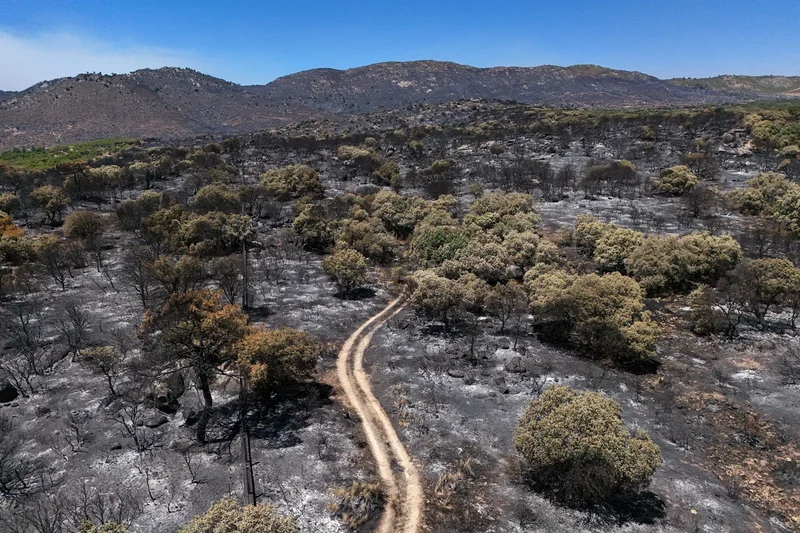
“For the people who deny climate change, come with us to fight the wildfires,” says forest firefighter Juan in an impassioned address on Spanish TV.
“I invite you to join us. Come and see how it changes everything,” he told Malas Lenguas. “These fires are caused by depopulation and climate change.”
For nearly a week, France and Spain have battled devastating wildfires that have led to the evacuation of more than 360,000 people and the burning of countless homes. More than 116,000 hectares of land has been scorched across France alone, in what President Emmanuel Macron called the worst crisis in the country since World War Two.
At least 75 firefighters have been injured and at least two have been killed in France as they battled towering pillars of flames with hoses.
But the resources have proved no match for the blazes so powerful that they have generated “fire clouds” with their own weather systems including winds and thunderstorms.
Climate experts have long warned that climate change will intensify natural disasters, including wildfires and hurricanes.
In Spain and France, both facing a third extreme heatwave of the summer this week, it is feared the crisis could last for months.
“Europe is one of the fastest warming continents on earth,” says Chatham House environment and society researcher, Barghabi Barharadwaj.
“Temperatures have been rising by around two degrees in 50 years, which is roughly twice the global average of warming intensity.”
She explains that while fires are manmade and can be started accidentally, underlying conditions including warmer temperatures, drier conditions in forests and on agricultural land “cause it to spread much faster than they would before and make it much harder to control after that point.”
“Climate change has not necessarily caused the individual fires, but it has intensified the conditions in which they are burning,” says Dr Francesca Di Giuseppe, a scientist at the EU’s Copernicus Climate Change Service.
“A warmer atmosphere increases evaporation and draws more moisture from soils and vegetation, allowing fuels to dry more rapidly. Heatwaves are also becoming more frequent and intense, creating longer periods of high temperatures, low humidity and extreme fire weather.”
While she says that a formal study is needed to quantify exactly how much climate change has impacted the recent fires, “the broader scientific evidence is clear: climate change is increasing the likelihood and severity of the hot, dry conditions that enable extreme wildfires. The ignition may have many causes, but climate change is increasingly loading the dice toward more dangerous fire behaviour.”
More than 150,000 hectares of land have burned across Spain since January, according to Spanish prime minister Pedro Sanchez, an area that is six times the size destroyed during the same time period last year.
On Monday, he was unequivocal about the cause: “What we're experiencing isn't a succession of isolated events. It's the most painful expression of a climate emergency that is making sixth-generation wildfires more ferocious, heatwaves more frequent, and our territory more vulnerable.”
According to Nasa, whose Terra and Aqua satellites detect active wildfires twice every day, extreme wildfire activity has more than doubled over the last 21 years, becoming “more frequent, more intense, and larger”. America has been the worst affected by wildfires in particular, with Nasa concluding that “human-caused climate change has been found to be the main cause for increasing fire weather” in the country.
”It's a year on year occurrence now,” says Bharadwaj. ”What climate change does is create those conditions for fires to become much more dangerous.”
She says that wildfires and other climate-related disasters need to be accounted for in planning, including in the planting of forests and the types of trees grow there.
“This is not a problem that’s coming down the line, it’s already here.”
Yet Europe appears to have bowed to pressure from the US, particularly climate change denier President Donald Trump, on its climate commitments. During a meeting of the G7 last month, all climate-related discussions were removed from the agenda in a move interpreted as appeasing the US leader.
Upon learning of calls for British prime minister Keir Starmer to resign, Trump said he had been “windmilling the country to death”, hitting out at Starmer’s renewable energy proposals.
Proposed reforms to the EU’s emissions trading system (ETS) unveiled earlier this month could also delay cuts to greenhouse gas emissions in a move that experts described as a “gift” to polluters to Euro News.
The commission cited a changing “geopolitical and economic context” that had put the European Union under “increased pressure” and said that businesses needed more time to adjust to reductions in carbon emissions.
“The spread of climate denial, particularly influenced by the fossil-fuelled US administration and the big polluters, is obstructing much needed climate action,” says Lukas Slothuus, a researcher in climate politics at the University of Sussex.
“At the same time, many European governments are rolling back and weakening action on climate. As risks increase, more funding is needed for adaptation.
“The sad irony is that the more politicians fail to act now, the worse and more expensive it will get in the future. Looking the other way won’t make the problem go away. We are in a climate emergency that could have been much less bad than it is.”
The European Union’s Copernicus team declined to comment on climate denial by politicians.