Philip Mathews, 68, who left his seafaring career 34 years ago after serving as a captain, says he no longer recognises the waters he once sailed.
His seafaring career began in 1978, when he was just 20, with the Shipping Corporation of India. He left the service in 1992 to start a shipping company in Kochi.
“Back then, seafaring was among the safest and most peaceful of careers. Then pirates appeared on the scene, targeting ships off Somalia and West Asia. The latest West Asia conflict has escalated the risks manifold. How are mariners supposed to deal with bombs and missiles?” Mr. Mathews asked. He stressed that governments must ensure compliance with guidelines laid down by global organisations such as the International Maritime Organisation, International Trade Federation, and the International Labour Organisation.
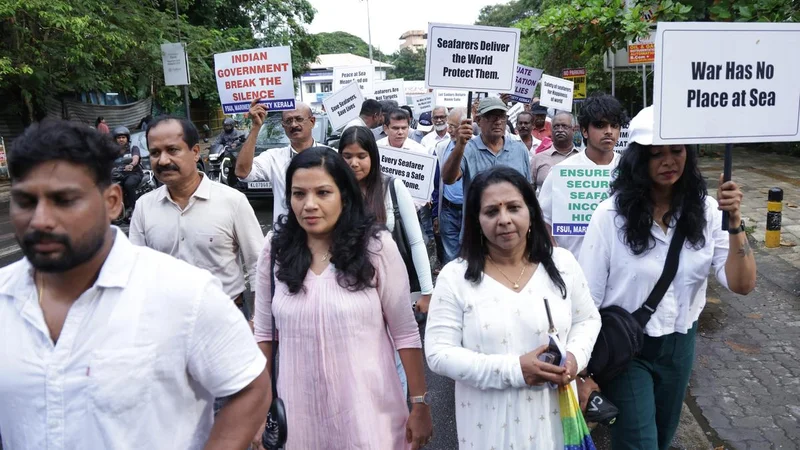
He was among the 150-odd active seafarers and families of mariners who staged a silent march under the aegis of the Mariners Society, Ernakulam, protesting the killing of seafarers in military action. They also held a candlelight vigil against the ongoing West Asia war, demanding that mariners not be made collateral damage. “War has no place at sea,” “Protect seafarer, protect trade,” and “Safe passage is a human right,” read some of the placards held aloft during the march.
Captain Sardar Kandathil, 59, an active sailor for the last three decades, said that among the many hardships facing mariners are difficulties in going ashore at various destinations, including the Persian Gulf, and joining duty on time due to increasingly complicated visa regulations. “The biggest threat, though, is the free fall in job opportunities caused by the volatile situation in the maritime sector. It threatens to sabotage India’s vision of becoming a global maritime power, despite substantial investments in shipbuilding and maritime training institutions to groom potential mariners, including many women cadets,” he rued.
Mr. Kandathil pointed out that the Director General of Shipping’s circular warning Indian seafarers against sailing through the Strait of Hormuz has ended up benefiting counterparts from countries such as China and Indonesia. “Those nations are facilitating their mariners, and this will eventually lead to long-term job losses for Indian seafarers,” he said.
Benny Kollassany, secretary of the Mariners Society and a former mariner with 36 years of experience, said the organisation had submitted a memorandum to the Chief Minister and would forward it to the Union government shortly. “India should leverage its market potential to take the initiative in ending the West Asia conflict. The prolonged conflict has driven up the prices of goods well beyond oil and gas,” he said.
T. Jayanchandran, whose son is currently on duty aboard a ship in Vietnam, said families of mariners live in a state of perpetual fear due to the conflict. “Many families are also dependent on the earnings of seafarers, who are often the sole breadwinners,” he said.
Published - July 28, 2026 09:58 pm IST