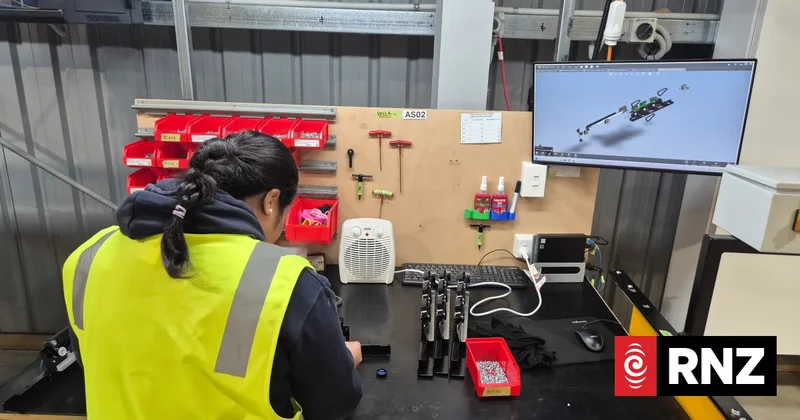
A surge in global demand for robotics and AI from the apple industry is driving big changes for a Hawke's Bay robot manufacturer.
Hawk Technology is making the robots in Hastings, then shipping the machines to the US where apple packhouses in Washington DC are lining up to get them.
General manager Sam Combs told RNZ it had built a few hundred machines for the New Zealand market over the past few years, and now the US market is really taking off.
He said the first 50 Gen 5 Apple Packers had been installed in Washington DC, with another 250 on order.
"The American market's about seven times the size of New Zealand for apples only. Washington's the Hawke's Bay equivalent of New Zealand and grows about two-thirds of the fruit.
"So we've gone and focused on that area. And yeah, the demand at this stage is greater than our manufacturing capability," said Combs.
It's a far cry from where it all began more than 30 years ago when Combs' grandad was collecting kerbside recycling to process and export for his business, All Brite Industries
The Comb family bought Hawk Packaging and began turning the recycling into the cardboard trays that sit between layers of fruit when it's boxed up in packhouses.
"We had customers start coming to us and say, 'hey, look, you supply your trays in bundles of 175 trays, and we've just got someone essentially standing there grabbing a tray and putting it onto a conveyor belt, is there some way that you can automate that for us'?"
The first machine they designed was a 'Tray Denester' which seperates out a bundle of apple trays, then they created a 'Tray Inserter'. But it's the third product that's been the most popular - the Robotic Apple Packer.
With 15 AI cameras working simultaneously, the robot inspects the fruit for any flaws and places it into cardboard trays according to its colour and quality.
"Probably where most of the IP sits is how we handle the fruit... it presents stem and calyx to the cameras so the guys upstairs can take photos and do the defects.
"This is quite a special piece of development, and is big part of what makes the machine so attractive," said Combs.
The entire process is done on site in Hawke's Bay.
"We've got a full design team in-house. We've got fabrication in-house, and electricals in-house.
"A big philosophy of ours is just keeping everything here. We didn't want to have to send stuff overseas, and we wanted our design team and our fabrication team and our assembly team in the same room," he said.
And while the robots are replacing some packhouse workers, Combs said for many employers it's solved a labour shortage problem.
"In New Zealand it was a real problem for our customers to even find that labour in the first place, so it's there to complement their existing workforces," he said.
Alan McDonald from the Employers and Manufacturers Association agreed, he said while there's been an increase in workplaces using AI and robots - it hadn't resulted in fewer jobs overall.
"I know there's a lot of concern about AI replacing people, but what we've seen in the past is that's not the case - there's displacement, re-training and different skills required, but more or less the same numbers are retained in the workplace.
"The common thing that we're hearing is that the issue with AI is it still needs human oversight and human input to work effectively in the workplace - so it's about how do we adjust those tasks, how do we re train our people," said McDonald.
It's the topic of a conference being held in Auckland on Tuesday night, called 'Workforce 2030', helping employers prepare for the increased use of AI.
"There's a reordering as people get used to working with these new tools and AI is just a tool... so how does that redesign the task or the job to accomodate both?," he said.
Seven years ago Hawk Technology had just two research design and development staff, which has grown to a team of over 50 workers to keep up with the growing demand for robotics.
Senior mechatronics engineer Ben Kloosterman has been with the company several years and is working on the Gen 5 Apple Packer.
"I'm currently writing machine codes, that's the software that runs on the machine and drives the packing behaviour of that machine, which involves everything from moving motors, vision processors from the cameras, inference to the AI models that we create and develop here," he said.
He's excited about where technology is headed.
"Previously with industrial automation it was always a bit frustrating cause the technology was like 20 years behind, so being free to learn and grow in that cutting edge technology is really really cool," said Kloosterman.
The next challenge Hawk Technology is keen to tackle, is robotics for the stone fruit industry.
"Stone fruit is on the horizon... for us, it's an obvious kind of next cab off the ranks. We'll be looking into that over the next year or so," said Combs.