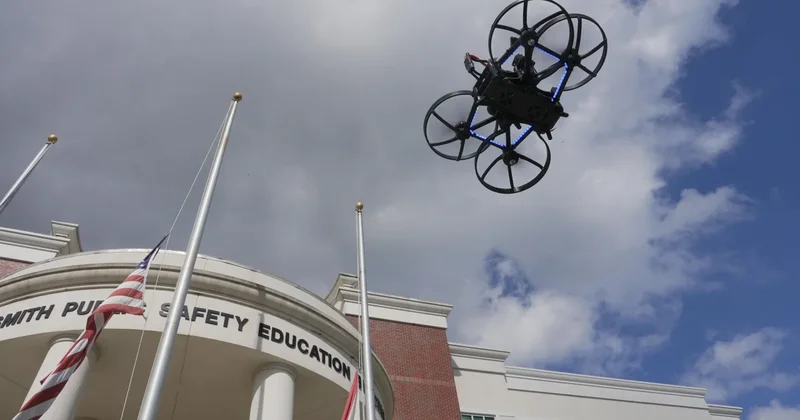
Several schools in three states will launch the new academic year with a new security measure: drones equipped with pepper spray, strobe lights and other features that their manufacturer says can be used against an active shooter within seconds.
The schools, located in Colorado, Florida and Georgia, will be the first to add drones from Mithril Defense, which has been developing and testing whether the devices can work alongside law enforcement to more effectively stop school shooters than a police response alone.
The drones zoom through school hallways at speeds of up to 50 miles per hour, guided by pilots at Mithril's Austin, Texas, headquarters, with the goal of locating an active shooter within 15 seconds, Mithril CEO Justin Marston told CBS News. The drones are designed to use a combination of sirens, strobe lights and pepper gel to overwhelm the assailant. As a last resort, the drones can ram the shooter at 60 miles per hour, Marston added.
The drones are part of the growing business of providing security services to the nation's thousands of K-12 schools amid the scourge of school shootings. American schools now spend about $4 billion annually on physically hardening their facilities by adding technology such as metal detectors and surveillance cameras, according to the Learning Policy Institute, an education research group.
"These are the first schools we're deploying into now," Marston said of the schools in the three states adopting the company's drones. "We think every school should have some kind of active-shooter suppression system, and five years from now, you wouldn't send your kids to a school that doesn't have one."
School shootings reached a peak of 352 incidents in 2023 before easing during the past two years, according to the K-12 School Shooting Database. In the 1970s and 1980s, there were typically fewer than 30 school shootings per year, the group's data shows.
The drones, which are housed in secure boxes inside the schools, can be deployed within seconds — a potentially critical feature given that most school shootings are over within two to three minutes, Marston said. The drones can also enter rooms ahead of police officers, which he said could save lives, given that data shows officers are shot in about half of mass shootings.
"An officer should never have to risk their life doing something that a drone can do, because we don't care if the drone gets shot. It's a lump of plastic," Marston said. "We just jump in with the next one. But an officer's life is irreplaceable."
Addressing root causes
Some experts say that dealing with the root causes of violence is a more effective response than using tech that may backfire by making students feel less safe or fueling their anxiety.
"Overwhelmingly, [research] indicates that the best way to keep students safe in schools is not just to attend to students' physical safety, but to ensure their psychological sense of safety as well," Jennifer DePaoli, senior researcher at the Learning Policy Institute, wrote in an April blog post.
These approaches include mental health support, building trusting relationships between teachers and students, and creating positive school environments, she added.
Marston favors addressing the factors behind school shootings. But he said that developing effective approaches to such incidents is also essential, comparing the issue to dealing with school fires.
"We should teach kids that they shouldn't start fires ... but I wouldn't send my kids to a school that didn't have a sprinkler system," Marston told CBS News. "They aren't mutually exclusive."
What it costs
The five school districts in Georgia and three in Florida that are adding Mithril's drones, called the Campus Guardian Angel, are being funded by the states, Marston said. The cost is about $20,000 a year for an 80,000-square-foot school, or less than hiring a security officer, he said.
The Colorado school testing Mithril's drone, a public charter school called the John Adams Academy, is tapping private funding after the county backed away from providing $200,000 for the program. Some parents in Colorado objected to the system, raising questions about whether children could ultimately get hurt.
"What about a drone spewing these pellets and hurting a kid?" parent Jennifer Iversen told CBS Colorado earlier this month, referring to the pepper spray. "It brings in so many ethical and legal issues that I just think it's a really bad idea."
At least one other state is examining the use of drones in schools, with Louisiana recently passing a law that would fund a drone pilot program in four schools.
"The primary selling point for these drones is their ability to offer live footage to law enforcement from areas where it previously would not have been available and to deploy deterrents, like strobe lights and pepper spray," said the Pelican Institute for Public Policy, a think tank focused on Louisiana.
Marston said demonstrations of the drones' capabilities typically sell people on the product. "Everybody sort of says, 'Show me,' and then when we show it, it's kind of like we invented electricity."