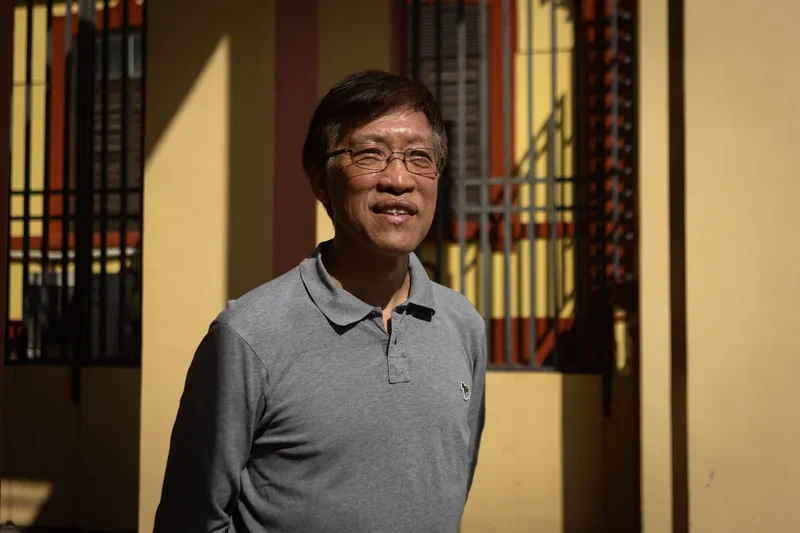
The last time Cherry Au spoke to her 68-year-old father, the call lasted just 54 seconds before a prison guard ordered him to hang up.
A year later, Cherry is still waiting to speak to Au Kam San, one of Macau's longest-serving lawmakers who remains incarcerated awaiting trial under the China-ruled city's national security law. He is being held at the city’s Coloane prison.
Au was arrested for alleged collusion with foreign forces to endanger national security, the first known arrest under that law in Macau, in a case that has many echoes of Beijing’s brutal crackdown on the pro-democracy movement in Hong Kong.
Au, who holds joint Portuguese citizenship, is one of the most prominent opposition figures in Macau and had been a lawmaker for two decades in a legislature dominated by Beijing loyalists. He decided not to seek re-election in 2021 after the Macau administration followed Hong Kong’s example by barring pro-democracy figures from running.
In an interview with The Independent, Au’s daughter says his arrest – one year ago on Thursday – came completely out of the blue.
"We didn't have any sign that something like this would happen," says Cherry, a London-based fashion photographer. On 30 July 2025, police barged into Au's home without warning and seized his phone, laptop, and books, which included some titles related to the 1989 Tiananmen Square massacre.
Au was at home with his wife and one of their daughters when police came.
"They ... took my mother away first and then stayed in the apartment with my dad collecting evidence,” Cherry says. “They basically did a search, and then they took him away after a couple of hours."
Cherry says police initially tried to treat her mother as a witness, but she declined after learning her legal rights and was released the following day. "She was very shaken and didn't know what was happening," she adds.
Since then, she alleges that Au has been denied calls and visits from his family and access to a private lawyer. He faces 10 years in prison if convicted following a closed-door trial conducted under Beijing's national security procedures.
The family learned through a court statement that Au had a preliminary proceeding on 2 July, Au’s daughter Au Hon I says. The statement says his lawyer was appointed by the court and approved by Au.
“He always believed in the justice system of Macau,” she says. “He believed it so much that he feels that he will be protected by the very justice system that is putting him where he is right now.”
In August last year, Macau's Public Prosecutions Office said "compulsory detention" has been imposed on Au after a "preliminary investigation" following his arrest at his home.
The European Union swiftly condemned the arrest by saying it heightened concerns about the “erosion of political pluralism” in the Chinese territory but stopped short of calling for his release.
Cherry says the family fears for the health of her father who suffers from diabetes, although the Chinese authorities claim he has been provided with appropriate medication.
Since 2020, public life in Hong Kong has been shaped around Beijing’s national security law imposed to crack down on pro-democracy protesters. At least 400 people have been charged and 160 convicted under the law in Hong Kong.
Now, Chinese president Xi Jinping's alleged crackdown on dissent has reached the former Portuguese colony across the Pearl River delta, where authorities are set to test the tightened law with Au’s prosecution.
The Macau court this month said a preliminary trial found Au was a "principal offender” and had committed crimes of “subversion of state power”.
The court said Au was suspected of “establishing links with organisations, groups or individuals outside Macau… to commit acts endangering national security”. Local police allege he had provided “a large amount of false and seditious information to an anti-China group” for public exhibitions online and abroad since 2022, and “stirred up hatred” against the Chinese government.
He was also accused of spreading false information to various groups, which disrupted the city’s 2024 chief executive election and caused foreign countries to take hostile action against Macau, police say.
Au’s family fears he was arrested for maintaining contact with foreign diplomats after he retired from politics, though they said there was nothing unusual about the meetings.
"What saddens me the most is seeing him being portrayed as a villain by the very government that he served for so many years.
“I hope people remember the person they knew throughout his career, the reason why they placed their trust in him and elected him time and again.
"Right now he is facing profound injustice. I hope those who remember his years of service will stand by him. We want a fair trial, due process, and for there to be more than three decades of dedication to the people of Macau, not to be erased or forgotten."
Au is also a founding member of the Macau Union of Democratic Development, which organised annual candlelight vigils commemorating the Tiananmen Square massacre for almost 30 years. Beijing has banned public commemorations of the Tiananmen Square massacre, where at least 10,000 pro-democracy protesters were killed by the Chinese army.
The group disbanded in 2023 after years of government pressure and abuse braved by the organisers.
Unlike Hong Kong, which saw big social movements challenge Chinese Communist Party rule in 2014 and 2019, the democratic opposition in Macau has always existed on the fringes amid tight Chinese control.
In March this year, lawmakers in Macau unanimously approved a bill allowing court proceedings to be held behind closed doors when deemed necessary to protect national security interests. The city enacted its first national security law in 2009 and tightened it with amendments in 2023.
Through the years, Au had led protests and railed against opaque governance and rising social inequalities even as gambling revenues exploded in the city of around 680,000.
Au’s wife and two daughters remain in Macau. They have spoken to a social worker who visited Au, but received only limited updates. They were also told to pay 7,000 patacas or £650 to apply to challenge his detention, which was later rejected by Macau authorities.
“We don’t know when these restrictions will be lifted,” Cherry says.
Au’s family has urged the EU to use diplomatic pressure to secure his release.
It is understood that the Portuguese consulate in Macau had requested consular access to Au, which was also denied by the Chinese authorities. China does not recognise the concept of dual citizenship.
"This man doesn't deserve to be in prison after decades, 30 years of working in the public service to help people who are in need and stand up for what's right. There's rarely a day that he wasn't thinking about how he could make life better for the people he served," Cherry says in her appeal to the EU.
"It is incredible, it's so selfless. I can't think of a man who has done more for the city than him throughout the decades. He's an amazing dad as well. Most importantly, we must be allowed to visit him or at the very least communicate with him somehow, not through a social worker."
Michael Polak, director of Justice Abroad who has been helping the family, says Au’s arrest violated the International Covenant on Civil and Political Rights that applied to Macau as well.
He says with the national security prosecution in Macau, "it seems like they are following the footsteps of Hong Kong".
"It's a big mistake in relation to the reputation of Macau as somewhere where people can do business and people can discuss things."
It is important to put Au’s case in the spotlight because otherwise they might just continue to hold him without trial, he adds.
“Portugal still sends judges to Macau. So if these kinds of extrajudicial cases are going to be brought, it's not really a court process when you hold someone incommunicado without a lawyer of their own choosing. Then the Portuguese judges and Portuguese authorities need to consider whether they can continue to do that,” he says, urging the EU to raise Au’s case at the highest level.
Human Rights Watch previously said in a statement Au’s arrest reflected the “broadening repression” under the Chinese president.
“Macau’s authorities should stop suppressing peaceful criticism and immediately and unconditionally free this activist and former legislator,” says Maya Wang, associate China director at the organisation.
The Independent has reached out to the Chinese embassy in London, the European Union, and the Portuguese consulate in Hong Kong and Macau for a statement.