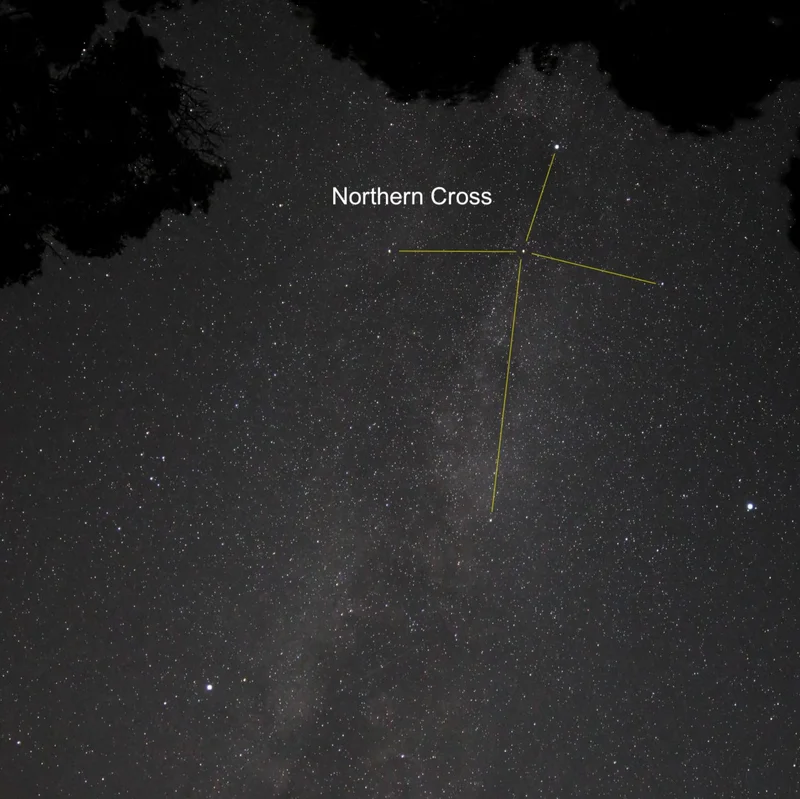
View at EarthSky Community Photos. \| Steven Bellavia captured this image from Mattituck, New York, on September 1, 2024. You can see the stars that form the asterism known as the Northern Cross. And you’ll notice the north-south portion of the cross follows along the Milky Way. Thank you, Steven.
We live in uncertain times. Look up! It’s peaceful. And please donate to help EarthSky keep going.
How to find the Northern Cross
The Northern Cross is an asterism, or noticeable pattern of stars within or overlapping a constellation. The Northern Cross is part of the constellation Cygnus the Swan. And it’s embedded within another, larger asterism: the famous Summer Triangle. It’s easy to see, even if your sky is less than perfectly dark.
Here’s step one for finding the Northern Cross. Look for the asterism’s most brilliant star, Deneb. Deneb marks the top of the Northern Cross. It’s also well known as one of the three bright stars of the Summer Triangle, along with Vega and Altair.
Now, look for a bright star roughly halfway between Altair and Vega and slightly offset toward Deneb. That’ll be Albireo. Although only a modestly bright star, Albireo is easy to see on a clear, dark night. There are no similarly bright stars near Albireo, so it’s fairly easy to find.
Once you locate Deneb and Albireo, you’re halfway to piecing together the Northern Cross. All you need now is the crossbar, which most people see as three moderately bright stars. Then as you can see in the illustration below, these three stars extend about halfway out into the wings of Cygnus the Swan.
The constellation Cygnus represents a graceful swan. But many also see it as a cross, and so these stars have become known as an asterism called the Northern Cross. The entire pattern fits inside a larger asterism created by the 3 bright stars Vega, Deneb and Altair: the famous Summer Triangle. Chart via EarthSky.
Backbone of the Milky Way
When you look at the Northern Cross, you’re looking directly into the flat disk of our galaxy, the Milky Way. In fact, the galactic plane (equator) runs right through the Northern Cross, encircling the sky above and below the horizon. So the Northern Cross serves as a great signpost for a view of our home galaxy. If you’re under a dark sky on a northern summer evening, the Milky Way appears as a luminescent river of haze passing directly along the length of the Northern Cross. You can see this hazy band stretching all the way across the sky on late July and August evenings.
You probably know that this haze is actually countless stars. So, these stars will emerge beautifully through binoculars, as will the star fields, star clusters and nebulae that abound within the disk of the Milky Way!
View at EarthSky Community Photos. \| Mohammed Abdallah in Suez, Egypt, used a telephoto lens to capture this view of the nebulosity surrounding the star Sadr, in the constellation Cygnus, on December 14, 2025. Mohammed wrote: “This is my shot of the Sadr region and the very distinct Butterfly Nebula (IC1318), which is very rich in Ha and has many star-forming regions. You can see below the Crescent Nebula too! I took this during the past several weeks. This is the best of the data from my backyard in Bortle 8.” Thank you, Mohammed!
Northern Cross as a marker of seasons
As seen from mid-northern latitudes, the Northern Cross is out for at least part of the night all year around. Plus, it’s out all night in summer. On Northern Hemisphere summer nights, the Northern Cross shines in the east at nightfall, sweeps high overhead after midnight, and swings to the west by daybreak. So when you see the Northern Cross in the east on summer evenings, it’s sideways to the horizon.
By the time northern autumn arrives, the Northern Cross is still out from nightfall until midnight, but it appears high overhead in the evening and sets in the northwest after midnight.
And when winter comes, the Northern Cross is standing upright over your northwest horizon before midnight.
The WyoAstro Allsky camera captured this shot of the July night sky – and Northern Cross – on July 5, 2026, from Wyoming. The Northern Cross is a clipped version of the constellation Cygnus the Swan. It’s an asterism, or pattern of stars. It lies embedded within another much larger asterism: the Summer Triangle, made up of the 3 bright stars Deneb, Vega and Altair. And when you look at the Northern Cross, you’re looking directly into the flat disk of our Milky Way galaxy. Used with permission.
Star chart
The constellation Cygnus appears in the lighter area. And 6 of its primary stars make the distinct pattern of the Northern Cross. On the right side of this chart you see the constellation Lyra the Harp with its brightest star, Vega. To use this chart on July or August evenings – when Cygnus is in the east – give the chart a single rotation to the left. Image via IAU and Sky \& Telescope magazine (Roger Sinnott \& Rick Fienberg)/ Wikimedia Commons.

Bottom line: The Northern Cross is an asterism – or recognizable pattern of stars – within the constellation Cygnus the Swan. And here’s how to find it in your sky.
Bruce McClure
About the Author:
Bruce McClure served as lead writer for EarthSky's popular Tonight pages from 2004 to 2021, when he opted for a much-deserved retirement. You can still find many articles at EarthSky.org that were originally written by Bruce, and which the EarthSky editors still update regularly. Bruce is a sundial aficionado, whose love for the heavens has taken him to Lake Titicaca in Bolivia and sailing in the North Atlantic, where he earned his celestial navigation certificate through the School of Ocean Sailing and Navigation. He also wrote and hosted public astronomy programs and planetarium programs in and around his home in upstate New York. Bruce he loves cycles of all kinds! You can still find many articles at EarthSky with Bruce's name on them, exploring the various, intricate cycles of the sky.