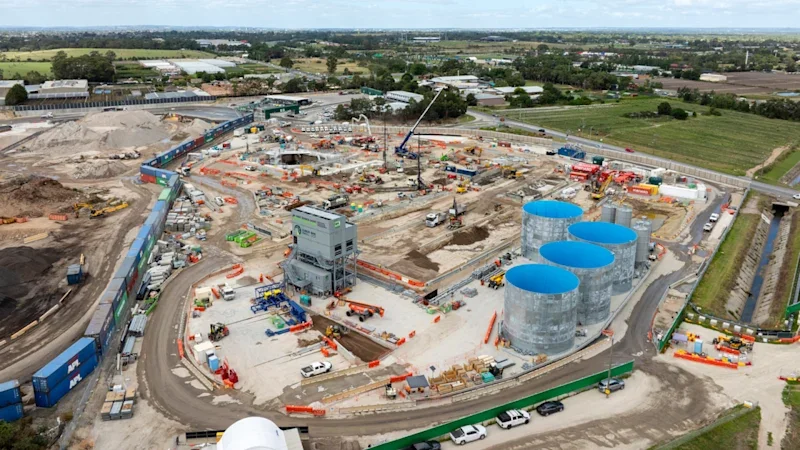
Asbestos and contaminated soil at two key Suburban Rail Loop sites are creating delays and have prompted heated discussions between construction companies and the authority in charge of the project about potential cost blowouts.
Three construction industry sources, speaking anonymously to avoid being blacklisted, said the soil conditions at Clarinda and Heatherton were creating headaches for the first stage of the project, an underground rail line from Cheltenham to Box Hill.
Clarinda is where tunnel boring machines will begin to dig the southern parts of the underground line, digging west towards Cheltenham and north-east towards Glen Waverley.
Heatherton, which sits between the Clarinda launch site and Cheltenham, is where a stabling yard will house the driverless trains earmarked for the project, and is along the tunnel’s route.
Suburban Connect, a consortium of CPB Contractors, Ghella and Acciona Construction, is responsible for the southern tunnelling contract.
Engineers were aware that land at the two sites was contaminated, but two industry sources said that over the past 12 months the company in charge of the sites had become concerned that asbestos and soil conditions were much worse than originally anticipated.
None of the contaminated land is believed to be dangerous to the community or workers, but stricter controls for handling it takes up more time and expense.
Part of the problem, two sources said, was that the Clarinda site had been chosen at a later stage of the project’s development.
In February 2025, the authority confirmed it had found an “alternative way” to construct the tunnels by moving the tunnel boring machine launch sites, and the significant construction associated, from Heatherton to the Alex Fraser Group Materials Recycling Facility and Transfer Station at Clarinda.
This meant the machines would be launched further away from homes and sewerage assets, which two sources said was also an effort from Suburban Connect to reduce costs.
Although the consultation process for this decision took place over 2023 and 2024, the site did not feature significantly in the environment effects statement for the project that was finalised in 2022. It was largely considered in the context of tunnel boring machines rather than excavation from the surface.
The sources said the soil issues had delayed work at the Clarinda site and had prompted tense negotiations with the Suburban Rail Loop Authority about overruns.
They said Laing O’Rourke, the construction company in charge of the rail loop’s early works, was also being blamed for the problem, prompting a three-way dispute over responsibility even as construction continued.
One source said it was likely Suburban Connect would seek cost overruns from the authority, which might then seek a payment from Laing O’Rourke.
The contaminated soil issue is one of the first public instances on the main rail loop project where there is a clear risk of builders claiming a blowout in cost.
The early works were initially costed at $2.2 billion, but appeared in the 2021-22 budget with an extra $159 million attached. By 2025, the Victorian Auditor-General revealed the cost was $2.5 billion, having identified additional funding not listed in the budget papers.
This week, The Age revealed tunnel boring machines at Burwood were due to begin digging within eight weeks, a watershed moment that Premier Ben Carroll will have to consider as he ponders whether to pause, cancel or alter the project.
Contracts for the construction of the loop’s first six underground stations were also due to be signed within months and are now in limbo as the premier weighs his options.
On Thursday, Carroll said he had no announcement to make but that “every dollar of my government will be invested where it delivers the greatest value for Victorians”.
“It will be invested responsibly, transparently, and respectfully,” he said.
A report from the Parliamentary Budget Office, commissioned by Libertarian MP David Limbrick, found that cancelling the project would improve the state’s budget position by $5.8 billion out to 2030 and $21 billion over 10 years.
But the report estimated the cost of terminating contracts would be $1.8 billion.
Limbrick said this showed there was still a chance for Carroll to cancel the project.
“Absolutely nobody in my electorate is pining for a train trip from Cheltenham to Box Hill,” he said.
Opposition transport infrastructure spokesman Evan Mulholland called on Carroll to publicly release the full costings of the project and confirm whether the first stage would cost $34.5 billion as was estimated in 2021.
“Since then, construction costs have increased by 20 per cent,” he said.
Mulholland also criticised Carroll for publicly supporting the project as deputy premier but now leaving the door open for changes.
“No one believes this premier,” he said.
In September 2024, the authority advised residents that workers had found materials with asbestos at the Heatherton site during investigation works. However, it was non-friable, so not at risk of becoming airborne.
It promised to safely remove the material from mid-September and undertake investigations if there was more asbestos on site.
A Suburban Rail Loop spokesperson said the presence of asbestos is common on worksites across Melbourne.
“Our contractors work closely with WorkSafe Victoria and EPA Victoria to ensure there is no risk to the public,” the spokesperson said.