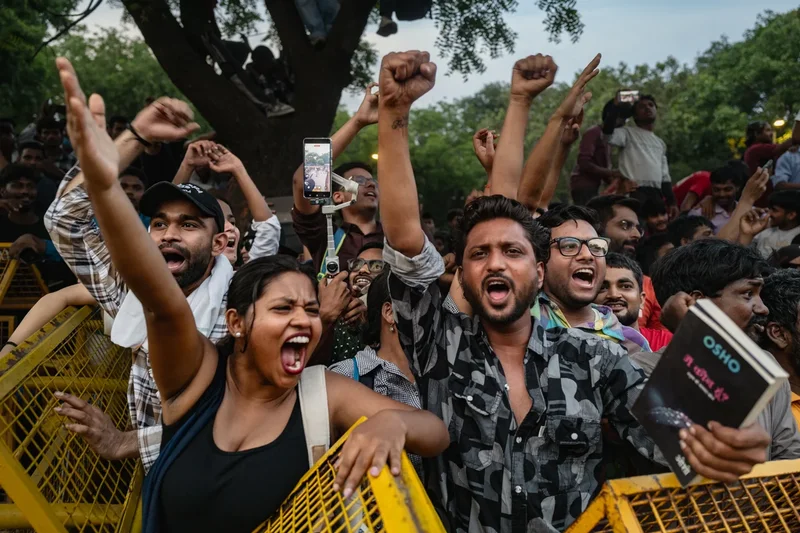
Police action against supporters of the recent Cockroach Janta Party (CJP)-led protests has reportedly intensified, with activists alleging nationwide crackdown on people who participated in the 36-day agitation.
A 25-year-old woman was booked for allegedly using "abusive and objectionable" language against prime minister Narendra Modi during the youth-led protests at Delhi’s Jantar Mantar on 23 July, according to the police complaint.
Local media reports quoted the police as saying that the woman from the Indian national capital's suburb of Noida, identified as Ruchika Singh, is absconding and is being traced.
Police in the southern Indian city of Hyderabad registered a case against Meta India’s head over Facebook posts that “depicted Mr Modi in an abusive manner”, a police official said on Friday.
Authorities are preparing to write to Meta as part of the investigation, V Aravind Babu, Hyderabad’s deputy commissioner of police for cyber crimes, said, according to Reuters.
The complaints allege that the manipulated content was derogatory, misleading, and capable of inciting public disorder.
Meta did not immediately respond to Reuters' requests for comment on Friday. The case adds to a string of tensions between Meta and Modi's government over content tied to the prime minister. India's IT ministry summoned Meta executives this week after Facebook briefly restricted Mr Modi’s post last week, with a top official saying the government wanted Meta to explain the matter at the highest level.
A Meta spokesperson said at the time that the post, which was Mr Modi's first where he addressed massive student protests that forced the resignation of the education minister, had been blocked inadvertently. Mr Modi has also come in for a barrage of online criticism, jokes and ridicule by protesters in recent weeks.
Protesters have said that authorities intensified detentions in the weeks following the agitation that forced the resignation of federal education minister Dharmendra Pradhan.
One of the protest’s best-known volunteers, 24-year-old law student Mohammad Junaid, approached the Supreme Court alleging that he was illegally detained, interrogated overnight and released the following day because of his role in organising the demonstrations.
In his petition, he has also alleged that police questioned his father and searched the family’s home. Ghaziabad Police have denied the allegations relating to the search, saying only that his father was questioned, the BBC reported.
Civil liberties groups and opposition leaders have criticised the police action, while CJP leaders have accused authorities of targeting volunteers after the protests ended.
The Delhi Police has not publicly responded to Mr Junaid’s allegations.
On Thursday, Delhi Police said no legal action would be taken against people who took part in the recent protests, provided they did not have a criminal record, according to News18.
The CJP is a youth-led satirical movement whose logo is an outline of a cockroach on a mobile phone. The group's 30-year-old founder, Abhijeet Dipke, says CJP was so named because of comments by Supreme Court Chief Justice Surya Kant comparing some unemployed youth to cockroaches. Kant later said he did not mean to criticise young people but was referring to those with “fake and bogus degrees” who were “like parasites”.
CJP spokesperson, Saurav Das, distanced the organisation from the alleged use of abusive language during the protests but criticised the use of criminal law against demonstrators.
“If any language used was derogatory in nature, then the person concerned is free to pursue civil and criminal defamation proceedings against the individual concerned. However, the use of the criminal justice machinery against protesters is highly condemnable, and no one should be punished merely for using objectionable language,” Mr Das was quoted as saying by Indian newswire Press Trust of India.
“The language may be wrong, and it may be objectionable to someone, but that is no reason to invoke the criminal justice machinery against such people. It creates a chilling effect. I don’t think this is acceptable to anybody, especially the younger generation,” he said.
“I would request the younger generation to be very careful about the words they use and the kind of insults or remarks they make against people in general,” he said.
Opposition Congress president and leader of opposition in upper house of parliament, Mallikarjun Kharge, called for the resignation of home minister Amit Shah over the police crackdown on CJP’s protests.
On Tuesday, India’s Supreme Court ordered the release of minors arrested during the protests and directed authorities to preserve CCTV footage after petitioners alleged police used excessive force against demonstrators.
Indian media reported that Mr Kant also ordered officials to preserve the digital and personal data of protesters and barred any coercive action against those who took part in the protests.
The reports said Mr Kant took interim steps in response to petitions filed by student protesters and activists seeking action against police and paramilitary forces for what they said was the use of excess force and pellet guns during the weeks-long demonstrations.
The government has, meanwhile, defended the police response, saying officers acted within the law to control the protests.
Solicitor General Tushar Mehta told the Supreme Court that allegations of students being assaulted were serious, but said around 250 police personnel were also injured.
The protests, triggered by the leak of question papers for a national medical college entrance exam, ended on Saturday after the education minister resigned and the government agreed to the protesters' demands for exam reforms, withdrawal of police cases, and compensation for families of students who died by suicide after the leaks.