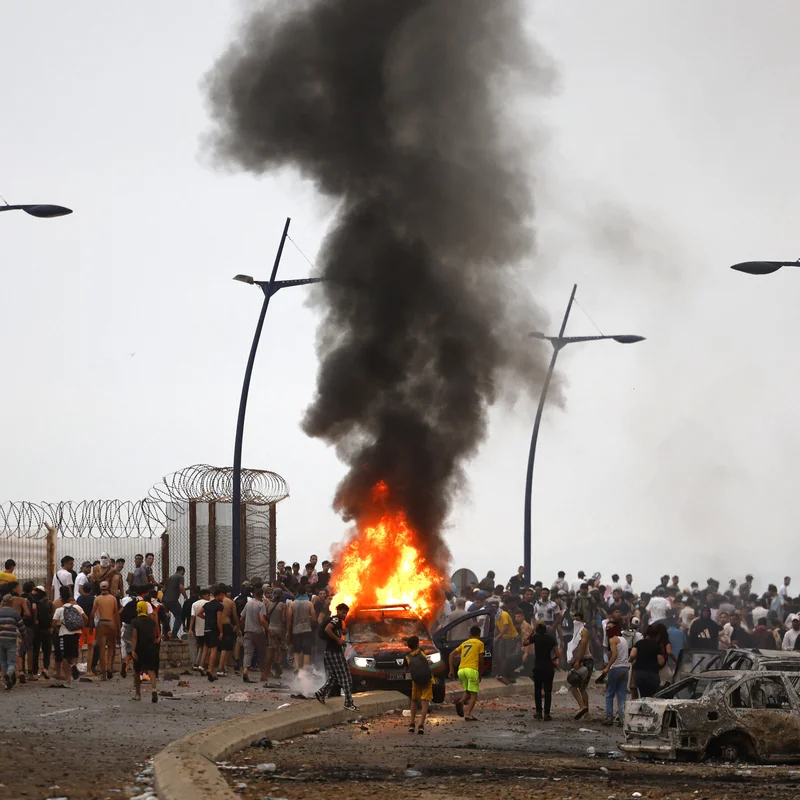
Ceuta, Spain11:55 a.m. July 31
Latest
Prime Minister Pedro Sánchez of Spain was set to arrive Friday morning in Ceuta, a Spanish enclave in North Africa, a day after thousands of migrants surged into the territory from neighboring Morocco, leading Spain to mobilize the military and setting off a deep political crisis for the left-wing government in Madrid.
Mr. Sánchez was expected to address what his conservative opponents have called an invasion of Spanish territory after migrants crossed the border by climbing over Ceuta’s border fences or swimming, sometimes for hours, to its shores.
Mr. Sánchez has developed an image as a pro-immigration liberal and Europe’s most prominent critic of the Trump administration’s hard line against migrants. He made global headlines this year by allowing more than one million migrants to apply to formalize their status.
Across Europe, right-wing critics of immigration cited the scenes from Ceuta to support their arguments against free movement. Giorgia Meloni, the prime minister of Italy who has taken a hard line against immigration, said the images from Ceuta were “shocking and demonstrate, once again, that uncontrolled illegal immigration poses a real threat to the security of Europe’s borders.”
She said that Italy was preparing to suspend an agreement with Spain that permits free movement between the two countries. Her foreign minister, Antonio Tajani, blamed Mr. Sánchez’s regularization initiative for incentivizing migration to Ceuta — prompting the Spanish foreign minister, José Manuel Albares, to summon Italy’s ambassador to Madrid.
Throughout Spain, Mr. Sánchez’s supporters and critics alike were asking how and why the border was so easily breached.
Spain has governed Ceuta, a six-mile-long peninsula on the tip of Morocco’s northern coast, for centuries. In recent years, as Morocco became a key staging ground for migrants seeking to reach Europe, Spain has depended on Moroccan border guards to stem the flow of arrivals.
Tensions have spiked in the past when Morocco appeared to let more migrants move toward Ceuta, a small enclave of about 83,000, to exert political pressure on Spain. In 2021, more than 10,000 people crossed into Ceuta in just two days.
Mr. Sánchez’s government has repeatedly sought to improve relations with Morocco, calling the country a loyal ally.
But migrants from Morocco to Ceuta started arriving in higher numbers again earlier this week, according to the area’s president, Juan Jesús Vivas. Then, on Thursday, many thousands swept into Spain, climbing over the fence, ducking through holes cut in it or swimming across the maritime border. At least 18 people died attempting to enter the territory, a spokesman for the Spanish government said on Thursday.
The arrivals were so numerous — and the potential political and security ramifications so serious — that the Spanish government on Thursday evening said that it had mobilized the armed forces to reinforce the severely overwhelmed police in Ceuta.
Madrid said in a statement that military platoons would enforce border security, that air and naval support would increase and that diving teams would patrol the waters. The European Union offered to send Spain support from Frontex, the bloc’s border and coast guard agency, to reestablish order.
Mr. Vivas told a Spanish radio station on Thursday, “We are in a situation of total humanitarian and social emergency.”
On Friday morning, images and footage of what the local government estimated was tens of thousands of arrivals spread around Spain. The nation’s conservative news media seized on a situation they had been warning about for years.
“Ceuta, Invaded,” blared the front page of the conservative newspaper ABC, over an image of thousands of people, mostly young Moroccan men, marching across a beach toward the Spanish territory.
Elisabetta Povoledo contributed reporting from Rome.
Thousands of migrants in recent days have crossed onto a tiny peninsula on Morocco’s coast that Spain has governed for centuries, aggravating tensions over a border that has long troubled the relationship between the governments of Madrid and Rabat.
At least 18 people have died so far in their attempt to reach Spanish soil, a government spokesman for Spain said on Thursday.
The peninsula, Ceuta, is one of only two cities on the African mainland that are officially part of Europe. In search of better economic prospects, thousands of migrants have scaled a 20-foot-high border fence into Ceuta or entered the territory by sea in mass crossing episodes over the years.
20 miles
spain
gibraltar
Strait of Gibraltar
Ceuta
morocco
portugal
spain
Atlantic
Ocean
Area of detail
morocco
algeria
western
sahara
libya
500 miles
mali
But so many migrants made the passage on Thursday that it prompted Spain to mobilize its military and ignited backlash from the country’s right-wing opposition, which accuses the government of Prime Minister Pedro Sánchez of being lax on border control.
We covered the news here. Here’s a guide to why Ceuta matters.
Why is Ceuta a crossing hot spot?
A six-mile-long peninsula on Morocco’s northern coast, Ceuta is a Spanish enclave fortified by a double fence and a Spanish police and paramilitary presence.
The city, along with Melilla, another autonomous Spanish city further east along the same coast, have the European Union’s only land borders with Africa.
That means both cities are places where migrants seeking better livelihoods, many of them from Morocco, frequently attempt to cross into Europe.
More than 10,000 people came over the border into Ceuta over two days in 2021, for example. In 2022, at least 23 migrants died in a stampede during an attempted mass crossing in Melilla. Many others have died at sea.
To get in, some migrants swim around the fences. Others take short, illicit boat trips to Ceuta from Morocco. But mostly, they run and climb the fence, or use bolt-cutters to cut through it, and are often spotted by motion detectors and guards in observation towers in the process.
(Here’s a fascinating story about Ceuta’s soccer team, which unpacks the territory’s relationship with Spain.)
What happened there this week?
Some 1,500 migrants had already entered Ceuta in recent days. But on Thursday, Fernando Rodríguez Contreras, a Spanish government official, said that what may have been tens of thousands of people crossed over, a working estimate that could not be confirmed. At least 18 of them died in the attempt, a Spanish government spokesman said.
Spain’s government said in a statement that it was dispatching military platoons to enforce border security, increasing air and naval support and sending diving teams to patrol the waters. The European Union offered to send Spain support from Frontex, its border and Coast Guard agency, to reestablish order.
Why does this mass crossing matter?
The African mainland border has been a major source of domestic political tension for the left-wing government of Mr. Sánchez and a diplomatic pain point between Morocco and Spain.
Domestically, Mr. Sánchez has sought to project an image of Spain as the West’s new melting pot. He has embraced immigrants, especially Latin Americans, who speak Spanish.
But on Ceuta, Mr. Sánchez has drawn criticism from anti-immigrant and conservative political opponents, who accuse him of being lax on border control — as well as pro-immigrant advocates who criticize the government for harsh immigration enforcement tactics.
Right-wing critics seized on the moment Thursday, blaming Spain’s new plan to give undocumented migrants already in the country a path to legal status for attracting illegal arrivals.
“This is an invasion,” said Santiago Abascal, the leader of the far-right party Vox, who accused Mr. Sánchez’s government of purposefully inviting in the migrants, who he suggested, without evidence, were criminals, rapists and potential left-wing voters.
The government, however, made clear for its part that the high volume of illegal crossings was not part of its vision.
On the international front, Spain is eager to keep up good relations with Morocco, in part to maintain its cooperation in deterring migrant arrivals. After the major crossing episode in 2021, Spanish government officials said that Morocco saw the migrants as a kind of currency, leveraging control over their movement across the border to extract financial and political prizes from Spain.
Hours after the migrants began pouring into Ceuta that year, Spain approved 30 million euros, about $37 million, in aid to Morocco for border policing.
It was unclear on Thursday evening what had prompted the latest amassing of people in Ceuta. Analysts said it was too soon to draw conclusions but that Morocco may have been upset about Spain’s recent effort to deepen ties with Algeria.
Thousands of migrants climbed over a border fence or swam onto the shores of Spain’s North African enclave of Ceuta on Thursday, prompting a mobilization of the Spanish military and fueling political tensions on the Spanish mainland.
In recent days, 1,500 migrants had entered Ceuta, a six-mile-long peninsula on Morocco’s northern coast that Spain has governed for centuries, according to the area’s president, Juan Jesús Vivas. At least 18 people have died attempting to enter the territory, a spokesman for the Spanish government said on Thursday.
20 miles
spain
gibraltar
Strait of Gibraltar
Ceuta
morocco
portugal
spain
Atlantic
Ocean
Area of detail
morocco
algeria
western
sahara
libya
500 miles
mali
The arrivals were so numerous — and the potential political and security ramifications so serious — that the Spanish government on Thursday evening said that it had mobilized its armed forces to reinforce the police in Ceuta. It said in a statement that it was dispatching military platoons to enforce border security, increasing air and naval support, and sending diving teams to patrol the waters. The European Union offered to send Spain support from Frontex, its border and Coast Guard agency, to reestablish order.
“We are in a situation of total humanitarian and social emergency,” Mr. Vivas told a Spanish radio station on Thursday.
On Thursday evening, the Ceuta government added in a statement that “this is an unprecedented situation that is testing our institutional response capacity and causing profound concern among the entire citizenry.” Fernando Rodríguez Contreras, an official in the government, said the working estimate for the number of people who had crossed was in the tens of thousands, though that figure could not be confirmed.
Migration at Ceuta, and at Melilla, another autonomous Spanish city in North Africa, has long been a point of tension between Morocco and Spain. The two areas constitute the European Union’s sole land border with Africa, and can draw large numbers of young men and other migrants seeking to enter the bloc. More than 10,000 people came over the border in two days in 2021, when the migration crisis reached its peak. In 2022, at least 23 migrants died in a stampede during an attempted mass crossing in Melilla. Many others have died at sea.
It was unclear on Thursday evening what had prompted the latest amassing of people in Ceuta. Analysts said it was too soon to draw conclusions but that Morocco, which controls migration flows across the border, may have been upset about Spain’s recent effort to deepen ties with Algeria. Right-wing critics blamed the Spanish government’s new plan to give undocumented migrants already in the country a path to legal status for attracting illegal arrivals.
What is clear is that the border, on the African mainland, has also been a major source of domestic political tension for Prime Minister Pedro Sánchez — both with anti-immigrant and conservative political opponents who accuse him of being lax on border control as well as pro-immigrant advocates who criticize the government for harsh immigration enforcement tactics.
Unlike the United States and some European neighbors defined by tough immigration stances, Spain’s left-wing government has projected an image of itself as the West’s new melting pot. It has embraced immigrants, especially Latin Americans who speak Spain’s language, share its religion and understand its culture. Some activists have argued that the warm welcome doesn’t extend to many Africans, and that Spain has a complicated historical relationship with Morocco, which accounts for the largest number of legal immigrants to Spain.
But the government made clear on Thursday that the high volume of illegal crossings was not part of its vision.
“The Spanish government is fully committed to providing an immediate response to the situation in Ceuta,” Mr. Sánchez wrote on social media on Thursday, as Spanish television stations broadcast footage of overwhelmed Spanish authorities watching as thousands of excited migrants streamed by.
The right-wing opposition seized the moment.
“This is an invasion,” said Santiago Abascal, the leader of the far-right party Vox, who accused Mr. Sánchez’s government of purposefully inviting in the migrants, who he suggested, without evidence, were criminals and rapists and potential left-wing voters.
The leading opposition party took a more measured tone but called on Mr. Sánchez to declare a national emergency.
“The situation in Ceuta is desperate,” said Alberto Núñez Feijóo, who leads the conservative Popular Party. “The government cannot shirk its responsibilities.”
Spain, eager to keep good relations with Morocco, in part to maintain its cooperation in deterring migrant arrivals, has downplayed criticism of the Moroccan government, saying that Morocco is helping prevent more people from entering Spanish territory. The Spanish government also said in a statement that it was directing more resources to the border, where the overwhelmed Spanish police and emergency services had been forced to focus only on treating those injured during the crossing.
Mr. Vivas, the Ceuta president, said the area’s reception centers and facilities for unaccompanied minors were overflowing.
Spain’s interior ministry said human-smuggling networks were seizing on a recent Supreme Court decision to encourage migrants to try to enter Europe through Spain. That decision barred the summary return of migrants intercepted at sea while attempting to reach the Spanish territories.
Spanish news media reports from Ceuta described some of those who had successfully completed the sea crossing as exhausted from the journey and near death, but others as jubilant, cheering “Long live Spain!” as they tossed flip-flops in the air or knelt to kiss Spanish soil.
But the footage of thousands of people, the vast majority of them young men, walking unencumbered onto Spanish territory touched a nerve for some in Spain and throughout Europe.
“The protection of the Union’s external borders is a crucial part of our efforts to fight illegal migration,” Magnus Brunner, the European Union’s commissioner for Internal Affairs and Migration, wrote on social media. “We are in contact with the relevant authorities on the evolving situation in Ceuta.”
Carlos Barragán contributed reporting from Madrid