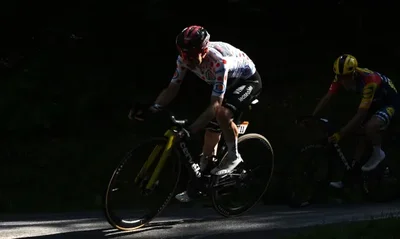
ÉVIAN-LES-BAINS, France — Exactly 84 minutes after Jonas Vingegaard spiked his right collarbone into a curb and limped into an ambulance and out of the Tour de France, the assembled press watched him gingerly wince his way down the steps of the Visma bus and into a waiting team car. A scrambled pack-job followed. A soigneur could barely hold the pile of backpacks and duffel bags he was carrying off the bus. A team doctor stood by holding two large red-and-yellow first-aid kits, adopting the tense posture and alert facial expressions of someone who knows they can't help but desperately wants to. The eventual driver nearly spilled Vingegaard's stuff all over the tarmac of a wholly unremarkable road, in an unremarkable town, at the base of the final climb of Stage 15 of the Tour de France. And then the two-time champion was off to the hospital.
For the first time since his 2021 debut, Vingegaard has abandoned the Tour. When something as shocking and painful as Vingegaard's crash happens, there is an understandable rush for a totalizing explanation or some form of oblique narrative resolution. That's especially true on an already-fraught day for Vingegaard at the Tour. Surely the crash can be explained to satisfaction, clear blame divined, verdicts rendered, lessons learned. Surely there's some way to then frame that resolution against Vingegaard's future hopes or past triumphs such that it means something. But there's only false refuge to be found down that road. When Vingegaard fell with 22 kilometers left on Sunday, he simply found himself subject to the mundane cruelty of his sport.
Vingegaard was pretty clearly not going to be relieve Tadej Pogacar of the yellow jersey in the final week of the Tour, but he and his team were having a go of it nonetheless when the crash happened. Victor Campenaerts was pulling hard at the front of the peloton, 11 kilometers from the foot of the Solaison, in an attempt to bring back the strong breakaway up the road. They encountered a normal roundabout—my colleague Iain Treloar later overheard Vingegaard's teammate Sepp Kuss saying "There are 100 roundabouts like that every day"—and the leading race motorcycle took an outside line around the cobbled triangle splitting the corner. Campenaerts blindly followed instead of judging the correct line.
All it took was a moment's error for disaster to strike. Campenearts had to brake coming into the corner, which meant that while he'd be safe, the accordion effect dictated that someone was going down. Vingegaard was the first and hardest to fall.
He was in the ambulance and out of the race almost instantly. FranceTV cut into a commercial break to show it, and a shocked hush fell over the press room, followed by the quickest display of hustle back to laptops I've seen from the cheese-addled press corps in two weeks.
After the race, Visma's management understandably didn't want to talk about it. We huddled around the team bus, only to be referred by a terse PR staffer to the team's earlier statement. When that understandably didn't deter the horde, Visma's director Marc Reef came out to talk to us. He blamed the motorcycle for brake-checking Campenaerts, and while I understand why he'd try to make that case, that's pretty clearly not what happened. But the big question people wanted to ask Reef, the one that Pogacar, stage-winner Remco Evenepoel, and pundits around the world also posed, wasn't about whether a motorbike caused Vingegaard to crash, but instead whether a knock on the door in the middle of the night did.
Very early Sunday morning, anti-doping authorities woke Vingegaard and Pogacar up at, respectively, 2 a.m. and 5 a.m. The unannounced tests came outside of the normal 6 a.m.–11 p.m. window, a deviation which the International Testing Authority is only allowed to make upon "serious and specific suspicion that the rider may be engaged in doping." We don't know the results of the blood tests, and per an ITA statement, their justification seems mostly proprietary. Both riders grumbled about having their sleep disrupted before such an important stage, though everyone connected to both riders also stressed that a night of jumbled sleep was a fair price to pay for the public's continued trust in their performances.
Many current and former riders were outraged by the tests. "It's actually something we cannot accept as riders," said Remco Evenepoel. "I would say, to be honest, if I would have had it, I would send my team tonight to wake them up as well, at 3:00 in the night, to let them feel how it is, and take blood at 2:00 in the night because like I say, it's something inhuman." Australian TV commentator Robbie McEwen called it a "borderline violation of human rights." In his yellow jersey presser, Pogacar gave the longest answer to any question he's given all Tour, going into an intriguing level of detail about how the testing regimen he and his fellow elite riders are subject to is different and more demanding this year. Like McEwen, he also brought up Vingegaard's "inhuman" wake-up, unprompted, as a possible explanation for the crash. "It ruined his sleep," he said. "It got me thinking that it could also be a small percentage why he crashed because he probably didn't sleep well today."
As tempting as it is to draw that connection, the two events had nothing to do with each other. There wasn't a thing Vingegaard could have done to avoid the crash. It was simply something that happened to him. The crash is especially painful because Vingegaard knows the brutality of his sport as well as any professional rider, from both a physical standpoint and a competitive one.
As to the former, Vingegaard has said this was the first season he's felt normal since a crash that nearly killed him at the 2024 Tour of the Basque Country and a concussion he sustained the following year. Part of that is physical recovery, but a critical part is his having been able to wrest a little control of his life back from the tremendous demands of his profession. "I said last year that if this was how it was going to be, I couldn't do it anymore," he told Danish broadcaster TV2. The time away from his family, the restrictive diet, and the monastic isolation in alpine hermitages that any top-level cyclist has to accept in order to compete had taken their toll, and he was ready to leave the sport before he turned 30. The late-night doping tests are also another indignity he has to endure to compete at this level. Again, we don't know why he was tested, though running second at the Tour de France is, in the eyes of the authorities, a worthwhile justification for knocking on his door.
That's what Vingegaard had to accept all over again to come back to the Tour de France and challenge Pogacar, and though it seemed like he was going to fall short again, he had quite the moment of redemption with two early days in the yellow jersey and he was running in second place when he crashed. It can be easy to underrate the performances Vingegaard has put together at the Tour, not just in his first three go-rounds, when he finished second to Pogacar then beat him twice in a row, but in the last two-and-a-half editions, when he stood no chance against a fully activated Pogacar. It is impressive to even challenge a rider like that, and it was also quite the feat this year for Vingegaard to hold off the snarling pack of challengers behind him in the general classification standings. Were he to stay upright and battle it out with a newly mature Evenepoel and the foreboding child duo of Paul Seixas and Isaac del Toro, he'd have earned his most impressive silver medal yet. That's not the yellow jersey, but it would have been something worth sacrificing for.
Jonas Vingegaard is a rider who has known pain, and now he knows it anew. There's nothing to feel as he exits the race but sadness—not indignation, not righteous anger at the testers or the motos, not assurance that he'll roll that boulder up that hill again. I don't know if this is the end of Vingegaard as a Tour competitor, but I do know that he's done enough to earn our admiration forever.