There are a number of things in the Universe that could wipe out life as we know it, but — for now, and for Earth — a blast from our galaxy's supermassive black hole isn't one of them. That's not to say that Sagittarius A* doesn't pose a danger. If it wakes up someday and blasts out a strong wind, that definitely could affect Earth. It could well have powered a quasar in the past, and could do so again.
What could happen? Let's see what happens with another quasar that is affecting its environment. A team of astronomers from Tohoku University, Tokyo Metropolitan University, and Kanazawa University in Japan studied the quasar H1821_643 and its activity. This quasar lies about 3.4 billion light-years away from us in the direction of the constellation Draco. They found that its explosive winds can carry energy well beyond the borders of its host galaxy.
That's a much more vigorous effect than astronomers thought. "Black holes are largely known for sucking matter in, but they also eject gas in the form of powerful winds," says Satoshi Yamada, Assistant Professor at Tohoku University's Frontier Institute for Interdisciplinary Sciences (FRIS). "These winds were thought to be contained within the galaxy, but our study revealed that the force is immensely more powerful than previously understood."
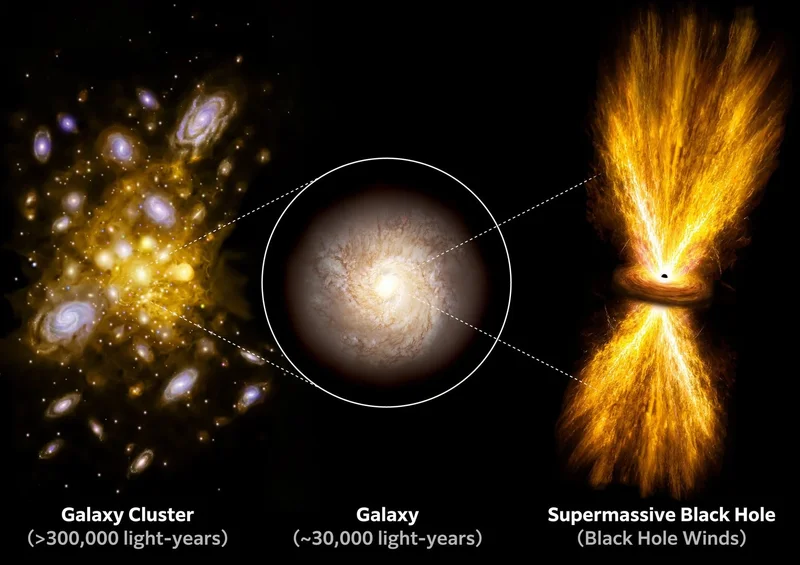
Conceptual illustration showing a "blast" driven by a supermassive black hole hidden at the center of a galaxy, with its energy propagating beyond the galaxy and into the surrounding galaxy group environment. The illustration depicts the transport of an enormous amount of energy - equivalent to several billion supernova explosions - into the surrounding space, driving the violent motion of hot gas extending out to distances of approximately 300,000 light-years. Credit: Tohoku University, used by permission.
About Quasar H1821+643
Like other quasars, this one is powered by an extremely active supermassive black hole in a galaxy at the heart of a massive cluster. As this one gobbles up material, it ejects strong winds and drives turbulent activity in a hot gas cloud surrounding the black hole. The cloud itself gives off X-rays. The astronomy team used the XRISM satellite to take spectra of the gas cloud and were able to map its motions by tracking ionized iron in the region.
They found that the high-temperature gas cloud is in constant motion. Due to the turbulence whipped up in the cloud, it tends to get dispersed across a wide area of space. The flow actually extends past the host galaxy at the heart of a heavily populated cluster. In some regions, the gas flow reaches out about 300,000 light-years away. That's three times the estimated width of the Milky Way Galaxy. According to Yamada, this is a rare finding. "For the first time, we have shown that black holes influence the broader cosmic environment through a shock wave of astonishing power," Yamada explained. "Black holes are key drivers of gas flows and motion in space, transporting vast amounts of energy to different regions of the cosmos."
The Effects of Quasars
The quasar population contains the most luminous objects we can detect, and there are more than a million of them known. The black holes at their hearts are the engines that power and brighten up the galaxy that hosts them. Their extreme activity affects the evolution of the host galaxy, often by gobbling up star formation material, or — as in the case of H1821+643 — sending out hot winds that stretch across a galaxy cluster.
Quasars mainly exist in the distant Universe. The light from the most distant early ones tells a story of galaxy formation and evolution at a time when the Universe was extremely young. It turns out that many (if not most) big galaxies went through a phase of their evolution as quasars, thanks to their embedded supermassive black holes. There is even a chance that our own Milky Way could have gone through an active phase around six million years ago, but whether that qualifies it as a quasar is a separate question to be answered. It's possible that in its infancy, our galaxy went through a quasar phase billions of years ago. Its effects could lie in the existence of a hot fog in the region.
This artist's concept depicts a distant galaxy with an active quasar at its center. Hubble found that the radiation pressure from the vicinity of the black hole pushes material away from the galaxy's center at a fraction of the speed of light. The "quasar winds" are propelling hundreds of solar masses of material outward into the galaxy disk each year. This affects the entire galaxy as the material snowplows into surrounding gas and dust. Credit: NASA, ESA, and J. Olmsted (STScI)
Quasar activities can affect stellar population growth rates. They actively gobble down material that could have made stars. Conversely, as they suck in material from surrounding regions, that material can clump together to create stars. Those aren't the only quasar effects astronomers see. In the future, Yamada and other astronomers hope to delve further into these behemoths using multi-messenger observations. Since quasars give off emissions across the electromagnetic spectrum, each wavelength of light should reveal more secrets of these bright, distant objects that ruled the infant Universe.