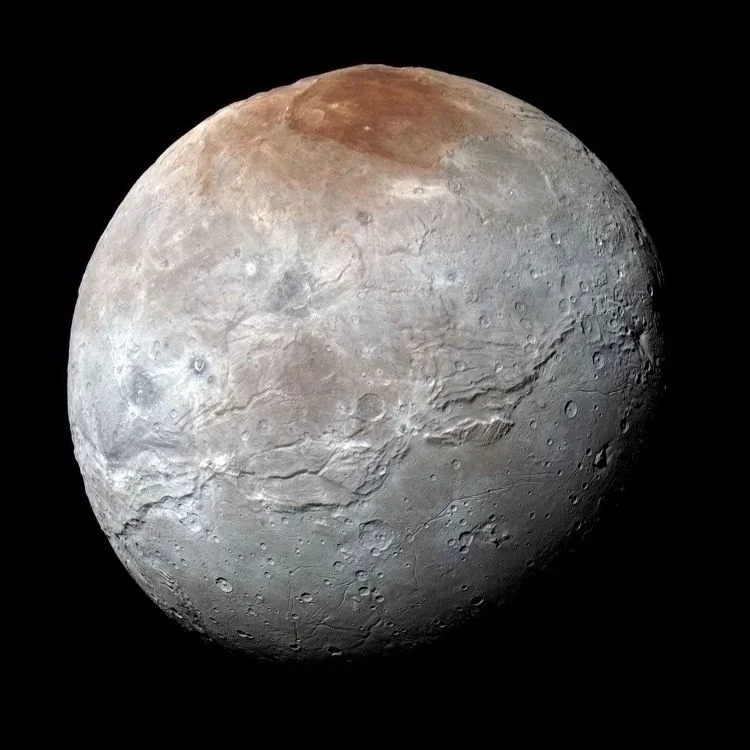
Plutoâs moon, Charon, is one of the most unexplored (and arguably underappreciated) planetary objects in the entire solar system. This is primarily because itâs only been visited once by NASAâs New Horizons spacecraft during its famous Pluto flyby in July 2015. Despite this quick encounter, New Horizons beamed back troves of data regarding Charon that scientists continue to pour over with the goal of gaining insight into Charonâs formation and evolution. This is because Charon is the largest moon compared to its parent body in the solar system, noted by it being half of Plutoâs diameter and one-eighth of Plutoâs mass.
Now, a team of scientists from the University of California, Los Angeles might be one step closer to piecing together Charonâs history, which could also contribute to the early histories of other outer solar system moons. Essentially, Charon is being used as a âtestbedâ for the formation and evolution of other outer solar system icy moons, with these findings being recently published in Nature Communications.
This is because Charonâs surface has been relatively undisturbed compared to other outer solar system moons, which have been blasted by resurfacing events like impact craters or internal heating. Additionally, Charonâs equator exhibits unique fault patterns, which scientists have hypothesized since the 1970s to be caused by Charonâs rotation initially starting fast but slowing down over time, also called despinning.
For the study, the researchers used a series of computer models to simulate Charonâs early history with the goal of confirming the despinning hypothesis or other factors that resulted in Charonâs present-day surface features. The researchers specifically focused on Oz Terra, which is a geologic region in the northern hemisphere of Charon featuring mountainous and fractured terrain that is vastly different from Charonâs much smoother southern hemisphere, Vulcan Planitia.
In the end, the researchers found that Charon potentially exhibited an initially ice shell thickness of about 30-36 kilometers (18-22 miles) while potentially having an initial rotation period of 14.3 hours. For context, Charonâs current rotation period is about 6.4 days (153.3 hours), which means Charonâs rotation in its early history was more than 10 times what it is today. This despinning could confirm the longstanding hypothesis that Charonâs notable geologic differences between the northern and southern hemispheres. Finally, the researchers note this despinning occurred prior to any cryovolcanism that might have erupted on Charon, indicating the despinning potentially occurred very early in Charonâs history.
The study notes, âOur work presents an approach for quantifying despinning-induced strain and stress on planetary bodies by adapting structural geology techniques developed for terrestrial settings. The distribution of tectonic provinces on Charon suggests that despinning was accompanied by global contraction, supporting a cold start for Charon. Although our work provides a plausible explanation for the tectonic patterns preserved in Charonâs northern highlands, further studies are needed for a more comprehensive understanding of the thermal-mechanical evolution of the crust.â
Discovered on June 22, 1978, at the United States Naval Observatory by American astronomer James W. Christy, it took only a few weeks for the International Astronomical Union to announce the discovery to the world. As noted, NASAâs New Horizons spacecraft is the only spacecraft to visit Charon during the historic Pluto flyby. However, those images and this study build on a growing body of knowledge about Plutoâs largest moon and could help scientists slowly piece together the formation and evolution of other icy outer solar system moons, including moons orbiting Jupiter, Saturn, Uranus, and Neptune.
What new insights into Charon and other solar system moons will researchers make in the coming years and decades? Only time will tell, and this is why we science!
As always, keep doing science & keep looking up!