Your support helps us to tell the story
From reproductive rights to climate change to Big Tech, The Independent is on the ground when the story is developing. Whether it's investigating the financials of Elon Musk's pro-Trump PAC or producing our latest documentary, 'The A Word', which shines a light on the American women fighting for reproductive rights, we know how important it is to parse out the facts from the messaging.
At such a critical moment in US history, we need reporters on the ground. Your donation allows us to keep sending journalists to speak to both sides of the story.
The Independent is trusted by Americans across the entire political spectrum. And unlike many other quality news outlets, we choose not to lock Americans out of our reporting and analysis with paywalls. We believe quality journalism should be available to everyone, paid for by those who can afford it.
Your support makes all the difference.
Read more
President Donald Trump has touted his new "Trump Accounts" as a way to help lift children out of poverty and give more Americans a stake in the stock market. But as he hits the road to promote the program, some parents say they're still waiting for the promised $1,000 from the federal government.
Trump is set to visit a Georgia high school on Wednesday to highlight the accounts, which provide a $1,000 government-funded investment for children born during his second term. The program launched on July 4 under Trump's "One Big Beautiful Bill."
The tax-advantaged accounts are available to children under 18, with the Treasury Department saying 6.5 million families have signed up. About 1.5 million children born between 2025 and 2028 qualify for the $1,000 seed payment.
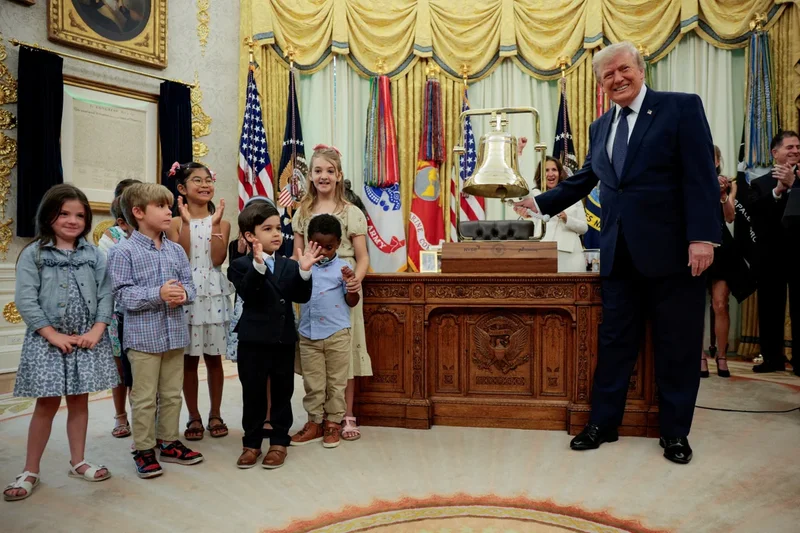
President Donald Trump rings the opening bell for the New York Stock Exchange (NYSE) and Nasdaq during an event to mark the launch of "Trump Accounts" in the Oval Office (Reuters)
Parents, relatives, friends and employers can add money to the accounts, which are invested in stock market index funds managed by private firms. The money generally can't be accessed until the child turns 18 and can then be used for education, buying a home or starting a business.
But some parents say the government's contribution has been slow to arrive.
Masaki and Kristina McLellan of Bergen County, New Jersey, opened an account for their daughter, Maya, who was born in March.
Trump spoke about his family's income on Monday as he attended a White House event for the launch of tax-free investment accounts for children (AFP/Getty)
After an initial application was rejected, Masaki McLellan spent an hour on the program's hotline before activating the account. He said he was first told the $1,000 would arrive within 10 days but was later told it could take up to four weeks.
The Treasury Department said the delay reflects standard processing times, comparing it to waiting for a tax refund. Officials said most families receive the money within one or two days, but longer estimates are sometimes provided.
"Trump Accounts level the playing field by allowing every parent to invest in their children's future, not just wealthy families with trust funds," the department said, calling the accounts the most successful government-backed savings product in U.S. history.
Trump appears on a screen at the Nasdaq MarketSite during a live stream, on the day he rings the opening bell for the New York Stock Exchange (NYSE) and Nasdaq during an event at the White House to mark the launch of "Trump Accounts" (Reuters)
Trump's push comes as Republicans face growing scrutiny over the economy ahead of next year's midterm elections. An AP-NORC poll in June found just 33% of U.S. adults approved of Trump's handling of the economy.
The accounts resemble "baby bond" programs launched in some Democratic-led states and cities, but unlike those initiatives, Trump's program is available regardless of family income.
Critics argue it does little to help families with the immediate costs of raising young children and note that the same legislation creating the accounts also cut funding for programs such as Medicaid and the Supplemental Nutrition Assistance Program that many families rely on.