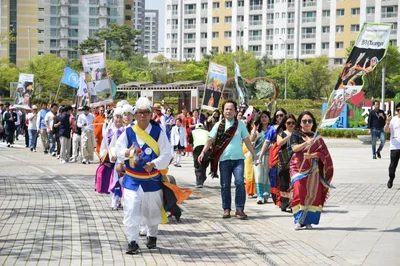
Members of the Jumma community in Korea march with traditional Korean performers in a parade at the Boi-Sa-Bi festival in Gimpo, Gyeonggi Province, April 19. Courtesy of Bereket Alemayehu
The new year is celebrated by Bangladesh's Indigenous Jumma community annually in mid-April, in a three-day festival called Boi-Sa-Bi.
Here in Korea, the Jumma community held its own Boi-Sa-Bi year-end and new year celebration for the 21st year on April 19 at Hangang New Town Lake Park in Gimpo, Gyeonggi Province.
Organized by the Jumma People's Network Korea (JPNK), established in 2002, and the Gimpo City Foreign Residents' Support Center, the celebration opened with a traditional flower-offering ceremony, a peace march featuring representatives of all 11 Jumma ethnic groups, and a samul nori (Korean percussion) performance by the Kkogume Pungmuldan troupe.
The most important traditional festival of the Jumma peoples, Boi-Sa-Bi is short for Boishuk Sangrai Bizu, a combination of the first syllables of the names for traditional new year festivals of three ethnic groups in Bangladesh's Chittagong Hill Tracts (CHT): Bizu for the Chakma people, Sangrai for the Marma people and Boishuk for the Tripura people.
It is observed on the final two days of the old year on the local lunar calendar and on the first day of the new year, embodying the Jumma values of forgiveness, compassion, equality, peace and ethnic solidarity, a celebration of cultural identity and the hope of a new beginning.
JPNK President Chakma Nikhil gave a speech welcoming all participants to the new year festival and expressed his sincere gratitude for their presence.
Chakma Nikhil, president of the Jumma People's Network Korea, attends a Boi-Sa-Bi festival in Gimpo, Gyeonggi Province, April 19. Courtesy of Bereket Alemayehu
He shared that the Jumma community has been able to settle in Gimpo, which he called their "second hometown," thanks to the care, love and solidarity of its citizens. He emphasized that this achievement is the result of the dedication and resilience of those who have worked hard since 2002 and continue to contribute today.
Reflecting on recent years, he mentioned that last year’s festival could not be held as planned in the aftermath of devastating forest fires in Korea. Despite ongoing global economic challenges caused by international conflicts, he expressed hope and joy that this year’s festival could be celebrated in a spirit of peace and renewal.
He highlighted that the festival is not only a cultural celebration but also a meaningful occasion to promote peace and inspire hope worldwide. He also praised Gimpo City for its designation as a multicultural city and its continued efforts to support diversity and inclusion. Through events such as the festival and various community programs, he noted that people can learn and embrace important values such as honesty, compassion and fairness.
In closing, he expressed a heartfelt wish for peace around the world and encouraged everyone to work together to make Gimpo a healthy and strong community.
Traditional Korean percussion musicians perform at the Boi-Sa-Bi Festival in Gimpo, Gyeonggi Province, April 19. Courtesy of Bereket Alemayehu
The Jumma people are the Indigenous inhabitants of the CHT in southeastern Bangladesh, comprising 11 distinct ethnic groups. Numbering approximately 900,000 — less than 1 percent of Bangladesh's total population of some 170 million — they are distinct from the Bengali majority in ethnicity, language, religion and culture.
Since the forced displacement of approximately 100,000 people caused by the construction of the Kaptai Dam in 1960, the Jumma people have faced ongoing human rights violations, including ethnic cleansing policies, unlawful detention, torture and land grabbing. Thousands have been displaced, and Jumma communities are now settled across India, Korea, Japan, Oceania, the United States, Europe and beyond.
JPNK supports Jumma migrants and refugees living in Korea, advocates for their rights and promotes cultural exchange and broader awareness of Indigenous peoples' issues.
Bereket Alemayehu is an Ethiopian photo artist, social activist and writer based in Seoul. He’s also the co-founder of Hanokers, a refugee-led social initiative, and a freelance contributor for Pressenza Press Agency.