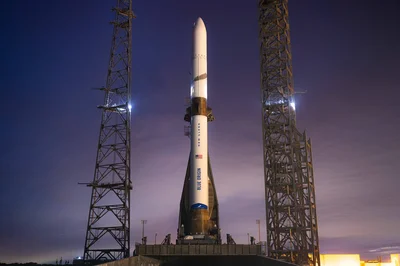
Blue Origin's New Glenn rocket nailed the landing this weekend, but failed at the crucial part of delivering a satellite to a usable orbit.
The rocketmaker, owned by Amazon kingpin Jeff Bezos, launched its New Glenn rocket on Sunday. The weekend outing marked the third launch as well as the company's first attempt to reuse a first stage. Everything went well until the part where the satellite, AST SpaceMobile's Bluebird 7, was supposed to be sent into its desired orbit.
The first stage landed successfully on Blue Origin's Jacklyn floating platform, but the fate of Bluebird 7 was left up in the air... or not, as the case turned out to be.
After a pause, Blue Origin admitted via its social media mouthpiece that the satellite did separate from the second stage and was powered on, yet it was in an "off-nominal" orbit.
AST SpaceMobile later confirmed the satellite's orbit was lower than planned and it would be unable to reach a usable location with its onboard thrusters. It said it is going to de-orbit the sat, and confirmed: "the cost of the satellite is expected to be recovered under the company's insurance policy."
Bezos's crew launched the rocket at 1125 UTC on Sunday, April 19, from LC-36 at Cape Canaveral Space Force Station in Florida.
Blue Origin has not yet explained what happened to the second stage, nor explained the impact on its manifest. It has launches scheduled for Starlink rival, Amazon Leo, another AST SpaceMobile mission, and a Blue Moon demonstrator. The Blue Moon is a robotic lunar cargo lander.
The lander will then demonstrate an uncrewed landing on the Moon, an essential step for future missions. NASA's Artemis III is due to launch in 2027 and conduct demonstrations with lunar landing technologies. It is unclear what this weekend's failure will mean for Blue Origin's role in those demonstrations.
The landing and reuse of an orbital-class rocket is an achievement, however, the loss of the payload eclipses that success. BlueBird 7 was AST SpaceMobile's eighth spacecraft deployed into low Earth orbit and was set to become part of its space-based cellular broadband network. BlueBird 1-5 were all launched on Falcon 9 rockets before the company turned to India's LVM3 launcher for the heftier BlueBird 6.
According to AST, BlueBird 8-10 are "expected to be ready to ship in approximately 30 days."
AST SpaceMobile has also launched a pair of BlueWalker prototype satellites using Indian and SpaceX rockets. ®