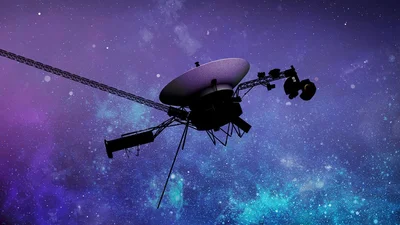
NASA’s Jet Propulsion Laboratory had to turn off Voyager 1’s LECP, or Low-energy Charged Particles experiment, in a bid to reduce power consumption as its nuclear power source continues to lose power over time due to aging. According to the government agency, an unexpected drop in power levels forced the team to reduce the number of instruments on board and prevent it from activating its undervoltage protection system. This would force the spacecraft to deactivate components on its own and require manual intervention from the flight team to ensure that it can continue operating until (and, hopefully, beyond) its 50th year in space.
The LECP measures ions, electrons, and cosmic rays from our solar system and the surrounding areas, which, NASA says, “has provided critical data about the structure of the interstellar medium, detecting pressure fronts, and regions of varying particle density in the space beyond our heliosphere.” While this has been a useful instrument aboard the Voyager 1, the spacecraft is slowly running out of fuel, requiring NASA to pick and choose which ones it will leave running to increase its longevity.
This space probe is powered by a radioisotope thermoelectric generator (RTG), its nuclear power source, which converts the heat of decaying plutonium into electricity. Its onboard RTG had around 470 watts when it launched in 1977 for a five-year mission, and it’s estimated that it loses about 4 watts annually. Universe Todayestimated in 2019 that Voyager 1 still had under 270 watts left, about 57% of its onboard power, so it’s expected to have even less today.
Article continues below
There shouldn’t have been an issue with this, but a planned roll maneuver in February caused a sudden drop in power. While this wasn’t a foreseen event, NASA scientists already have several planned contingencies for cases like this, which include turning off the LECP. The team did not fully shut off the instrument, though — it left its small motor, which only consumed 0.5 watts, turned on so that it’s easier to reactivate the LECP if they wanted to.
This might sound surprising, as Voyager 1 is more than a light-day away from Earth, and refueling it is next to impossible. However, engineers are working on an “ambitious energy fix” called “the Big Bang.” The idea is that several powered devices on both Voyager 1 and 2 will be swapped out simultaneously for lower-power alternatives. This should make the probes more power-efficient and help their RTGs potentially last longer. It will first be implemented on Voyager 2, which is closer to our planet, and if successful, the fix will be deployed on Voyager 1, too. If all goes well, then there’s a chance that the LECP can be turned back on, allowing the old spacecraft to continue its mission well past its supposed retirement date.
Follow Tom's Hardware on Google News, or add us as a preferred source, to get our latest news, analysis, \& reviews in your feeds.
Get Tom's Hardware's best news and in-depth reviews, straight to your inbox.