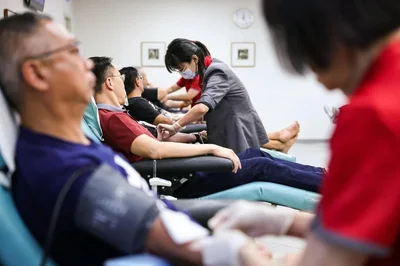
SINGAPORE - Rewarding blood donors with monetary incentives requires a delicate balance to avoid undermining the noble act.
The Health Sciences Authority (HSA) and the Singapore Red Cross (SRC) announced on April 15 that Healthpoints will be awarded to blood donors from the second half of 2026 as one of the new measures to recognise and enhance donor experience, especially against the backdrop of a possible blood supply crisis looming in 2033.
Healthpoints can be used to redeem e-vouchers for public transportation or for purchases at some food outlets and supermarkets; as well as redeem MediShield Life premium discounts.
Concerns have been raised, including whether tying donations to rewards would risk undermining the core principle that blood donation should remain a voluntary and altruistic act.
This is the basis in Singapore, where HSA says on its website that there is a voluntary and non-remunerated blood donation (VNRBD) policy – donors donate of their own free will and do not receive any incentives. This ensures donors are honest about their medical history and any high-risk social activities they may have engaged in.
“If donors were paid or given incentives, they might be tempted to withhold important information. This could put both the donor and the person receiving the blood at risk”, says HSA.
This policy is also aligned with the World Health Organization (WHO) and the International Federation of Red Cross and Red Crescent Societies.
WHO released a global framework for action towards 100 per cent voluntary blood donation in 2010.
It stipulated that a voluntary, non-remunerated donor gives blood, plasma, or cellular components of his or her own free will and receives no payment, whether in cash or in kind, such as time off work beyond what is needed for the donation and travel.
WHO said, however, that “small tokens, refreshments and reimbursements of direct travel costs” are compatible with voluntary, non-remunerated donation, without pegging any monetary value to such gestures.
Madam Ng Cheng Hoon wrote to the Straits Times Forum page to express her concern that introducing incentives may unintentionally shift motivations, and financially constrained individuals may feel pressured to donate in exchange for the rewards.
Speaking to ST, the housewife in her 60s said even if the rewards are low in monetary value, people may over time view donation as an act for a benefit, rather than out of goodwill, and “this could slowly change the spirit of giving”.
Senior public health physician Chew Suok-Kai expressed similar concerns and added that the Human Organ Transplant Act explicitly prohibits the trading of organs and blood.
Dr Chew had served as the deputy director of medical services at the Ministry of Health, and was a senior advisor at the Ministry when he retired in 2022. The director of medical services, now redesignated as director-general of health, is the nation’s chief medical adviser.
“If the rewards can be monetised, this is akin to buying and selling blood, regardless of its dollar value,” said Dr Chew, who noted that the small tokens of appreciation given to donors now, such as medallions, are not directly monetisable.
HSA and SRC explained in their forum letter reply that blood donors have always been appreciated through non-financial modalities such as tokens of appreciation, and the introduction of Healthpoints is “an extension of this same spirit of appreciation”.
In a separate reply to ST, HSA said all donor recognition initiatives, including Healthpoints, are consistent with the WHO’s definition of VNRBD.
It, however, did not provide details of the rewards that qualify as “small tokens of appreciation”, which it has said will be announced in June.
Asked how it could avoid a situation in which donors may misrepresent themselves to get Healthpoints, the HSA pointed to the legal safeguards in place.
“All donors are required to complete a questionnaire before every donation and make a health declaration related to their donation”, said HSA.
Under the Infectious Diseases Act, persons who provide false or misleading information related to a blood donation may face penalties of a fine of up to $20,000 and/or imprisonment of up to two years, upon conviction.
Ethicists interviewed by ST lent their support for showing appreciation to donors with Healthpoints of monetary value.
Professor Julian Savulescu, head of the Centre for Biomedical Ethics at the National University of Singapore’s Yong Loo Lin School of Medicine, said where altruistic schemes fail to deliver sufficient supply, it can be important to incentivise donation.
He cited an example of how in recent years, Germany has moved to incentivise plasma donation, as there are sometimes shortages.
He said some countries will import blood and blood products at times of shortage from countries that do incentivise blood donation, and that it would be better to properly control incentivisation locally.
“Shortages of blood and blood products can be lethal. Time is money. In medicine, time is life,” added Prof Savulescu.
He believes that incentives should be “as large as are necessary” to provide sufficient supply, and that “altruists can still donate for free, or donate their monetary incentives to a good cause”.
Dr Voo Teck Chuan, head of SingHealth’s Office of Ethics in Healthcare, said that with the real risk of a blood supply shortage, Singapore needs to take proactive measures to increase it.
“A modest reward framed as appreciation differs significantly from compensation equating to the ‘full value’ of donated blood,” said Dr Voo, who is also a bioethicist at the SingHealth Duke-NUS Medical Humanities Institute.
He said that compared with an incentive system that alters blood allocation, such as granting priority transfusions to frequent blood donors in low supply situations, a system that continues to allocate blood based on medical need and utility would be far less ethically problematic.
Dr Voo agreed that undue influence on financially disadvantaged individuals is a legitimate concern, though this is managed through measures such as capping the donation frequency and setting a stringent eligibility screening.
Currently, a donor can donate platelets and plasma once every four weeks; and double red cells once every 16 weeks. The intervals allow the body enough time to fully replenish its blood or blood products and ensure long-term health.
A study published in the academic journal Transfusion Medicine Reviews in 2023 looked at the incentive policies for whole blood donors across 63 countries and all 50 states of the US.
The team of researchers from the Netherlands, the UK and the US found that approximately half of those countries did provide financial incentives, and 23 offered paid time off work to donors.
Specifically, 28 countries, including Indonesia, Maldives, the Philippines, Poland, the UAE and the US, offered financial incentives such as cash and tax benefits, or less traditional incentives such as vouchers for local stores and restaurants, or lucky draw tickets to win a car or a trip.
An example cited was the American Red Cross Blood Services, which offered gift cards worth US$10 (S$12.70) to US$15. Its 2022 lucky draw gave out “gas for a year” – petrol worth US$6,000. In January 2026, the prize was a trip for two, which included tickets to The Super Bowl, airfare, three-night hotel accommodation and a US$1,000 gift card.
Checks on the Healthy 365 app showed that Healthpoints can be used to redeem e-vouchers of $1 or $5 value, and for MediShield Life premium discounts of as much as $580.
Gestures of appreciation in the 1960s even included free beer and cigarettes for donors and lucky draws with cash prizes, according to the National Library Board’s information on the National Blood Programme. Recent donation drives here have also featured blind boxes as gifts.
As details on Healthpoints rewards have not been announced, its impact remains to be seen.
On one hand, if the rewards are minimal and indeed “small tokens”, they may not sufficiently shift the supply needle.
On the other hand, too high a reward could turn blood donation into a transactional relationship, and potentially lead to continuous upping of the rewards in the future to meet the needs.
Hence, a delicate balance is necessary when dealing with monetary incentives.
Some of those interviewed also had other suggestions on attracting new donors.
Noting that SRC currently provides blood donor perks such as discounts at a hotpot restaurant chain and a bubble tea chain, Dr Chew said more of such perks could be offered.
Madam Ng, who is not a regular blood donor herself, suggested sharing real-life stories of those who depend on blood transfusions to survive, or experiences of regular donors.
Dr Voo said Healthpoints could be used to redeem health-related products or support charitable causes.
“This would better preserve the meaning of donation as an altruistic, health-giving act, whilst still providing meaningful appreciation,” said Dr Voo.