Nearly two months after the IDF entered Lebanon as part of Operation Roaring Lion, the Hezbollah drone threat is once again making headlines. At this point, it appears to be the most significant threat facing the IDF in Lebanon. Just yesterday, IDF soldier Sgt. Idan Fox, 19, from Petach Tikva, was killed by an explosive drone, which also wounded six other soldiers.
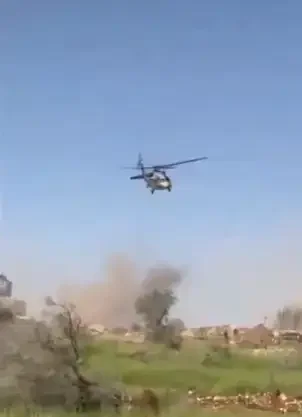
In that incident, shortly after the evacuation helicopter landed, another explosive drone detonated nearby and almost hit it. This was not the first incident, and regrettably will not be the last, in which IDF soldiers are hit by drones operated by Hezbollah.
Hezbollah drone explodes near IDF force evacuating wounded soldiers from incident in southern Lebanon
Unlike the threat posed by rockets and missiles, and even larger enemy drones launched from more distant fronts, Israel's security establishment does not have an adequate response to the problem. It is important to recall that this was not a major surprise. Until the ceasefire between Israel and Lebanon in November 2024, the drone threat was the issue keeping senior officials awake at night, because no answer had been found.
In the months before Operation Roaring Lion, the IDF Military Intelligence Directorate and Northern Command identified the drone threat operated by Hezbollah's Unit 127 as the main threat in Israel's northern front, and one that had not received an adequate response.
During those months, and also during Operation Northern Arrows, the Defense Ministry, the IDF and Israel's defense industries tried to find solutions for dealing with the drones, but without sufficient success. However, officials familiar with the matter tell Israel Hayom that there had been a significant improvement in detecting and intercepting these threats. Without the improvements that were made, they said, the situation would likely have been worse. Still, they added, "There is no single solution for drones."
Hezbollah drone (archive). Photo: EPA
The first problem with these drones is that they are extremely difficult to detect. They are very small, fly slowly and are not always identified in time by Israeli systems. After the complex process of detecting the drone, the systems must track the aerial threat and intercept it in time, before it reaches its target.
Interception can be carried out in several ways. The preferred method is interception through jamming or electronic warfare, but some of the drones operated by Hezbollah are immune to such measures.
A range of solutions, but no full coverage
Another option, which has so far not proven itself in this campaign, is intercepting these threats with lasers or electromagnetic energy. It can be said that the defense establishment is trying to bring this capability into operational use, but it is not yet mature. Israel is also using drones that intercept other drones, but this solution, too, is still not perfect.
To all of these must of course be added ground-based interception capabilities, whether through Iron Dome, which has intercepted quite a few aerial threats, or through fire from additional ground-based systems. In cases where it is possible, and the threat is identified in time, Israeli Air Force attack helicopters and fighter jets are also scrambled to intercept it.
Iron Dome battery. Photo: Defense Ministry Spokesperson's Office
In recent months, the Defense Ministry has tried to hold several "competitions" among defense industries in an effort to find solutions to the problem. Some have criticized this approach, arguing that the ministry should not create competition among the industries, but should instead try to get them to join forces and produce an integrated solution.
In the meantime, some of what was presented and demonstrated in those competitions has entered use. At the same time, additional detection and interception systems have been deployed. But defense officials acknowledge that, as of now, the solution is still insufficient. This is the place to note that these aerial threats are not troubling Israel alone. One need only point to the Russia-Ukraine war.
"We need to work fast and on a large scale. The learning curve has to be faster. At this point, this is not solvable," Israeli officials say. "The whole world is interested in this, and we are trying to find a solution that will protect the entire country, 360 degrees, including strategic sites, cities and communities."