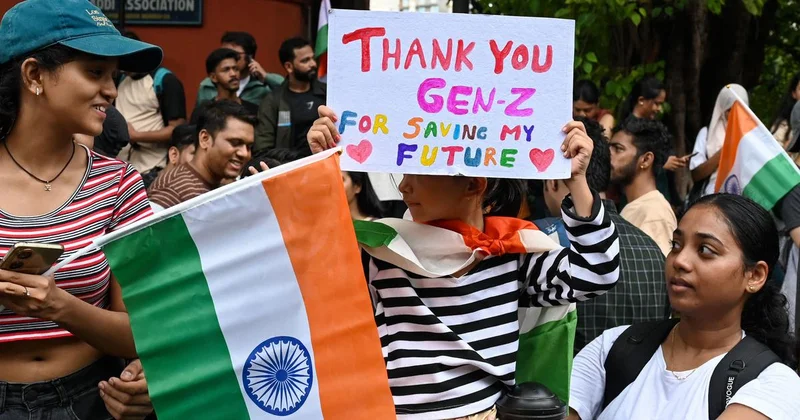
Last Saturday, with the sudden exit of Union Education Minister Dharmendra Pradhan, a protest in Mumbai’s Bandra neighbourhood called to demand his resignation was transformed into a victory rally. The waterfront resounded with whoops of triumph.
But in a community hall down the road, the mood was markedly different. As volunteers helped visitors fill out forms for the Special Intensive Revision of the electoral rolls underway in 16 states and three Union Territories, the room was filled with murmurs of aggravation and sighs of frustration.
A mere 750 metres separated the two venues, but the visions of India they represented were worlds apart.
At the amphitheatre on the waterfront, the supporters of the youth protests against the mismanagement of national examinations (and more) were aiming to deepen democracy, to pressure the government to listen to the voices of the people who had voted them to power.
In the community hall, however, the government machinery had been deployed to conduct an exercise that views every Indian with suspicion and casts doubt on the fact that their voices are actually legitimate.
The government says that it is conducting the revision to remove the names of voters who have died or moved away.
But many believe that a more pernicious endeavour is unfolding: the revision is yet another piece of evidence that illustrates how India, under the Bharatiya Janata Party, is carefully curating who it will allow to be counted as a bonafide citizen.
The special intensive revision places all residents under suspicion until they can prove that they belong. However, as Scroll staffers noted last fortnight, producing the documents required to prove eligibility to stay on the electoral rolls is inconvenient at best, impossible at worst.
When the exercise to “purify” the voting rolls was conducted in West Bengal earlier this year, for instance, 91 lakh names were deleted – removing 12% of the state’s 7.6 crore electorate. Of them, 34 lakh have appealed against their voting rights being extinguished. At the rate at which tribunals are processing cases, it could take 21 years for petitioners to be heard.
It isn’t surprising that by June, a year into the revision, the rolls in states and Union Territories where the exercise has been completed have been pruned by 10.2%.
Not only is the BJP trying to control who can vote, it is working hard to stifle the voices in the legislatures that oppose its policies and ideology. Since June, 20 of 28 MPs of the Trinamool Congress have left the party, presumably under pressure, while six of nine MPs owing allegiance to the Uddhav Thackeray faction of the Shiv Sena have defected to a BJP ally.
These moves by the ruling party demonstrate why the exhilaration sparked by the campaign catalysed by the Cockroach Janta Party must be tempered with realism.
Street protests of this sort are effective in achieving single-point agendas – demanding that a minister resign or that a set of laws be repealed. But structural reform requires electing representatives to frame sagacious laws and policy. And over the past decade, India’s ability to make its voice heard in legislatures has been critically imperilled.
Until that changes, India will remain what boomer uncles believe Gen Z protestors would describe as a delulu democracy – an electoral autocracy deluding itself that it truly represents the aspirations of its people.
Here is a summary of last week’s top stories.
Opposition mounts pressure. Congress leader Rahul Gandhi demanded that Amit Shah be removed as the Union home minister, alleging that he was responsible for “the brutality carried out against students” during their protest in Delhi on July 20. He also demanded an investigation by a Supreme Court-monitored high-powered committee into violence against protesters.
Gandhi said at a press conference that either Shah ordered the violence or that he did not know it was happening. “If he didn’t know it was happening, he is incompetent,” the Congress MP said. “If he knew, then he is culpable. In either case, he has to go.”
Earlier, while speaking in the Lok Sabha, Gandhi had alleged that Shah had “authorised the shooting of our students” during the nationwide youth protests. “He put the pellets into the blood of our students,” the leader of the Opposition in the House said. “He ordered the students of India to be shot.”
New laws, old problems. Parliament passed a bill to amend the 2024 anti-paper leak law in the wake of nationwide protests against alleged irregularities in competitive examinations. It awaits presidential assent. The draft legislation proposes imprisonment of five to ten years and a fine of up to Rs 50 lakh for those found using unfair means in public examinations.
If instances of paper leaks or other offences listed under the bill are found to be organised, the bill proposes a minimum sentence of seven years and a fine of up to Rs 10 crore.
Fifteen illegal acts, including leaking question papers, tampering with optical mark recognition sheets, creating fake websites and issuing fake admission cards have been listed as offences under the bill.
Saffronisation of sports? Hockey India chief Dilip Tirkey sought an explanation from the sport’s national governing body about its decision to change the colour of the Indian team’s jersey to saffron from blue, ahead of the world cup. Tirkey also said that Hockey India’s executive board had not been consulted before the change was implemented.
Following backlash on social media, including from former captains, Hockey India had said on Thursday that the colour had been changed following consultations with players and the staff because of technical requirements. The federation said that the blue jersey blended with the blue synthetic playing surface used in international hockey, affecting visibility, and that players and coaches had suggested alternative colours, including saffron and yellow.
Critics said that the change hurt the identity and legacy of the team that has traditionally worn blue as its primary colour.
Also on Scroll last week
Scrolllast week
- Watch: Arundhati Roy: ‘Does Modi know what was being said about him?’
- Modi government took over trusted helpline for distressed children. Two years later, it’s struggling
- Cockroach protests show Modi’s deep disconnect with India’s impatient youth
- Two days after Bihar promise to withdraw cases, families wait anxiously for protestors’ release
- ‘Wounds from CAA are fresh’: Why young Muslims remained ambivalent about the ‘cockroach’ protests
- Why the trans community fears exclusion in the ongoing SIR
- Three reasons why India’s household savings are falling despite a huge working-age population
- Why an Aadhaar fix for India’s education crisis won’t work
- Tigmanshu Dhulia on playing the waiting game: ‘When you go against the tide, there will be problems’
- ‘Bhai Tera Star Hai’ review: Pointless comedy strains patience levels
Follow the Scroll channel on WhatsApp for a curated selection of the news that matters throughout the day, and a round-up of major developments in India and around the world every evening. What you won’t get: spam.
We welcome your comments at letters@scroll.in.