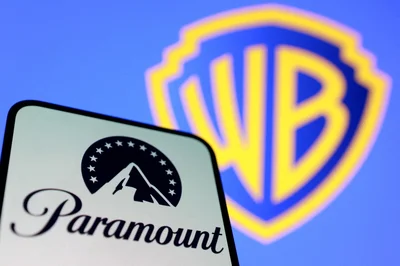
Paramount and Warner Bros logos are seen in this illustration.
Dado Ruvic \| Reuters
Paramount Skydance's proposed acquisition of Warner Bros. Discovery hit its first official roadblock when a judge granted a temporary restraining order on the merger as part of a lawsuit brought by state attorneys general.
California District Judge Araceli Martínez-Olguín signed off on the order Monday after hearing arguments from both sides in an Oakland courtroom on Friday. The order puts a 14-day pause on anything moving forward with the merger.
Last week, a group of state attorneys general led by California's Rob Bonta filed a lawsuit seeking to block the $110 billion acquisition due to antitrust concerns. The proposed deal would unite the storied film studios of Paramount and Warner Bros, the CBS broadcast network, a sprawling portfolio of pay TV networks that includes CNN, TNT, MTV and BET, and streaming services Paramount+ and HBO Max, under one roof.
Paramount's lead trial counsel Jeffrey Kessler said on CNBC earlier this week that the TRO was filed after Paramount indicated its intention was to close the deal as early as July 22, when the company expects to have all regulatory clearances.
The states could seek another temporary restraining order after the 14 days, or a preliminary injunction, which would further delay the deal.
Another proposed media deal — the $6.2 billion tie up of broadcast station group owners Nexstar Media Group and Tegna — has been put on pause following a similar lawsuit and preliminary injunction that was granted by a U.S. court. The lawsuit is also being led by Bonta.
The Paramount-WBD deal has been under review by the European Union and the U.K., which provided a new provisional deadline of July 22.
The Antitrust Division of the U.S. Department of Justice signed off on the tie-up in June, clearing it of federal concerns. It has also won approval from several global jurisdictions.
Paramount has said it's on track to close the deal by the end of September.
If the deal were to be delayed beyond then, Paramount could face additional costs, namely a so-called ticking fee that kicks in if it's not closed after Sept. 30. The fee would be an additional 25 cents paid to WBD shareholders per quarter until closing — which would equal about $650 million in cash value per quarter.
Paramount also agreed to a $7 billion breakup fee if the deal does move forward due to regulatory concerns.
Bonta called the merger unlawful and said it would "lead to higher prices, lower quality, and less content for film and television, harming movie theaters, basic cable distributors, and ultimately, audiences on every sofa and movie theater seat in the U.S."
The states that brought the lawsuit against the deal said they believe that the merged entity would control nearly one-third of films and nearly a third of basic cable TV programming.
Paramount has defended the deal as "pro-competitive."
In court papers filed on Thursday, Paramount said the temporary restraining order "presents one of the weakest merger challenges in modern antitrust history."
The company said the deal would "produce more high-quality content for consumers; it will incentivize investment in job-creating film production; it will stabilize basic cable television (which is gravely threatened by cord cutting); and it will increase the output of theatrical releases in a challenged entertainment landscape."