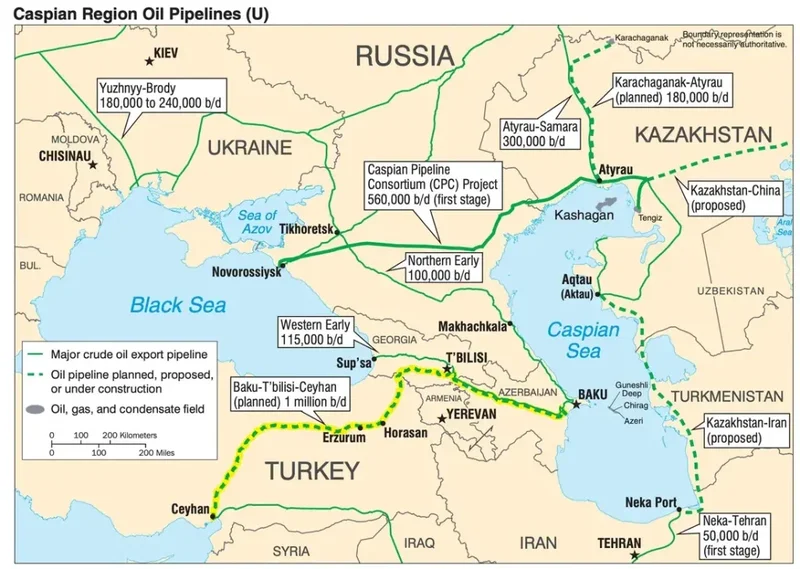
As part of the escalating NATO-Ukraine front against Russian energy infrastructure, on the night of July 17 a Liberian-flagged crude oil tanker was struck twice by drones. A subsequent fire on board forced the vessel to cancel its call at the Caspian Pipeline Consortium (CPC) Black Sea terminal.
The CPC is a 1,510-km oil pipeline connecting Kazakhstan’s Caspian Sea oil fields with Russia’s Black Sea port of Novorossiysk, and it brings roughly 80% of Kazakhstan’s oil exports to the world market. Its operations have been disrupted at various points during the war by Ukrainian attacks on pumping stations in Russia and by drone strikes on the CPC loading terminal.
Ukraine of course denies it is involved in the attacks on Novorossiysk. What’s interesting is that not only Western majors have ownership stakes in CPC but this specific tanker that was hit by drones was chartered by ExxonMobil, according to Reuters. This attack comes on the heels of another Chevron-chartered tanker being struck two weeks ago.
And here’s the ownership structure of the CPC, courtesy of BlackSea Energy \& Commodities:
Attacking the CPC is nothing new for NATO-Ukraine. Back in April Moscow accused Kyiv of hitting the terminal with drones, which likely caused a three-day scheduled shutdown for maintenance purposes. Last year, following multiple attacks, Kazakhstan demanded Kiev halt its aggression on the pipeline loading facilities.
Yet despite the Ukrainians’ best efforts, the CPC Terminal in Novorossiysktransshipped a record of 70.52 million tonnes of crude oil last year, up 7 million tonnes from the previous year.
The CPC brings a little more than one percent of global oil to markets but it does have an outsized role for some countries. According to BlackSea Energy \& Commodities:
The CPC pipeline is not only vital for Kazakhstan but also plays a significant role in global oil stability. At peak capacity, it transports nearly 1.4 million barrels per day to global markets, supplying major economies in Europe and Asia. This volume is sufficient to influence global oil prices and mitigate supply disruptions, positioning CPC as a stabilizing force in international energy markets.
Kazakhstan Says Thank You?
Kazakhstan is highly dependent on the CPC for its oil exports, with over 80% of its crude routed through the pipeline.
Yet despite NATO-Ukraine sustained attacks on its economic lifeline, Kazakhstan continues to move toward the West with open arms and do harm to its relationship with Russia.
Kazakhstan is now building NATO-standard shell factories and last year signed a military cooperation plan with Türkiye. They followed it up with an April agreement with Türkiye to allow the transit of military cargo and personnel. Such deals are frowned upon in Moscow and Beijing, seeing as Turkiye is a member of NATO and plays a role in the export of CIA Islam. Kazakhstan now has military intelligence cooperation, joint defense industry projects, drone production, and joint military exercises with Ankara.
Kazakhstan and U.S. companies recently signed artificial intelligence agreements worth $10 billion.
Kazakhstan is party to the corrupt deal to enrich the Trump and Lutnick offspring and maybe get American hands on a whole bunch of Kazakh tungsten, a critical mineral in short supply due to China choking off the US war machine.
Late last year at the 12th Summit of the Organization of Turkic States (OTS) Türkiye, Azerbaijan, Kazakhstan, Kyrgyzstan, Uzbekistan and Turkmenistan agreed to deepen cooperation across a range of areas, including trade and logistics—which would sideline Russia and increase cooperation with the EU—and defense cooperation, including joint military exercises.
Kazakhstan is also doing its part to squeeze Russian wheat exports. NATO-Ukraine attacks in the Sea of Azov are forcing Russian wheat exporters to consider more expensive alternative routes just as the new harvest enters the market. At the same time Kazakhstan is cutting off its market for six months.
Over 100,000 views for this false claim.
Kazakhstan hasn’t imposed a blanket ban on Russian wheat, what it’s introduced is a partial six-month restriction covering imports from all EAEU members and third countries (Ukraine, China, France, Australia, whoever) with major… https://t.co/v4KB9h1JJZ
— Brian McDonald (@BrianMcDonaldIE) July 19, 2026
While McDonald is technically correct, it’s worth noting that nearly 100% of Kazakhstan’s wheat imports come from Russia. According to The Times of Central Asia, Kazakhstan’s six-month pause risks a trade war with Moscow and undermines the Eurasian Economic Union (members: Belarus, Kazakhstan, Kyrgyzstan, Russia, and Armenia, which has been threatening to leave):
Kazakhstan’s order is country-neutral and preserves supplies to approved processors. Yet previous countermeasures often arrived through plant-health rules, certificate disputes, and border controls rather than openly declared retaliation.
The wider problem lies inside the EAEU…The Eurasian Economic Commission can identify barriers and convene negotiations, but it has struggled to stop national protection measures being implemented when prices or food security become politically sensitive. Trade disputes now affect goods ranging from food to road cargo, despite the common-market rules…
The wheat ban, however, shows how the union now functions through exceptions. For northern Kazakhstan’s farmers, fewer cheap truckloads will support crop prices, while millers pay more for rail deliveries. Rail transit will remain exempt, but the argument over what an EAEU common market should provide is growing harder to contain.
Now many analysts like to point out how the Central Asian states need to hedge their bets and play all sides, but this seems beyond the pale.
And while in isolation it is nothing more than a few flies in the Russian soup, when taken together with daily Ukrainian strikes, problems in Armenia, Baltic issues, seizure of “shadow fleet” tankers, other Central Asia-EAEU problems, Syria, and Turkish moves in the Black Sea and Central Asia, well, you start to end up with a bowl full of flies.
NATO Lake Not To Be
Getting back to the Black Sea, there is nothing new in the NATO efforts to turn it into their own little lake. That goal has existed for years. You can go back further as the Black Sea has been fought over for centuries.
And efforts to “contain” Russia are always focused on its sea access. Glenn Diesen. The Norwegian political scientist who specializes in Russian foreign policy writes:
In the Clash of Civilizations and the Remaking of World Order, Samuel Huntington argued:
“The immediate source of Western expansion, however, was technological: the invention of the means of ocean navigation for reaching distant peoples and the development of the military capabilities for conquering those peoples… The West won the world not by the superiority of its ideas or values or religion (to which few members of other civilizations were converted) but rather by its superiority in applying organized violence. Westerns often forget this fact; non-Westerners never do”.
Russia’s economic development was obstructed ever since the disintegration of Kievan Rus as it severed Russia from the maritime arteries of international trade. Russia’s “return to Europe” and subsequently becoming a great power was made possible under Peter the Great by gaining access to the Baltic Sea. Containment of Russia has since relied to some extent on denying Russia reliable access to the sea. …
In Europe, NATO has been instrumental to expand US control over the Black Sea, the Baltic Sea and the Arctic. NATO expansion to Bulgaria, Romania and possibly Ukraine aims to convert the Black Sea into a NATO lake.
Yet Project Ukraine, whatever else it may have achieved, has failed miserably on that front. As GIS Reports noted recently, “Russia holds its strongest position in the Black Sea region since 1991 and is poised to strengthen it further.” Oops.
But at least NATO-Ukraine is doing its part to hammer global food supplies.
\<blockquote class\=”twitter-tweet”>\<p lang\=”en” dir\=”ltr”>1.5 mmt. -29% YoY; -62% vs Jul 2024.\<br>\<br>That\'s SovEcon\'s forecast for Russian \<a href\=”https://x.com/hashtag/wheat?src\=hash\&ref_src\=twsrc%5Etfw”>#wheat\</a> exports this July – the lowest since 2017.\<br>\<br>Azov/Black Sea disruptions plus soft demand are the drivers. If shallow-water terminals stay shut, this gets a lot worse come August, when exports… \<a href\=”https://t.co/33HPSGNI27″>pic.twitter.com/33HPSGNI27\</a>\</p>\— Andrey Sizov (@sizov_andre) \<a href\=”https://x.com/sizov_andre/status/2079577593402020174?ref_src\=twsrc%5Etfw”>July 21, 2026\</a>\</blockquote> \<script async src\=”https://platform.x.com/widgets.js” charset\=”utf-8″>\</script>
Ukraine’s grain exports, 90 percent of which typically move through Odessa, are also at a standstill. With the Strait of Hormuz closed, it’s quite a time for the NATO-Ukraine to do its best to kill a third of global wheat supplies.
Turkish Gambit
We featured an article yesterday from Andrew Korybko describing the fear that Türkiye might test Russia’s resolve by trying stunts like escorting Ukrainian commercial ships or, further down the line, allowing the transit of NATO warships through the Turkish Straits, permission it has thus far denied during the war in Ukraine.
Escorting ships would be quite the gambit, even for Erdogan’s Türkiye, as Russia intensifies its blockade of Odessa by hitting ships that try to dock there. And where might they escort them to after the war, as it looks increasingly likely Russia will eventually take all of Ukraine’s Black Sea coast?
Moscow also appeared to issue a warning to Türkiye when officials announced on July 17 (the day after Turkish FM Hakan Fidan made the comments about Black Sea security) that the country would restrict stone fruit (peaches, nectarines, apricots, plums, cherry plums, cherries, sour cherries, and olives) imports from five large Turkish exporters. That’s a big hit for the Turkish agricultural sector. From Turkiye Today:
Türkiye ranks among the world’s largest exporters of stone fruit, with shipments worth around $336.6 million in 2025, with Russia accounting for over 40%, or $140.6 million, of the total.
On the energy front, nearly half of Türkiye’s oil imports in 2025 came from Russia, and a little less than 40 percent of its natural gas came from Russia.
Both of those totals are declining however as Türkiye signs big LNG deals with the US and others and works with Washington to get oil flowing into Türkiye from Iraq.
Türkiye would also could lose its status as exporter of Russian gas to Europe at the end of this year due to the EU vow (they really mean it this time!) to completely halt imports of Russian fossil fuels by 2027.
Elsewhere, Turkish and US officials continue to insist that the long-running dispute over the Russian S-400 air defense system Türkiye purchased in 2019 is coming to an end.
According to Turkish Deputy Foreign Minister Levent Gümrükçü, a resolution is at hand, which would see Ankara readmitted to the F-35 fighter jet program and, more importantly, the removal of sanctions under the Countering America’s Adversaries Through Sanctions Act.