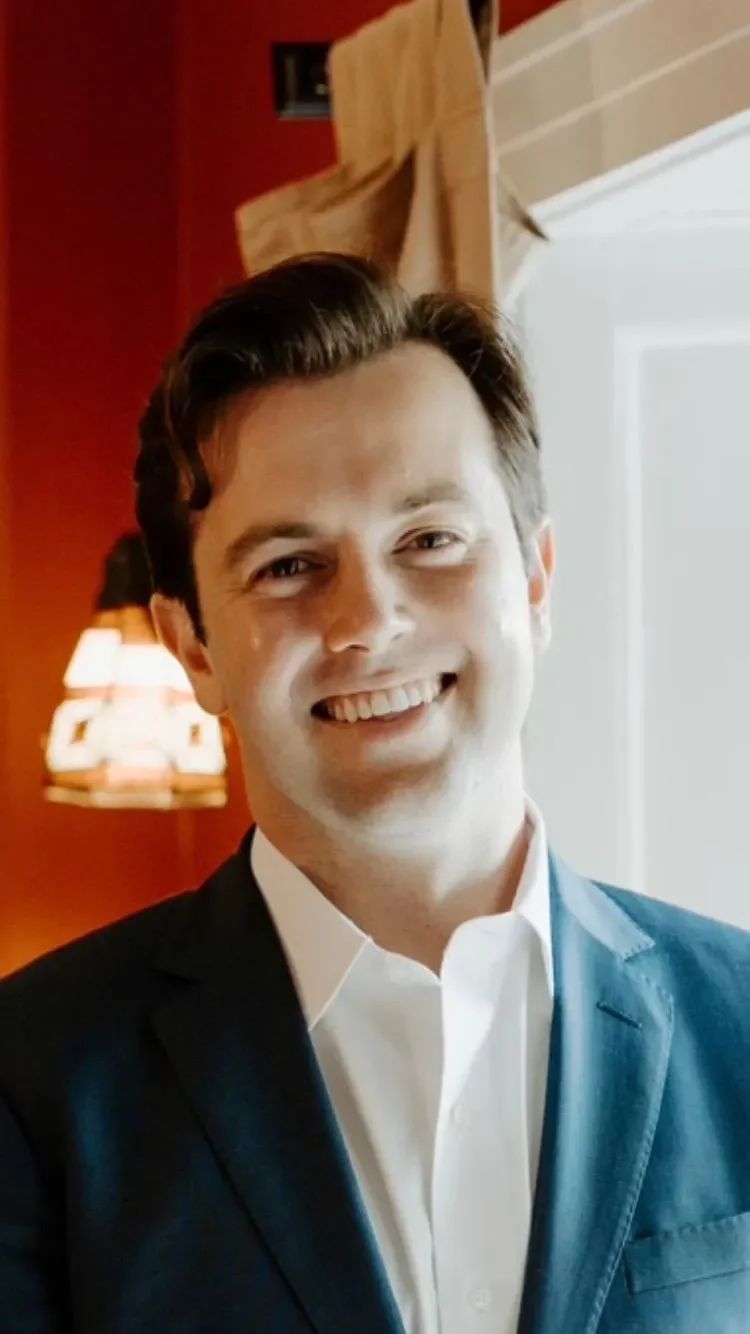
David McCullough III has built an unlikely nonprofit around a lesson from his late grandfather, Pulitzer Prize-winning historian David McCullough: “You’ve never met anyone in your entire life who didn’t have something to teach you.”
It’s advice McCullough has translated into American Exchange Project, the nonprofit he cofounded in 2019 with PBS NewsHour economic correspondent Paul Solman and the late Harvard economist Robert Glauber. The idea, which earned him a spot on the Forbes __30 Under 30 __list in 2023, grew out of what he describes as a “lark-ish research project” exploring whether a simple, scalable idea could help bridge America's growing social and geographic divides.
McCullough insists he never set out to become an entrepreneur. “I discourage young people who say, ‘I want to be an entrepreneur,’” he says. “I think you should want to fix a problem.” Six years after developing the idea while substitute teaching and living in his parents’ attic, McCullough now leads an organization with 30 employees, thousands of volunteers and an ambitious goal: making a two-week domestic exchange trip between high school graduation and college as common as prom. So far, he’s attracted more than $16 million in philanthropic commitments with the largest—$9 million over three years—coming from the private foundation of billionaire filmmaker Steven Spielberg and his wife, retired actress Kate Capshaw.
For McCullough, return on investment is measured in students like Alonnah Ashworth. Growing up in Lake Charles, Louisiana, Ashworth, now 22, had never boarded an airplane before AEP sent her to Wellesley, Massachusetts, in 2021. She arrived expecting Northeasterners to be “mean,” “uppity” and “rude.” Instead, her host family welcomed her as one of their own, and the exchange ended up reshaping her life as well as perceptions. She abandoned plans to study pharmacology and switched to psychology at Prairie View A&M (ranked third on Forbes’ list of Top Public Historically Black Colleges). There, she created an annual live performance celebrating African and Caribbean dance, music and art that grew from 200 attendees to 650 by the time she graduated. “What Mr. McCullough did with me on the national scale, I implemented within my university on a smaller scale,” she says.
Ashworth credits AEP with giving her the confidence to pursue opportunities she once thought were beyond her reach. She studied abroad in Uganda and Jamaica and, this fall, begins a master’s program in clinical mental health counseling at William James College in Boston. One day, she hopes to launch a nonprofit focused on mental health and community outreach.
Stories like Ashworth’s are exactly why McCullough believes the summer after high school graduation may be one of the most wasted opportunities in American education. While schools, sports, internships and enrichment programs crowd nearly every other stage of adolescence, the weeks between graduation and college remain unusually open, he argues. “It’s a blank space,” he says. “As an entrepreneur, it screamed opportunity.”
McCullough says that timing matters psychologically as much as logistically. Teenagers, he contends, are still deciding who they are before settling into college, work or military life. “It’s after you’ve left the nest, but before you’ve landed with whatever group you’re going to assimilate to next.”
The idea grew out of McCullough’s own experience. Growing up outside Boston, he imagined a future in baseball. “I still want to play for the Boston Red Sox when I grow up,” he jokes. Instead, a shoulder injury ended his athletic career at Yale. “I flip-flopped around trying to figure out what could fill the void in my heart that baseball left open,” he says.
The answer came on a 7,100-mile road trip across America during the summer after his junior year of college. Visiting communities he’d been warned were dangerous, McCullough instead found generosity, curiosity and friendships that challenged his assumptions. Graduate study at Cambridge University during Brexit reinforced his belief that Americans needed more opportunities to know one another in person, rather than through headlines or social media. “I realized that this deeply personal experience I had might shed a little light into what we can do about the divides of the moment,” he says.
After McCullough connected with cofounder Solman and embarked on their research project, one theme became clear: “Every young person we talked to said, ‘I feel like I’m growing up in a bubble, and I’ve never seen life outside the bubble.’”
McCullough calls it “the closest thing we had to a light-bulb moment.” Still substitute teaching, he called Solman and their third cofounder, Glauber. “I just said, ‘I got it! Kids feel like they grow up in a bubble. So go live in a different bubble.’”
To figure out how to scale AEP, McCullough looked to organizations that had successfully expanded ambitious ideas, including the European Union’s Erasmus+ exchange program, the Peace Corps, Teach For America and even the public library system.
That strategy appears to be working. McCullough had never run a nonprofit or raised money before, but he’s learning how to persuade philanthropists to invest in an idea with no American precedent. While AEP’s largest backer is the Hearthland Foundation, Spielberg and Capshaw’s private foundation, it’s also raised money from the Carnegie Foundation ($3 million), the Ibis Group ($1.5 million), the MacArthur Foundation and the family foundation of billionaire Arthur M. Blank, the cofounder of Home Depot and owner of the Atlanta Falcons and Atlanta United. “Our donor base completely covers the political and geographic spectrum,” says McCullough, adding that the organization’s budget has roughly tripled this year. So far, 94% of funding has come from major philanthropic gifts, but several states are beginning to explore public support as well, he says.
Whether McCullough succeeds in his goal of making post-high school domestic exchanges as common as prom remains to be seen. But he’s already changed Ashworth’s life. “I’ve never gone a day without biscuits and gravy and sweet tea, and I’m moving to Boston,” she says. “That willingness, that confidence, that I'm gonna go do it anyway and learn something—all that was birthed from that exchange project. It taught me that without understanding, you have nothing.”