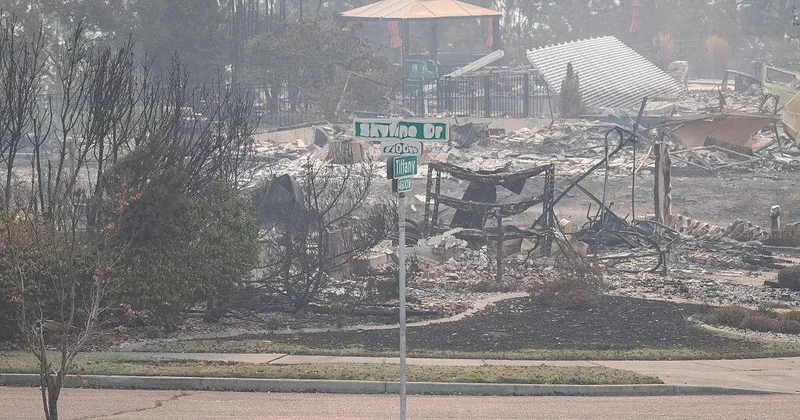
With some 67,000 people under evacuation orders amid three , hundreds could be coming home to nothing.
"All of our memories are gone," said Anna Andreachi, a Spokane resident whose home was lost in the blaze. "My dad just died, and all of his stuff was still in there, too."
More than 700 buildings in the Spokane area have been destroyed, and another 400 have yet to be assessed, officials said Monday.
"It's a nightmare situation," Washington Gov. Bob Ferguson said. "This is likely the worst natural disaster in Spokane history."
Joe Cvancara and his family managed to save their home by digging a fire line. But his neighbor's home and at least eight others in the area were destroyed.
Cvancara said he's grateful but that it feels like "survivor's guilt in a way. Like, wow. So we're going to open our home to our neighbors. I know it's going to take a long time to rebuild."
The fires began Saturday, when extreme drought, bone-dry brush, high heat and wicked winds combined to create a dangerous environment for fires to spread quickly. Firefighters went door to door trying to save as many homes as they could, but were soon overwhelmed.
As of Monday, no deaths had been reported. Spokane County Sheriff John Knowles told reporters on Monday there were 14 people authorities were trying to get in touch with, but stressed that he didn't want to qualify them as missing.
"These are people who may have called for help or for help evacuating, and many of them likely did get evacuated," he said. "You know, with poor cell phone coverage, people's cell phone batteries die or they get to some place where they do find shelter and we haven't been able to reach them by phone. So, that's the task ... for those 14 people that we haven't been able to talk to."
The Old Trails Fire and the Fairview Fire are both still burning, but the main focus for firefighters on Sunday and Monday was the Autumn Lane Fire.
The heat and wind that initially fueled the fires had died down by the beginning of the week, but the dangerous conditions are expected to return by Wednesday.
Daniel Ramey, a spokesperson for the California Interagency Incident Management Team 7, told CBS News on Monday that the next few days could be critical for firefighting efforts.
"It looks like Wednesday into Friday we're going to be seeing a heat trend up to the 90s, so it's really time for us to put in the work ... on this fire up north and continue the efforts with getting the communities back into their homes as soon as possible below us," he said.
Ramey said that while the three fires aren't particularly big compared to other notable wildfires, the issue is that they have occurred in what's known as the wildland-urban interface — areas where human structures sit on the edge or within the wilderness.
"There's always a chance when you live next to trees and grass and the beautiful nature that you're going to have a potential for fire like we saw," he said. "We didn't have rain for the whole month of July in this area, so everything was extremely dry. Everything was susceptible to those new starts, like we saw."
For the Pacific Northwest, this has been one of the worst fire seasons in three decades. At least 16 major fires are burning in Washington state. In Utah, a fire has burned nearly 70,000 acres after doubling in size Monday. The Big Rock Fire in southeastern Idaho has burned more than 2,500 acres and forced evacuations.
Ramey warns things could get worse, with California still relatively quiet so far but firefighting resources already stretched thin.