The presumption that US elections are legitimate died last week in Washington. It was 237 years old. It did not die of one wound. It died of three, inflicted in a single day, in daylight, on the record. And the country, running to the loudest of them, never examined the one most likely to kill.
In critical care we distinguish the mechanism of death from its cause. The mechanism was a Thursday. The cause was chronic, progressive and untreated.
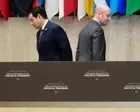
The morning belonged to the secretary of state. Before officials of more than 60 countries, he announced that the counterterrorism architecture of the free world, built over a generation against jihadist mass murder, should be rebuilt and aimed at the domestic left. He named a transnational enemy defined by hatred of the west, “a revolt of the worst against the best”. He tied it to Iran and to Cuba and offered no evidence for either link. He said the journalists and thinktanks who might check the claims often agree with the enemy’s goals. The move is old and reliable: discredit the second opinion in advance.
Midday belonged to the White House deputy chief of staff. What he said deserves to be quoted rather than summarized, because summary is a mercy it has not earned. He called “leftwing political terrorism” a “fatal cancer of civilization”. He said that its politics, left to run its course, “always becomes a gulag”. He said antifa demonstrators are “all deformed in some way, in their appearance, in their dress, in their mannerism”, that “their outer appearance becomes a manifestation of their inner hatred”, and he asked why there is “not one normal-looking person among them”. He said that when the leftist protests that his rights are being violated, those appeals “must fall on deaf ears”. He urged the assembled governments to be “completely unflinching in the pursuit of justice against these enemies of civilization”. And he described the work already under way in six verbs: “disrupt, identify, defund, debank, arrest and prosecute”.
I have been practicing medicine for four decades. Cancer is my vocabulary, not his. And I know what happened the last time a government borrowed it. The Nazi state’s central perversion was the medicalization of killing: the enemy as tumor, as bacillus, the nation as patient, extermination as cure. Robert Jay Lifton called it the biomedical vision. It recruited my profession first, and my profession answered willingly. When a government describes citizens as a cancer, it has written the first line of a treatment plan. On Thursday, the plan was read aloud, from a state department podium, in six verbs.
One disclosure belongs in the chart. My family left Russia in 1917. My relatives left Germany in 1933. In both generations, leaving was called excessive; staying was the reasonable position. But an alarm that was right both times it sounded is not overcaution. On Thursday, it sounded a third time.
The evening belonged to the president. In primetime he called the American election system indefensible, claimed a foreign power held 220 million voter files, declared mail voting inherently corrupt, accused his own intelligence services of concealment, and told Congress that the only reason to oppose his bill is the intent to cheat. That framework converts every future outcome into evidence. Pass the bill and win: the bill worked. Fail and lose: the cheaters blocked it. A presumption of legitimacy cannot survive inside a belief system engineered to be unfalsifiable.
It was just a Thursday. Netflix’s forecast disappointed Wall Street. A rocket aborted on the pad. No sirens sounded, because this is not how they sound. Democracies do not die to soundtracks. They die on ordinary weekdays, between the earnings reports, while the country is at work.
Then came the response, and the response was a triage error. Nearly all of it ran to the evening. The factcheckers parsed the voter files. The law professors graded the bombshells. Real work, spent on the loudest injury. The morning’s remarks, the ones that declared a class of Americans a cancer and read enmity on their bodies, drew the attention of an ordinary news cycle: straight coverage in the mainstream, horror at the margins, and in a portion of the press, open applause. I have watched teams run to the dramatic patient while the quiet one, the one not crying out, exsanguinates behind a curtain. The most dangerous words spoken in Washington on Thursday were not spoken in primetime. They were spoken before lunch, to more than 60 countries. The official transcript records the applause.
The decedent is survived by the federal courts, still open. By 50 secretaries of state, still certifying. By a general election, still on the calendar, 108 days out. And by an electorate that has not yet been asked the only question that matters, which is whether it will accept a count its president has pre-declared corrupt, counted among citizens its government has pre-declared malignant.
In 40 years of intensive care, I have pronounced death many times. The criteria are strict because the declaration is irreversible, and so we are taught to be certain before we speak. I have also, more than once, seen a rhythm return after the room had gone quiet, when someone refused to stop compressions on schedule. This notice is filed in the knowledge that pronouncements can be premature. It is filed in the fear that this one is not.