Your support helps us to tell the story
From reproductive rights to climate change to Big Tech, The Independent is on the ground when the story is developing. Whether it's investigating the financials of Elon Musk's pro-Trump PAC or producing our latest documentary, 'The A Word', which shines a light on the American women fighting for reproductive rights, we know how important it is to parse out the facts from the messaging.
At such a critical moment in US history, we need reporters on the ground. Your donation allows us to keep sending journalists to speak to both sides of the story.
The Independent is trusted by Americans across the entire political spectrum. And unlike many other quality news outlets, we choose not to lock Americans out of our reporting and analysis with paywalls. We believe quality journalism should be available to everyone, paid for by those who can afford it.
Your support makes all the difference.
Read more
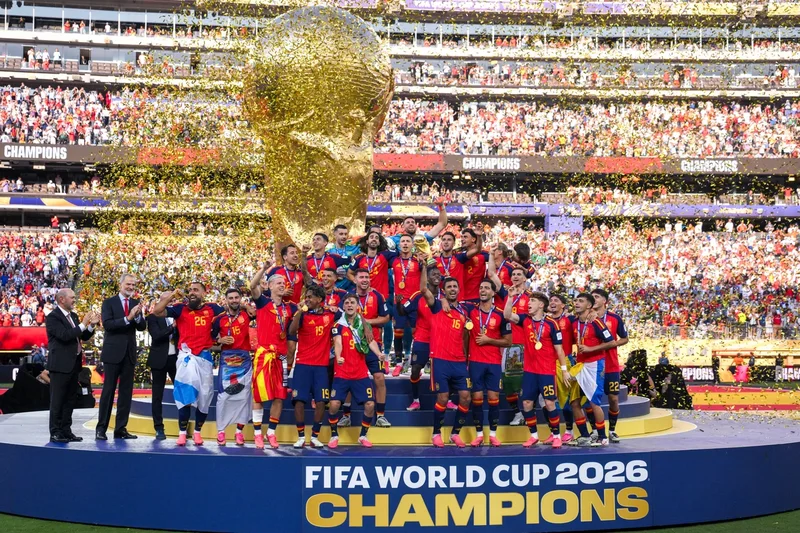
Football's burgeoning appeal in the United States has been emphatically underscored after nearly 63 million Americans tuned in to watch Spain clinch the World Cup final on Sunday, shattering previous viewership records.
The landmark figures highlight decades of concerted efforts to broaden the sport's audience across the Atlantic.
The final, held in New Jersey, saw Spain secure a narrow 1-0 victory over Argentina, with Ferran Torres’ extra-time winner enough to see La Roja lift their second ever title.
Fox’s English-language broadcast alone drew 38.9 million viewers, while Comcast’s Telemundo and its Peacock streaming platform added another 23.9 million for the Spanish-language coverage.
This combined audience significantly surpassed the 22.3 million US viewers who watched the 2022 World Cup final in Qatar, marking a substantial leap in engagement.
Fox’s English-language broadcast alone drew 38.9 million viewers for the World Cup final (AP)
Analysts have hailed the tournament as a resounding success for broadcasters, with several knockout-stage matches outperforming recent championship games in other major US sports.
The round of 16 clash between England and Mexico, for instance, attracted nearly 45 million viewers – considerably more than the roughly 27 million who watched Game Seven of Major League Baseball's World Series or the nearly 25 million for Game Five of the NBA Finals.
While these numbers still fall short of the colossal 126 million viewers for Super Bowl LX, they represent a significant milestone for a sport historically overshadowed in the US.
The strong turnout on Spanish-language broadcaster Telemundo also highlighted football's deep popularity among Hispanic audiences.
"Ratings have blown past internal forecasts for both networks, and it's not close," said Vicente Navarro, managing partner at football-focused marketing firm GotDigital.
Navarro highlighted a marquee 30-second advertising spot in the knockout-stage matches cost as much as $1m, more than double 2018 levels.
However, it remains to be seen whether some of the tournament's more 'Americanised' elements will endure.
These included a major halftime show, drawing comparisons to the Super Bowl, which extended the interval to 27 minutes – significantly longer than football's traditional 15-minute break.
Fifa also announced that World Cup champions would, for the first time, receive a ring, a clear nod to "one of the most recognisable American sporting traditions”.
Looking ahead, the next World Cup will be co-hosted by Spain, Portugal, and Morocco in 2030, followed by Saudi Arabia in 2034. Both tournaments are likely to feature less favourable kickoff times for US viewers, a factor that could potentially impact future ratings despite the sport's recent surge in popularity.
Reuters