Your support helps us to tell the story
From reproductive rights to climate change to Big Tech, The Independent is on the ground when the story is developing. Whether it's investigating the financials of Elon Musk's pro-Trump PAC or producing our latest documentary, 'The A Word', which shines a light on the American women fighting for reproductive rights, we know how important it is to parse out the facts from the messaging.
At such a critical moment in US history, we need reporters on the ground. Your donation allows us to keep sending journalists to speak to both sides of the story.
The Independent is trusted by Americans across the entire political spectrum. And unlike many other quality news outlets, we choose not to lock Americans out of our reporting and analysis with paywalls. We believe quality journalism should be available to everyone, paid for by those who can afford it.
Your support makes all the difference.
Read more
Australia’s foreign minister said she directly confronted her Chinese counterpart about Beijing’s recent “destabilising” test of a nuclear-capable missile in the southern Pacific Ocean.
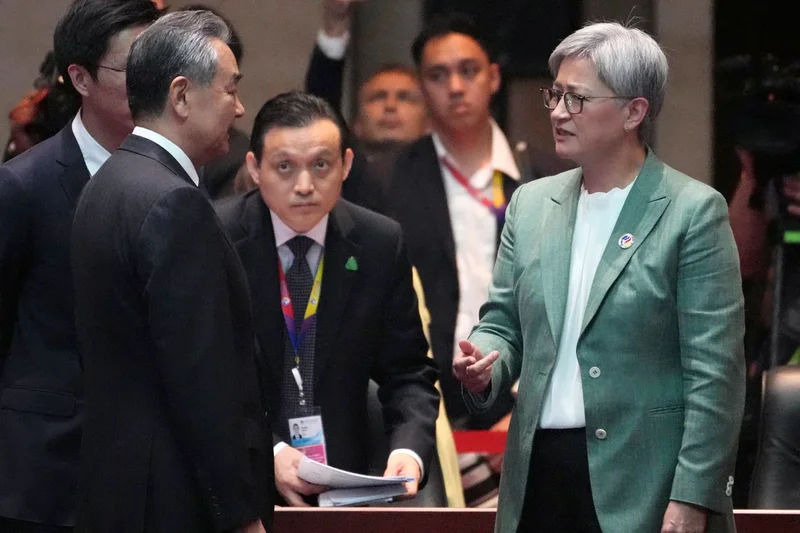
Penny Wong met China’s Wang Yi on the sidelines of an Asean ministerial meeting in the Philippines on Tuesday.
The talks came soon after Australia condemned China's “dangerous conduct” following a clash between Chinese and Philippine sailors near a disputed shoal in the South China Sea. It was also the first meeting between the diplomats since Beijing conducted a rare test launch of a long-range ballistic missile from a nuclear-powered submarine in the South Pacific Nuclear Free Zone.
“We have made clear publicly and directly to China that we regard the missile test as destabilising,” Ms Wong said. “And we have put that publicly and we have put that directly to foreign minister Wang Yi in my discussions yesterday.
“We have said we have real concerns about behaviour that is destabilising and risky,” she told reporters on Wednesday.
Mr Wang reportedly responded by urging Australia to give up “double standards” and not allow ties to be disrupted or undermined by prejudice.
Australia foreign minister Penny Wong with Indonesia’s Sugiono at the Asean meeting in Manila (Getty)
Ms Wong also told Mr Wang, according to a readout of her remarks, that “we’ll cooperate where we can and disagree where we must and we want to continue to engage because we believe that’s in our national interest”.
She said Canberra intended to discuss regional security issues, including “safe and professional military conduct, and the importance of transparency and reassurance of intent”.
Mr Wang called on Australia to seek common ground while managing disagreements and foster a cycle of positive growth in relations.
Philippines foreign secretary Theresa Lazaro with China’s Wang Yi (Getty)
In a statement, China's foreign ministry said that Australia was not a party to the South China Sea issue. It said Canberra had no right to intervene in related maritime matters.
"China urges relevant countries to stop stirring up tension and inciting confrontation," the ministry’s spokesperson, Lin Jian, said at a daily briefing, adding that Beijing would continue to properly handle maritime disputes through dialogue and consultation.
China also faced a “strong protest” from Manila’s top diplomat over the incident in the South China Sea. Philippine foreign affair secretary Ma Therasa Lazaro said she lodged a protest with Mr Wang over the Chinese Coast Guard’s “violent actions” at Second Thomas Shoal.
She called on Beijing to remove all remaining structures at Scarborough Shoal, where it had deployed a floating structure before removing it.
US Secretary of state Marco Rubio speaks at a press conference on the sidelines of the Asean meeting in Manila on 22 July 2026 (AFP/Getty)
The Asean meeting comes at a time when the US-Israeli war against Iran is disrupting global trade and creating economic strain across Asia.
Asean is an economic and security forum of the 11 Southeast Asian nations. It was originally formed as a bulwark against Communism but evolved over time into a platform for diplomatic dialogue and trade talks.
Besides the regional bloc’s foreign ministers, the meeting in Manila was attended by top diplomats from the US, UK, Russia, India, Japan, South Korea, and New Zealand.
US secretary of state Marco Rubio also had talks with Mr Wang. He said they discussed a planned visit to the US by Chinese president Xi Jinping as well as bilateral trade issues. The two sides had their differences, he said, but their job was to manage them, adding that there were areas of potential cooperation.