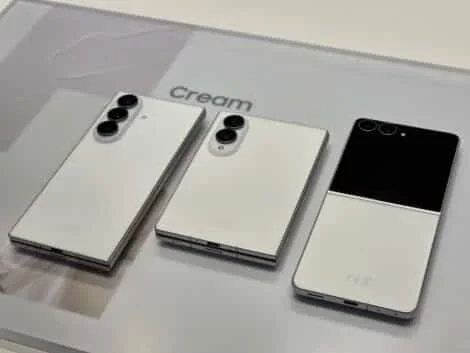
Samsung now has three foldable phones in their latest 2026 lineup. As a Fold user from two iterations back, I’d like to share some insight on how the three differ in terms of use cases.
Three flagships. Three foldables. Mostly similar internals.
Samsung Galaxy Z Fold8 Ultra
Not to be mistaken with the S-series Ultra sporting a candybar form factor, the Fold8 Ultra is the new name for last year’s Fold7 form factor. Closed, it resembles a Samsung S-series flagship with a slightly shorter width. To be honest, the Fold7 form factor was the best of both worlds, for people like me who would use the phone folded while on the go for basic tasks like messaging and social media. I found that after using the Fold7 for a year, I tend to unfold it mostly while sitting down. The same can be said for the Fold8 Ultra. I call this “deploy mode” where I am at a coffee shop or at home in my safe space browsing the web, watching YouTube or Netflix or checking an Excel file, a PowerPoint presentation or a PDF. It’s for activities that require 100% attention. Folded up, I appreciate that the phone’s width allows for one-hand operation as my thumb can pass across the entire screen, say for tapping the back button or reaching for apps right across.
Article continues after this advertisement
The Fold8 Ultra comes with three cameras, a 200MP main camera with HDR, a new 50MP ultra-wide camera, and a 10MP telephoto camera with 3x zoom. For those looking for better telephoto, it seems that this feature is relegated to their other flagship line, the S26 Ultra. But if you’re more after improved night photography, the Fold8 Ultra does take some lessons from the latest S-series, so there’s that.
If you’re a stylus fan and was hoping for a comeback in this new series, you’re out of luck. In a round table discussion on the durability of the Fold8 Ultra, it seems that Samsung had placed a layer of titanium plate and a thin layer of a titanium alloy film for enhanced durability and to remove the crease. This comes at a trade off where the digitizer screen layer is no longer present to preserve the thinness. Samsung says that they have based this decision on user behavior. Anecdotally however, I have seen demand for a stylus-enabled foldable from people in my circle. It seems the stylus will remain in the S-series.
The Fold8 Ultra comes with a 5,000mAh battery, which is a bump from the previous generation. With AI pushing some battery saving magic, we should be getting similar or even slightly better battery life to the S26 Ultra, which is roughly a 24-hour day, give or take a few hours.
The Fold8 Ultra comes in four colorways: Violet Shadow, Cream, Graphite, and an online exclusive Green Shadow, which looks super elegant.
Article continues after this advertisement
The Z Fold8 Ultra has the following pricing:
P165,990 for 1TB
P137,990 for 512GB
Article continues after this advertisement
P123,990 for 256GB
Samsung Galaxy Z Fold8
The newest member of the foldable family is the passport-sized Fold8. This device sits right in between the Flip and the Fold8 in terms of form factor. After getting to play with this device multiple times in the past 48 hours, I can give some insight on why this exists.
You see, as a previous Fold7 users (and now with the Fold8 Ultra), I found myself rotating the screen when unfolded for media consumption. In fact, games on Android such as Wuthering Waves and Zenless Zone Zero default to a rotated screen, which I think is a mild hassle to flipping an already wide screen. The issue here is aspect ratio, that despite having wider real estate, viewing video in “book mode” where the fold is at a horizontal line down the middle crops the screen somewhat. I have a comparison shot in this piece to show what I mean.
From left to right: The Fold8, Fold8 Ultra, Flip8 screens in YouTube
The passport-sized Fold8 addresses this problem by delivering a more classic 4:3 aspect ratio compared to 6:5 from the new Ultra series. The 4:3 aspect ratio is more native, more natural, more vintage, and is easier on the eyes compared to a more cropped 6:5.
The Fold8 comes with a dual-camera setup with two 50MP wide and ultra-wide with 2x optical zoom. So it goes without saying that this phone is more of a content-consumption device due to the lack of a telephoto lens, with selfie features similar to the Flip8.
I had to hold this angle so the phone does not fully open.
Because of its aspect ratio, unlike the Fold8 Ultra, you can’t really use the phone at an angle — either it’s fully open or fully closed since the hinge will automatically snap shut. Perhaps it’s a design philosophy choice for content consumption, but it would be nice if Samsung offered a software update to allow the phone to be used like a mini laptop, or plopped on the ground for more stable selfies like the Flip8.
Fold8 on the left and the Fold8 Ultra on the right
The Fold8 comes with a 4800mAh battery with 45W fast charging and 20W wireless charging.
The Fold8 comes in four colorways: Lavender, Cream, Graphite, and an on online exclusive Pistachio.
The Fold 8 has the following pricing:
P151,990 for 1TB
P123,990 for 512GB
P109,990 for 256GB
Samsung Galaxy Z Flip8
The refreshed Z Flip8 continues to be Samsung’s portable selfie companion, albeit with a refresh of internals. Weighing in at only 180 grams, this is the lightest Flip so far. Enhancements have been made to the FlexWindow allowing you to access AI features like Gemini automation right from the cover screen. Among the threee devices, the Flip8 has the strongest selfie camera at 50MP.
The Flip8 comes in four colorways: Pink, Cream, Graphite, and an online exclusive Mint.
The Z Flip8 has the following pricing:
P91,990 for 512GB
P77,990 for 256GB
Final thoughts
We have three new flagships in three different form factors but all the same Snapdragon 8 Elite Gen 5 chipset. This is a signal from Samsung that at this level, the internals don’t really matter and it’s all about the form factor. With similar batteries ranging from 4800 to 5000 mAh, the name of the game is form factor. Samsung is making a huge bet on the passport-sized design for content consumption, and I can see why. It brings both the selfie and wide-screen consumption worlds together in a hugely pocketable all-in-one. It also cements a choice that the new Z Fold family is a productivity and entertainment-focused line while the S-series is your concert camera because of the better telephoto.
So, which one to buy? First, if money is no object, go for it! But if you want to be wise with your money in these unprecedented times of price increases, I would say that if you are already a Fold7 or Flip7 user, upgrading to the Fold8 Ultra or the Flip8 are minor jumps. I would have preferred if the Fold8 Ultra upgraded the telephoto lens further like the S26 Ultra — this would have been a noteworthy reason to upgrade, but this is not the case. If you are a first-time foldable convert, the Flip8 is attractive at less than P100,000. I predict however that the darling device that will sell loads is the passport-sized Fold8, if even just for the 256GB model.
That being said, Samsung Philippines is once again offering the “double your memory” preorder promo that also lets you save as much as P7,000. The usual phone trade in promos are also available with free Samsung Care for up to three months. The new 8-series foldables are also available on 0% installment promos with major banks including BDO, BPI, East West, UnionBank, MetroBank, PNB, Security Bank, HSBC, RCBC, and Chinabank.
Your subscription could not be saved. Please try again.
Your subscription has been successful.
Now, last but definitely not the least, because Samsung offers 7 years of free software and security updates, you may also want to consider previous-generation foldables from the past two years, if you can still find good deals. I think the Samsung ecosystem is so robust that there’s no shame in trying to find a good deal on foldables that were released in the past 24 months.