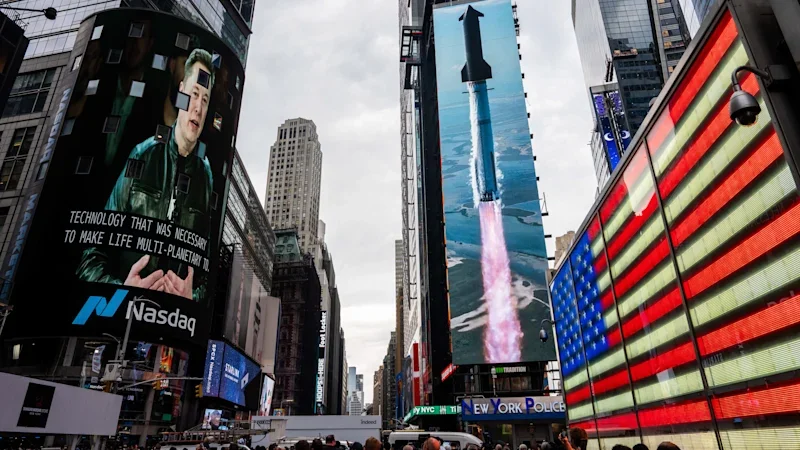
There was something very familiar about SpaceX’s first quarterly result as a listed company. A near-doubling of revenue was swamped by a massive increase in spending.
After initially soaring more than 9 per cent on the result, SpaceX shares gave up all its gains as investors digested the rate and scale of the increase in capital expenditures, which dwarfed the 92 per cent jump in sales to $US7.8 billion ($11.1 billion).
SpaceX’s capex leapt from $US2.8 billion in the same quarter last year and $US10.1 billion in the March quarter to a whopping $US18.4 billion, with the company flagging it will remain at about that same rate for the rest of the year. That would mean capex of about $US65 billion this year.
While SpaceX isn’t a pure artificial intelligence play – it also has its profitable Starlink satellite business and its unprofitable Starship rockets – that broad narrative of explosive revenue growth being overwhelmed by the scale of investment is consistent throughout the AI sector.
Critical to the fate of AI, or at least of those US companies pursuing their costly proprietary advanced AI models, is whether the trillions of dollars they are investing will ever generate a return commensurate with that investment and its inherent risk. At this point in the sector’s development, that remains an open question.
Revenue from AI is up about 250 per cent. But the capex driving that revenue growth is up by more than 550 per cent.
SpaceX is generating revenue growth beyond market expectations, including growth in its AI revenues, which have risen from $US737 million in the June quarter last year to $US818 million in the first quarter of this year and then to $US2.6 billion in the latest June quarter.
So, revenue from AI is up about 250 per cent. But the capex driving that revenue growth is up by more than 550 per cent.
Moreover, SpaceX’s sales growth isn’t coming purely from selling AI products to customers, but rather from selling access to its AI infrastructure. The company is selling “compute” – processing power – to Google for $US920 million a month, and to Anthropic for $US1.25 billion a month.
As for the rest of the AI sector, the future for SpaceX’s AI business is cloudy, with the only near-term likelihood that its losses – $US1.26 billion in the latest quarter and $US2 billion for the first half of this year – will continue to mount.
Elon Musk, of course, remains super confident. He says he expects the “cadence” of AI development to improve dramatically and the company to end this year with 2GW of capacity and “closer to 10GW of compute than 5GW of compute” next year.
He also believes SpaceX’s overall revenue base is about to explode.
The June quarter revenues, annualised, produce an annualised run-rate of just over $US30 billion. By 2030, he says, he expects revenues to reach $US1 trillion – a year earlier than his earlier projections. Indeed, there was a “non-zero probability” that the $US1 trillion mark could be achieved in 2029, he said.
To get there by 2030 – which would require an annual compound growth rate in revenues of about 140 per cent – AI will have to be central for the company, but it won’t all be about AI.
The only profitable business in SpaceX’s portfolio at this stage is its Starlink satellite business, which had revenue of $US4.3 billion (up from $US2.6 billion a year earlier) and generated a profit of $US1.66 billion. Starlink now has 12 million subscribers, double the level of a year ago.
SpaceX still has a market capitalisation of about $US1.7 trillion. That’s pretty impressive for an unprofitable, capital-devouring company..
That satellite business might soon be complemented with a wireless service, which will send shudders through the senior ranks of AT&T, Verizon and T-Mobile, whose share prices all fell on the news. SpaceX said it will acquire spectrum and build the terrestrial infrastructure that will enable Starlink to offer a direct-to-mobile service.
Critical to Musk’s vision of data centres in space and the colonisation of Mars (and strengthening Starlink’s coverage and capabilities) is the space business, in which SpaceX invested $US1.2 billion during the quarter, and which generated revenue from its Starship launches of $US962 million.
Starship’s giant reusable rockets, while having had a troubled gestation, would dramatically reduce the cost of launching payloads, and people, into space and are the key to SpaceX’s ability to build those orbiting data centres, powered by the sun, and eventually putting people on Mars.
SpaceX, which launched two Starship V3 test flights earlier this year, says Starship “continued to advance towards full and rapid reusability.”
The underlying questionmark over all Musk’s ambitions is whether he will run out of cash before he realises them.
The cash burn at SpaceX is significant and accelerating. The initial public offering in June, which raised about $US85 billion, may have left the group with net cash of $US93.5 billion, but the AI and Starship programs will rapidly diminish that cash pile.
There have been reports that Musk is considering the sale of Tesla’s China operations as a prelude to a merger of SpaceX and Tesla, which has more than $US40 billion of cash, but Musk wasn’t drawn on the merger question in the analyst briefing for SpaceX’s results.
There is, however, a significant amount of overlap between SpaceX and the increasingly AI-centric Tesla, and the market expects Musk’s two listed vehicles to eventually merge.
Whether that would resolve, or at least delay, a need for new SpaceX funding is uncertain, given that Tesla, too, is significantly ramping up its capex and spending on AI.
While most of the analysts who follow SpaceX (many of whom work for banks involved in the IPO) remain wildly bullish about SpaceX’s prospects – and SpaceX did beat almost all their forecasts, other than their big miss on capex – the wider market is a little less certain.
Shares in the IPO were offered at $US135 each and, post-listing, initially soared to $US225. They closed at about $US125 on Tuesday, before tumbling more than 8 per cent – at one point they were down by about $US11 a share – after the market closed. SpaceX has lost more than $US1 trillion of market value from its peak.
And there may be more losses to come.
On Thursday in the US, about 911.5 million shares that were in lock-up before the quarterly’s release, will be available for trading.
That compares with the 640 million currently available, accounting for roughly 5 per cent of SpaceX’s issued capital. It could have been even more, had SpaceX shares continued to trade at elevated prices, with the release of a further 455 million dependent on the company hitting share price thresholds.
The 911.5 million shares are a giant over-hang on the shares, and short-sellers have been queuing up in anticipation, with positions equivalent to more than a third of the shares currently available for trading.
While the IPO’s aftermarket might have been disappointing - and costly, for those who subscribed to the IPO, who could still face a rocky few days, weeks or months - SpaceX still has a market capitalisation of about $US1.7 trillion.
That is pretty impressive for an unprofitable, capital-devouring company and an indicator of the market’s faith in Musk, his fantastical visions and the eventual (and necessarily unprecedented, given the sheer scale of the investments) profit-generating potential of AI.
The Market Recap newsletter is a wrap of the day’s trading. Get it each weekday afternoon.