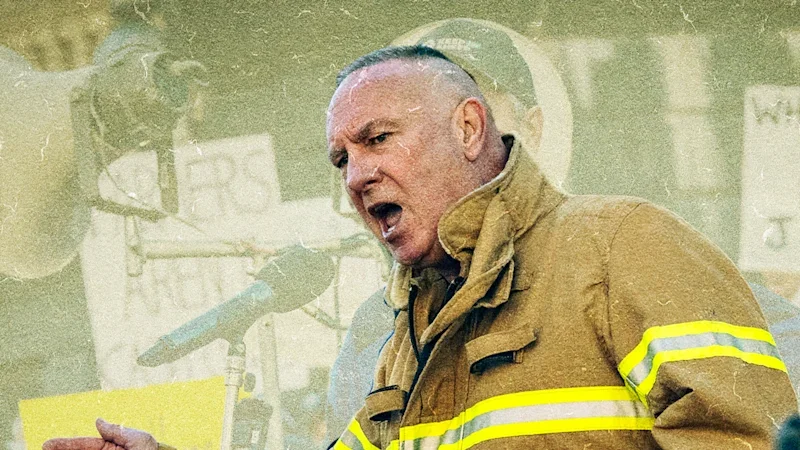
On Wednesday morning, Victoria’s Independent Broad-based Anti-corruption Commission (IBAC) handed down its report into Operation Richmond – an eight-year investigation into dealings between the state government under former premier Daniel Andrews and the United Firefighters Union boss, Peter Marshall.
Here’s what you need to know.
What are the Operation Richmond findings?
IBAC found that Victorian Labor ministers, MPs and public servants engaged in what it called “serious and concerning conduct”. It did not, however, find that there had been corrupt conduct.
IBAC identified serious problems in how the Andrews government struck pay deals with the Country Fire Authority (CFA) and the Metropolitan Fire Brigade (MFB), alongside the creation of Fire Rescue Victoria (FRV).
The commission found senior members of the government negotiated the CFA’s enterprise bargaining agreement (EBA) with Marshall without the knowledge of the responsible minister, agencies and department.
This backroom deal was contrary to the “established policies, procedures, codes of conduct and conventions”, and saw the government place Marshall in a position where he could exert “extraordinary influence” over the EBAs of both the CFA and MFB.
“IBAC also found that Mr Marshall was afforded privileged access to senior members of government which, in many cases, were not disclosed and were to the exclusion of other key stakeholders,” the report said.
“Operation Richmond highlights how government leaders, including ministers and the premier, can undermine established checks and balances when they fail to model high integrity standards and act as stewards of good governance.”
Is Daniel Andrews implicated?
Yes. While IBAC did not find any individuals “engaged in corrupt conduct as defined by the IBAC Act”, it did find that “serious and concerning conduct by senior public officers, including ministers and members of parliament”, which includes the former premier.
As premier, Andrews authorised the then-special minister of state Gavin Jennings and Tony Bates, a deputy secretary from the Department of Premier and Cabinet (DPC), to start secret negotiations with the United Firefighters Union (UFU) Victoria over a new EBA for the CFA. When a deal was struck, Jennings texted Andrews: “Handshake has occurred – it’s done!”
Peter Marshall later described the EBA as “negotiated with f---in’ Jennings in a back room. It was endorsed by f---in’ Andrews and cabinet”.
In its report, IBAC said it found the actions of the premier, Jennings and Bates “over this period were contrary to government policy, procedures, convention and their respective codes of conduct”.
Which other ministers and MPs are implicated?
Gavin Jennings, who served as the special minister of state between 2014 and 2020, was central to negotiating the secret deal.
“The failure to disclose Minister Jennings’ negotiations with the UFU to the responsible agencies, parliament and the public meant that no one was in a position to properly hold the government to account for the way in which the fire services EBAs were negotiated and finalised,” IBAC found.
Lisa Neville, who was sworn in as minister for police and emergency services in 2018, is also implicated.
In 2019, during negotiations for the passage of legislation backed by Marshall, she received a phone call from the UFU boss, who told her he’d secured the crucial support of a crossbench MP by offering to employ their relative.
IBAC Recommendations
- IBAC recommends that the premier introduces legislation to establish a statement of values for ministers and require the publishing and periodic review of a Ministerial Code of Conduct to be based on the statement of values.
- IBAC recommends that the premier publish a Ministerial Handbook that brings together existing integrity guidance and policies for ministers and their staff, with new guidance on the operation of the Westminster conventions in a Victorian context (with reference to the New South Wales Ministerial Handbook provisions).
- IBAC recommends that the secretary of the Department of Premier and Cabinet update training materials for ministers to include new guidance on navigating relationships with interest groups and lobbyists [and] Westminster principles and conventions.
In a recording of the intercepted call, the two can be heard joking about the matter.
Marshall: “It was a considered deliberation between … the skills subcommittee of our branch committee for the board and a recommendation to the board, mate, so … and it was on merit too, ’cause there was two other applicants [laugh] … Do you believe a word I just said? [laugh]”
Neville: “Yeah, I absolutely believe everything, I do, I do. For anyone listening in, I believe – 100 per cent believe that [laugh].”
What has been the reaction?
UFU boss Peter Marshall said he felt IBAC had invaded his privacy and not allowed him a fair say during the investigation.
Marshall said on Wednesday the report was “extremely creative writing”, IBAC had used intrusive powers to access phone conversations and that he had been compulsorily coerced into being examined during its investigation, but was denied procedural fairness.
“Where is there a finding that says I’ve done anything wrong?” Marshall told a press conference.
“In two reports, eight years, $8 million of public money, witch hunt, raid my house, listen to my phone calls, raid this office, take all the paperwork: [there’s] not one finding of corruption, not one adverse finding.”
Asked if he had struck a backroom deal with Andrews, Jennings and Bates, Marshall said his job as union secretary was to negotiate on behalf of his members.
“We’ve done nothing wrong here,” he told 3AW Radio. “IBAC went looking for something that simply was not there.”
Commissioner Victoria Elliott said the findings were serious because the public needs to have confidence in the “integrity and processes” of government in negotiating EBAs.
“The responsible minister, relevant cabinet ministers, the CFA, other senior stakeholders, and public officials were not aware of this backroom deal,” Elliott told ABC Radio on Wednesday.
“It’s important there’s transparency, it’s important there’s accountability, so there is effective decision-making, and the process occurs.”
Premier Ben Carroll said on Wednesday morning he had not yet read the report due to prior commitments.
“I’m going to read the report carefully. I’m going to study it and give the Victorians the action and the answers they deserve,” he said.
The premier also said the abuse of government processes laid bare in the report was intolerable and unacceptable behaviour.
Opposition Leader Jess Wilson said the report was evidence “corruption goes to the very core of this government”.
“What this report does demonstrate is that this is a corrupt government, a gangster government that always will put the interests of themselves before Victorians,” she said.
She called on the government to sack Bates – who assisted in the EBA negotiations as a deputy secretary in the DPC – from his current role as secretary of the Department of Education.
“It’s now on Ben Carroll to demonstrate that integrity is not optional to him,” she said. “He must sack Tony Bates by 5pm today to demonstrate that he is putting Victorians’ interests ahead of his own and his government’s interests.”
What happens now?
The premier said his government would adopt all three of the recommendations made by IBAC. This includes the introduction of legislation to establish a statement of values for ministers; the publication of a ministerial handbook for parliamentarians and their staff, and training for ministers that includes guidance on navigating relationships with lobbyists and interest groups.
It is unclear whether Bates will remain as secretary of the Department of Education or if he will be sacked as the opposition would like. Carroll said on Wednesday morning that Bates had taken a leave of absence.
Read more on Operation Richmond:
Secret missions and staged meetings: How a backroom deal led to the IBAC probe.
Damning report: A previous report exposed the influence of Peter Marshall and the firefighters’ union.
The dispute: This is how the firefighters’ union took centre stage.
The delay: The IBAC called for greater powers after a bid to block its report.