English 'didn't have to compete' for official status - Māori Language Commissioner
Te reo Māori has had to fight for recognition after generations of suppression, while English has long dominated life in Aotearoa, professor Rawinia Higgins says.
Last week, Parliament passed the English Language Bill, formally recognising English as an official language alongside te reo Māori and New Zealand Sign Language.
The bill is part of New Zealand First's coalition agreement, and party leader Winston Peters said at the bills first reading it would help solve a "virtue signalling narrative," and that the country should be using English as the primary language.
Te Taura Whiri i te Reo Māori - Māori language commission chair, professor Rawinia Higgins told RNZ te reo Māori, NZSL and English have not had the same journey to recognition. She uses a Commonwealth Games analogy to help articulate her whakaaro.
"The English language is the athlete that didn't have to compete. Like they just qualified anyway," she said.
"They got automatically selected for the team without having to be on the same kind of journey as te reo and as for sign language.
"There has been a lot of challenges for te reo and getting recognition. And we've seen attitudes towards te reo kind of wax and wane through successive governments."
Higgins said she is holding on to wording in the new legislation that states recognising English as an official language will not affect the status or use of te reo Māori or New Zealand Sign Language.
"I think I'm holding on to that phrasing and hopefully the legislation lives up to that, that there will continue to be support for te reo and for sign language," she said.
"I struggled to see at the time when it was being proposed, what is the problem we're trying to solve here?"
Her whakaaro is grounded in the history of te reo Māori, which she said has been shaped by generations of government policy favouring English.
"If we go back, of course, we have 1840 as a good kind of marker for everybody in terms of the signing of Te Tiriti o Waitangi, but come 1847, you have the Education Ordinance Act, which essentially starts the journey of assimilation," Higgins said.
"And so that is the dominance of the English language in schools."
The Native Schools Act 1867 further entrenched English in education, with Māori children in many schools punished for speaking their first language.
"That, of course, totally eradicates te reo from the education system. And then consequently, you kind of have these different kinds of policies that shape the way Māori value their own language. Because there's a kind of conditioning to believe that the language of the day is clearly English in society. And so in order to support their children, they stop speaking te reo at home."
She said urban migration after the Second World War also accelerated language loss, as Māori families moved into towns and cities and were dispersed through government housing policies.
"Come World War II, where you also have a lot of men who don't come home from the war, that has a huge impact on whānau. And post-World War II is also when you get the urban migration. And so with that, moving into the towns, you have housing policies, that are pepper pot policies to ensure that Māori were being integrated into society so they didn't cluster together and regain their language and as such."
By the 1970s, a new generation of Māori university students were confronting the consequences.
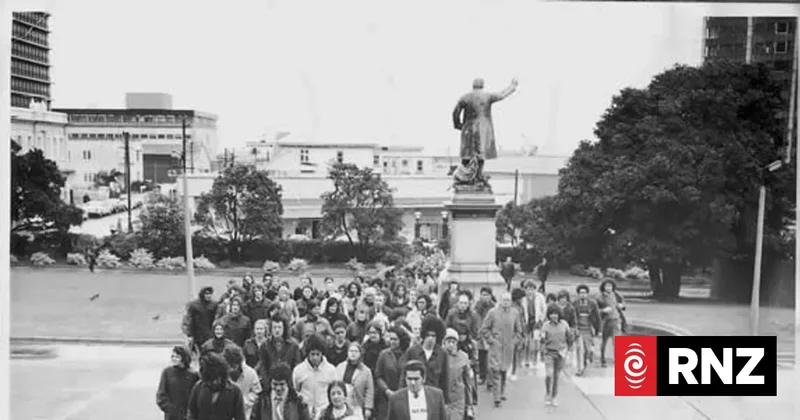
Higgins said the Māori language petition delivered to Parliament in 1972 was driven by young Māori who were increasingly aware of what had been lost.
"They're also the first generation urban migration. And they are often the first ones to go to university," she said.
"And it's also around the same period where you have heightened awareness of civil rights movements overseas, that kind of global understanding of race relations. And these, this generation, don't have the language.
"So they understand that loss of the language, it really affects them, that their core part of their identity they don't have."
That activism helped spark the Māori language revitalisation movement, leading to institutions including kōhanga reo, kura kaupapa Māori, wānanga and Māori broadcasting.
Higgins said the progress made since the 1970s is significant, but language revitalisation is a multi-generational kaupapa.
"It takes one generation to lose a language. It takes three generations to restore that language. And often if you're that first generation to try and turn the tide, it feels like you're fully on an uphill battle, that you're trying to gain the language, you're trying to learn the language. That in and of itself to become bilingual is, it takes time."
She said the emergence of new generations of first-language speakers is one of the most encouraging signs for the future of te reo Māori.
"For some whānau they have restored the language as a first language in their whānau. And, you know, they're doing amazing things.
"I'm always heartened by that generation who are first language speakers today because they're more creative. They don't have any inhibitions because they don't actually understand what it means to not have the language.
"So hopefully that continues to thrive for generations to come."