SMRT teams up with Chinese rail operator for joint bid to operate Cross Island Line
AI generated
SINGAPORE – Rail operator SMRT Trains is teaming up with China’s Guangzhou Metro Group (GMG) in a joint bid to operate the upcoming Cross Island Line (CRL) when the authorities reopen the tender for the Republic’s longest fully underground line.
Speaking to reporters at Bishan Depot on Aug 5, SMRT chairman Seah Moon Ming said the Chinese rail operator has “extensive experience” in using a fixed overhead conductor rail power system, which is what trains plying the new line will use.
Only the North East Line – operated by SBS Transit – employs an overhead system. All other MRT lines use a third rail, which supplies power to the trains.
Noting that GMG operates a network with a daily ridership of more than nine million passengers, or roughly three times that of Singapore’s MRT network, Seah said the Chinese operator’s experience “will complement SMRT’s strengths and create long-term value for Singapore”.
Both companies signed an agreement in June to team up for the bid.
Spanning about 67km across 27 stations from Changi Airport Terminal 5 to Gul Circle, the CRL will be Singapore’s eighth MRT line and is being built in three phases.
The third and final phase, which comprises four stations, will serve residents and workers across the western industrial estates and substantially improve connectivity to the rest of the island, said Transport Minister Jeffrey Siow on July 31.
Although the tender for the line’s operator had been called in May 2023, the Land Transport Authority (LTA) said in November 2024 that it decided not to award the contract.
SMRT Trains and a joint venture between SBS Transit Rail and the subsidiary of French public transport operator RATP Dev had submitted bids, but the authority said then that the tenderers’ proposals had not “adequately reflected the uncertainties of operating the line when service commences in six years’ time”.
The CRL’s first phase is slated to be completed in 2030.
Testing new innovations
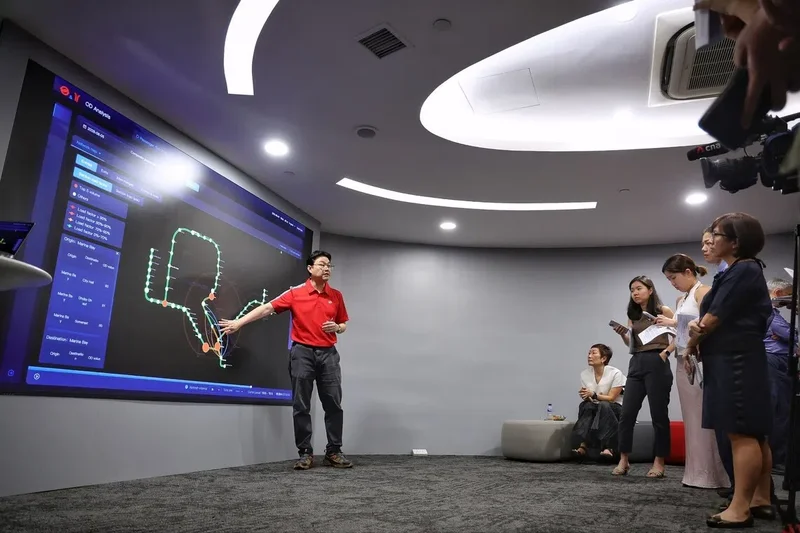
Besides the tie-up with GMG for the CRL bid, SMRT Trains has also partnered the Chinese company in setting up a joint facility at Bishan Depot to trial new innovations before they are rolled out on a larger scale.
The SMRT-Guangzhou Metro Rail Innovation Laboratory, launched in June, allows digital solutions that GMG developed and actively uses to be adapted for the Singapore operator’s needs.
At present, the lab is testing the adaptation and integration of three systems already in use by GMG.
One of them is a commuter analysis feature that uses fare gate data to determine commuter movements, with crowded stations represented by large red circles.
Used in tandem with artificial intelligence, SMRT Trains can then take a more proactive approach, whether in managing crowds or scheduling trains, said its deputy head of engineering Reuben Lim.
Also being tested is a system that allows staff a comprehensive view of station operations and facilities – including the real-time condition of facilities such as lifts and escalators. Certain systems can also be remotely operated.
Another monitoring system integrates information on the track, tunnel and rail systems, so teams can better detect anomalies, analyse trends and understand defects by location, type and seriousness.
Upgrades to Mandai Depot, bus operations
Separately, Seah said Mandai Depot is currently undergoing upgrading as part of a project dubbed Depot 4.0, in which automation and digital solutions are tapped to improve maintenance quality.
Slated for completion by mid-2027, the refresh will double the depot’s train overhaul capacity and halve the overhaul time for Thomson-East Coast Line trains from 24 days to 12 days.
In 2025, SMRT completed a two-year, $7 million project to upgrade Bishan Depot, doubling the facility’s monthly train overhaul capacity from two to four.
In the nearer term, SMRT will launch what it terms Bus 4.0 at the end of August.
Seah said it will be similar to Depot 4.0, but will differ in scale. “Bus 4.0 will transform the entire bus operations and maintenance from end to end,” he added.
JB-S’pore RTS
On cross-border rail, Seah described the Johor Bahru-Singapore Rapid Transit System (RTS) Link as one of “immense national significance”, saying it is undergoing extensive testing, and operations will begin only when there is full confidence that it is safe and ready for service.
The railway link’s operator, RTS Operations – a joint venture between SMRT and Malaysian public transport firm Prasarana – will continue updating the two grantors, LTA and Malaysia’s Ministry of Transport, on the progress of tests.
The grantors will then announce the opening date in due course, with the announcement of fares to follow after consultations with key parties.
Passenger service is expected to start at the end of 2026.