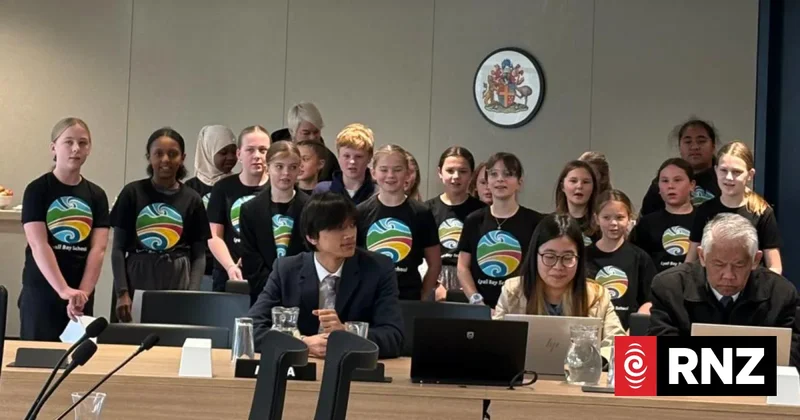
Primary school students sway Wellington City Council on road safety measures
A group of primary school students have achieved something in minutes that many adults have attempted for decades - quick change through council on a contentious issue.
The Year five and six students at Lyall Bay School visited Wellington City Council on Wednesday to deliver their submission on a trial that had made going to and from school safer for them.
A low-traffic area was trialled on Freyberg St, outside the school, making it easier for the children to cross at drop-off and pick-up times.
Schools across the country struggle with dangerous drivers, with a pilot programme launched in Auckland to curb the growing issue, while other schools have had to close roads during peak hours.
Minutes after the students' submission, the council committee voted to make the road-safety changes a permanent fixture.
Lyall Bay principal Melanie Dean told Checkpoint the students were ecstatic to have made a difference.
"[There were] huge grins and fist pumps, they were excited that they'd had some influence."
Dean said she was incredibly proud of the students' submission, which all came from them.
Primary school students prompt quick change from the council
The trial first began, after safety concerns were raised by the school around traffic speeds, volumes and the use of local streets as rat runs.
Dean said parts of the road had been blocked off to create a cul-de-sac outside the school, meaning cars could travel one way down the street, before having to turn around.
"Cars can come up from the beach, drop the children at school and turn around, or cars can come from the town area, drop the children, and then turn around and go back out again."
While there hadn't been any accidents before the trial, Dean said the children had noticed the dangers of the busy road.
"Cars were speeding down Freyberg Street, they were using it as a rat run to get from town to the beach," she said. "It was never safe to be out on the footpath.
"After school, people would be gathering around the crossing, waiting to cross the road, but it was very difficult to ever get across the road."
In their submission to the council, the students made it clear to the council why it was so important to keep the crossing, which they said had made them much more confident to cross the street.
To get all their thoughts across, the children presented to the council in a reporter-and-interviewee style, asking the questions they thought everyone would wonder about why the crossing needed to stay.
Others who weren't so keen on presenting came along to support their peers with handmade signs.
While 36 percent of the submitters strongly opposed or opposed making the changes permanent, Dean said the students understood the reasons why not everyone would be on side.
She said the kids felt they had had a huge impact on the final decision.
"They said that the submission team were all smiling and laughing, and enjoying their submission, so they felt very proud and positive about themselves."
Dean said the students were incredibly excited that they were involved.
"They were surprised that they were allowed to be part of the democratic process at first, but they thought that they brought a lot to the table and that the committee must have liked what they did, because it had gone through.
"It was a really important thing to them and so they should be able to have as much say as possible in something that really does affect them."
The work to make the changes permanent was expected to begin in late 2026.