In the era of artificial intelligence, there is an arms race among companies to build the best chip. Nvidia’s dominance in the space has encouraged Google, Amazon, OpenAIâand most recently, Anthropicâto start building their own custom chipsets to get in on the business of providing compute capabilities to an industry hungry for it.
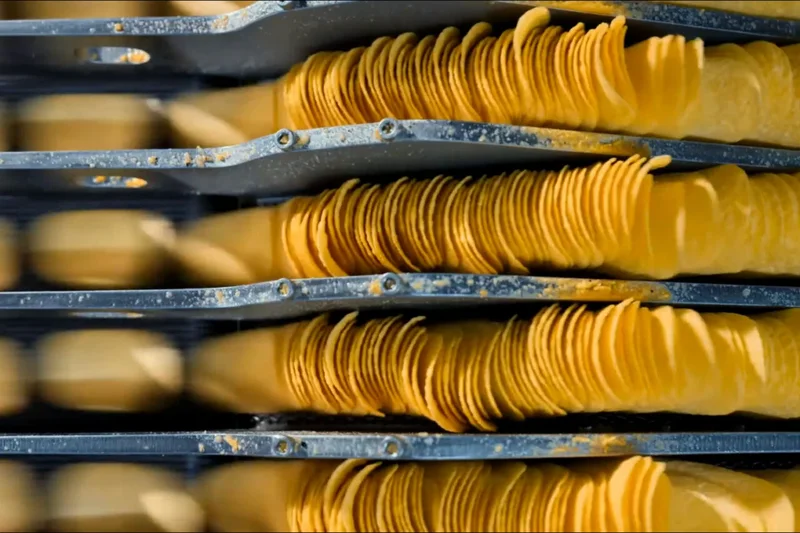
And yet, it appears they’ve been bested. We finally have the perfect chip, and it’s a Pringle. According to the Wall Street Journal, Pringle parent company Kellanova has been working tirelessly to master the art of the stackable chip. Several years and about $5 million later, with investments in AI and specialized machines, the company believes it has finally broken through with a quantum-level leap in chip-making.
They apparently got there by first creating a “digital twin” of the dough that the company uses for Pringles. That allowed them to accurately simulate the way that chips go through the manufacturing process to figure out where the company’s hurdles were occurring and whyâthings like broken dough and sticky chips getting caught in the fryer.
They then apparently equipped the entire chip line with sensors that capture real-time data about the dough, details like the particle size of the flour. That information is processed by an AI model that provides the company with proactive solutions to potential problems by spotting unexpected variances and inconsistencies before they turn into a bottleneck. Per the WSJ, the company now collects about 200 different points of data from across the production line.
The result, according to the company, is the perfect chip every time: “The same crunchiness, the same taste and feel when you open the can,â Jan Laenen, a senior director of engineering at Kellanova, told the Wall Street Journal. Of course, if you don’t like Pringles, it probably doesn’t matter how consistently they manage to recreate the thin, curved form or how evenly the salt and flavoring are applied.
Pringles are an interesting case of AI-assisted production, because it’s not really something you associate with needing precision. Per WSJ, Siemens has offered a similar “digital twin” approach to help improve manufacturing of things like rockets heading to space, batteries, and microchips.
But in general, potato chips don’t seem like the kind of thing that requires perfect consistency. Reach into the average bag, and you’re going to get chips of all shapes and sizes, some covered in seasoning and some with less. Pringles kinda created a problem where there wasn’t one by deciding to need to stack chips in the first place.
Regardless, it’s just more proof that the only place there’s any real money in AI is chips.